

AI×GOLD type sign, if made by AI it gained +203 pips in 2 days lol
0
This post is a development log that re-creates, with AI, the ideas behind the popular GoGoJungle product "AI Scalper GOLD." It is not intended to criticize any specific product, and the reproduced item is completely different from the original.
I am writing this as a project to disclose the process of “making a sign tool with AI.”
A quick recap of last time
In the previous article #1-1 | AI Scalper GOLD-type contrarian signals, let AI analyze them, and I even prepared a minimal specification. I asked the AI to analyze the logic from the product page and sample images, and I produced a minimal specification document.
In short, a simple contrarian logic: “Buy when the price deviates significantly from the moving average and there are signs of reversal (lower wick, bullish candlestick, close near the high).”
This time, I am feeding that specification directly to AI, creating code that runs on MT4, running it, and examining the results.
Entrusting it to AI
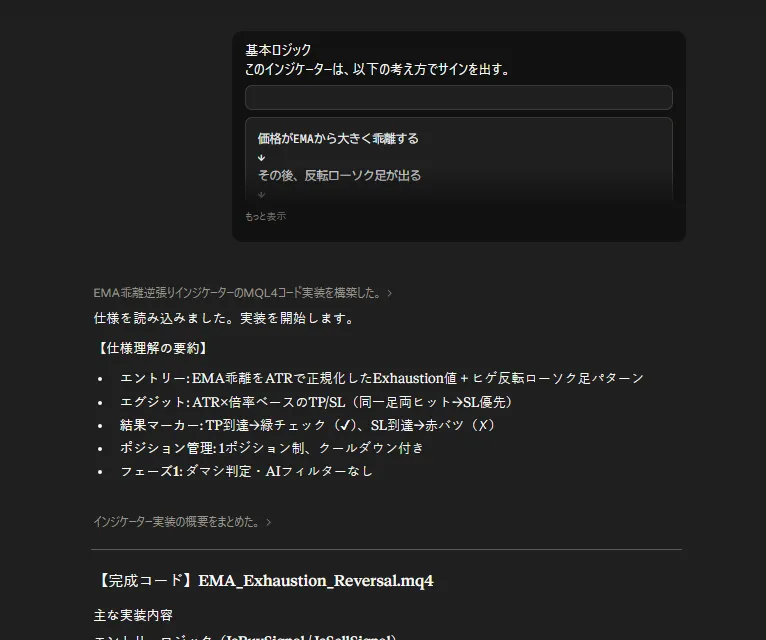
Paste the specification created last time directly to AI. That’s all the instruction needed.
“Please create code for an MT4 indicator that behaves according to this specification.”
…and, after waiting a few minutes.
It came out normally.
Moreover, this original Bot even includes a backtest statistics panel (win rate, PF, expectancy, max drawdown). Very thoughtful.
When I first saw it, I honestly felt a bit moved, thinking, “No way, it actually works in one go.”
Also returned proper caveats
Along with the code, AI provided these cautions.
“Pips are written for 5-digit currencies. For 4-digit pairs, please remove part of the code.”
“Wingdings arrow codes (check marks, crosses) may look different depending on the MT4 environment.”
If you just say loosely “make working code,” you might end up delivering something with environment-dependent bugs you can’t see. It’s helpful that it tells you this in advance.
Especially for gold, the number of digits differs by broker, so you’ll need to adjust when pasting into MT4 later.
Placing it into MT4 and running it
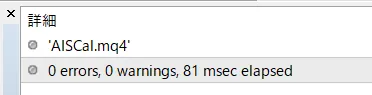
Drop the generated code into MT4’s Indicators folder as-is and compile it.
…No errors. It compiled on the first try.
Apply it to GOLD’s M5 chart.
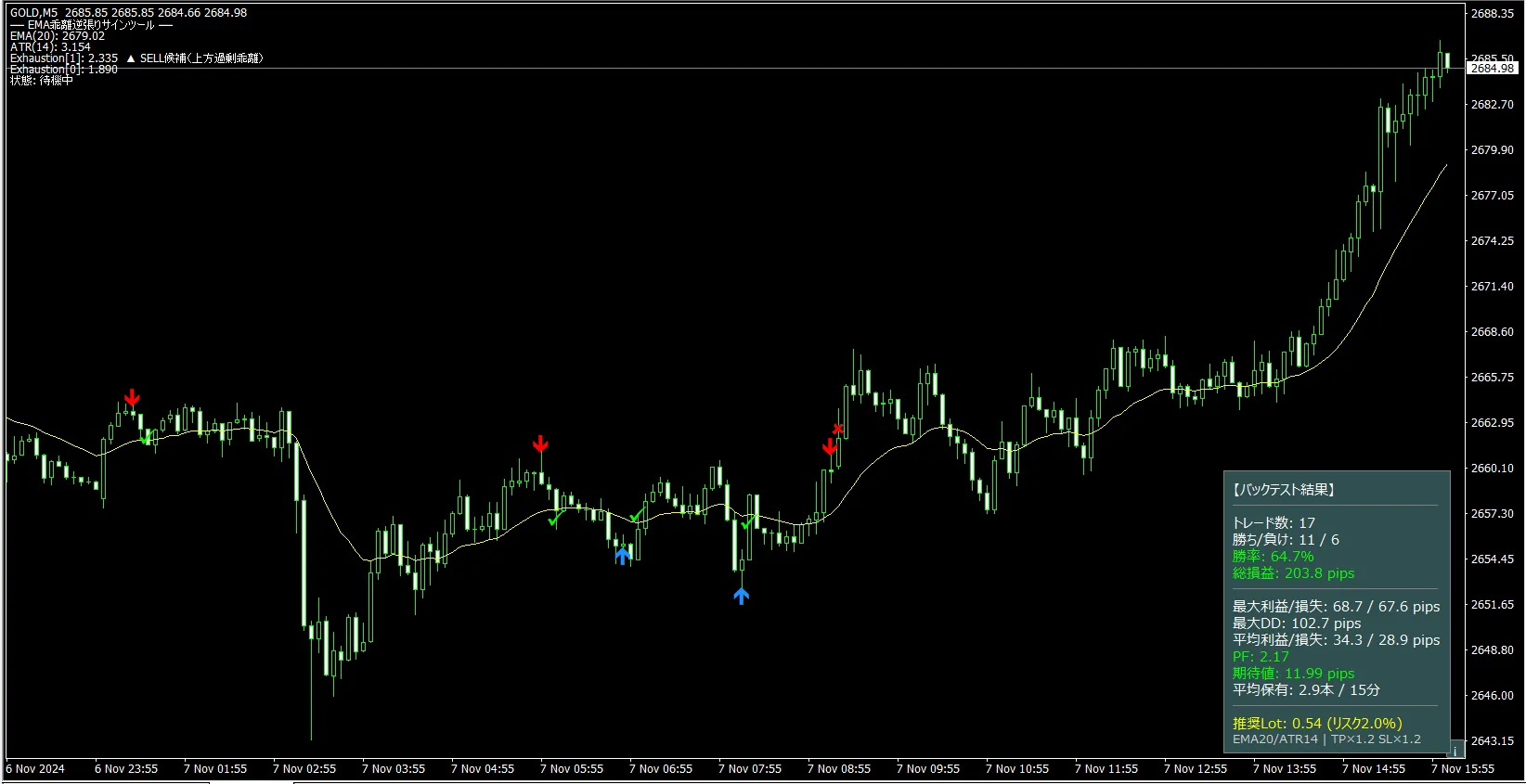
Under the low of the bullish candle’s lower wick, a blue upward arrow appears. Above the high of the bearish candle, a red downward arrow appears. After a signal, a green check (TP reached) or a red cross (SL reached) is drawn.
…it’s working properly.
Huh, the results were better than expected
Now for the main point.
Let’s look at the AI-generated statistics panel for the most recent 500 bars (GOLD on M5, about two full days) to see how it performed.
Trades: 17
Win / Loss: 11 / 6
Win rate: 64.7%
Net profit: +203.8 pips
Max profit / loss: 68.7 / 67.6 pips
Max DD: 102.7 pips
Average profit / loss: 34.3 / 28.9 pips
PF: 2.17
Expectancy: 11.99 pips
Average holding: 2.9 trades / 15 minutes
…Huh, that’s pretty good, isn’t it?
Win rate 64.7%, PF 2.17, +203.8 pips.Even though it’s only two days and 17 trades, these numbers aren’t bad.
Especially the PF 2.17 is quietly impressive; for a scalping-type indicator, that’s a level you could live on.
Honestly, I didn’t expect to reach this level with the minimal first-phase configuration.
Why the results were so good
Let’s look at the charts to understand.
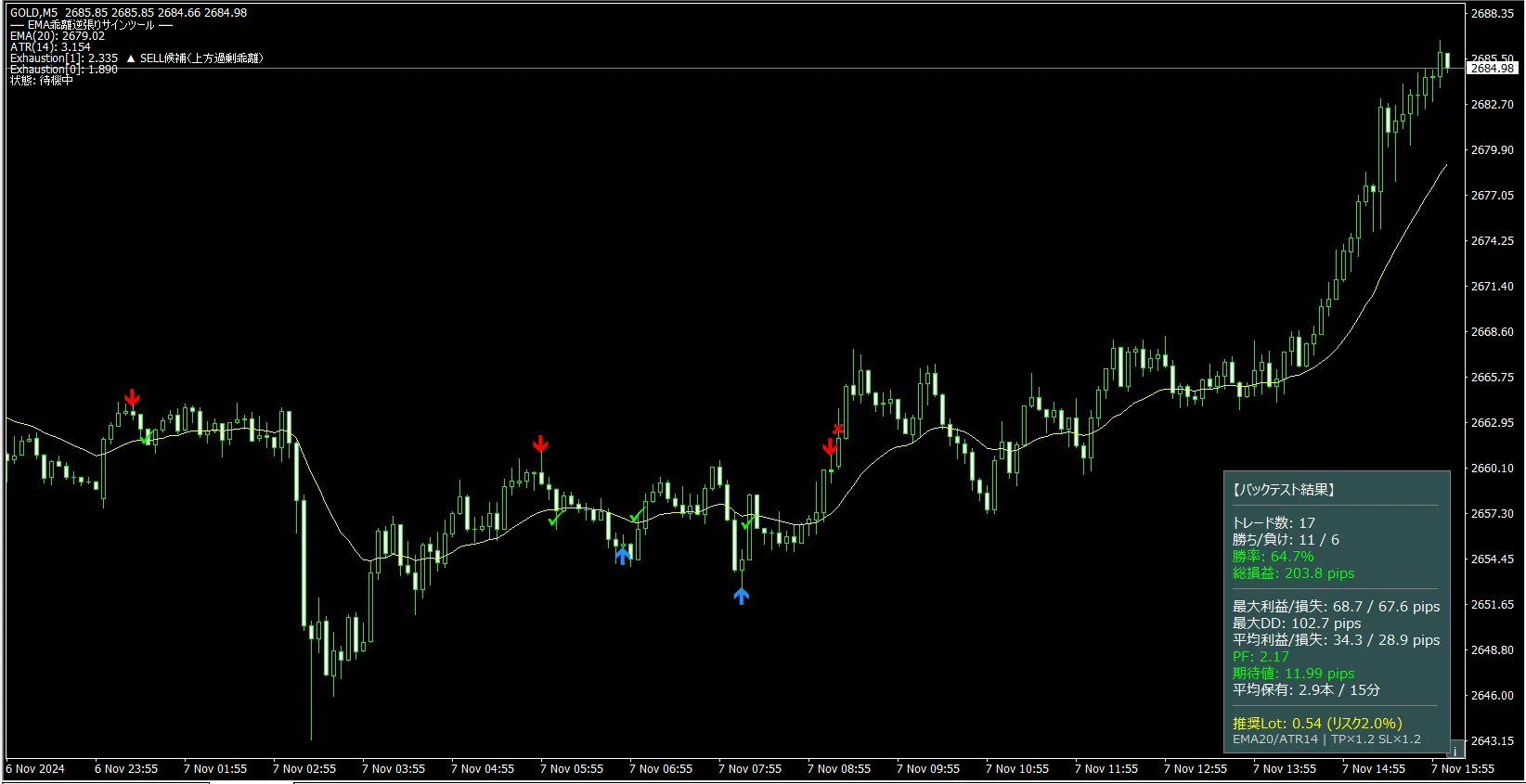
A big factor is that the tested period was essentially a ranging market for GOLD. Contrarian indicators tend to be extremely strong in ranging markets, so it’s likely it hit a favorable environment by chance.
In reality, the latter part showed a strong uptrend, and in that situation a red cross (stop-out) occurred.
That’s the classic weakness of contrarian signals: they get hit as soon as a trend starts. This is exactly why the “higher-timeframe trend filter” I mentioned earlier is absolutely necessary.
Also some challenges surfaced
Judging only by the numbers looks good, but the chart reveals clear challenges.
Gets hit by strong trends when contrarian. Loses in the latter rising phase.
Exhaustion rises and doesn’t return, so Sell signals fire off and all lose. This is a typical pattern.
Only 500 bars of data. Only 17 trades. It’s premature to conclude this is a winning indicator from this alone.
You need at least thousands to tens of thousands of bars to judge.
Max DD over 100 pips. There are moments when a single loss is large. It’s RR 1:1, so one loss nearly hits 100 pips. This suggests a redesign of TP/SL could be warranted.
This time’s takeaways
After actually running the code, there are three major insights.
① If the specification is solid, AI outputs working code in one go. The work to “trim to minimal configuration” done previously is paying off here.
② Even the minimal configuration yields decent results. In other words, the original product’s “AI learning features” and “higher-timeframe filters” might be added elements that raise win rate by about 5% to 10%, and the core logic could be simpler than thought.
③ It is only when you run it that you clearly see the issues. Imagining “Perhaps a higher-timeframe filter is needed” during planning becomes a firm conviction after seeing how trends actually affect it.
Next episode teaser
In the next episode #1-3, I will distribute this indicator for free as a gift.
I plan to provide the code, configuration file, and a simple usage manual as a bundle. I will also add detailed code comments so readers can modify it themselves, e.g., to add a higher-timeframe filter.
Until next time.
By the way, the “AI makes a sign tool” flow we’re doing in this series is all available as templates for sale.
Professional FX sign tool mass-production AI system
→ A complete package including prompts to create the spec, prompts to generate code, and fixes for common bugs. A prompt collection created in this series will be added weekly.

× ![]()

Is it OK?