
Understanding "Parabolic" by Iwamoto Makkusu Part 2 [Iwamoto Makkusu]
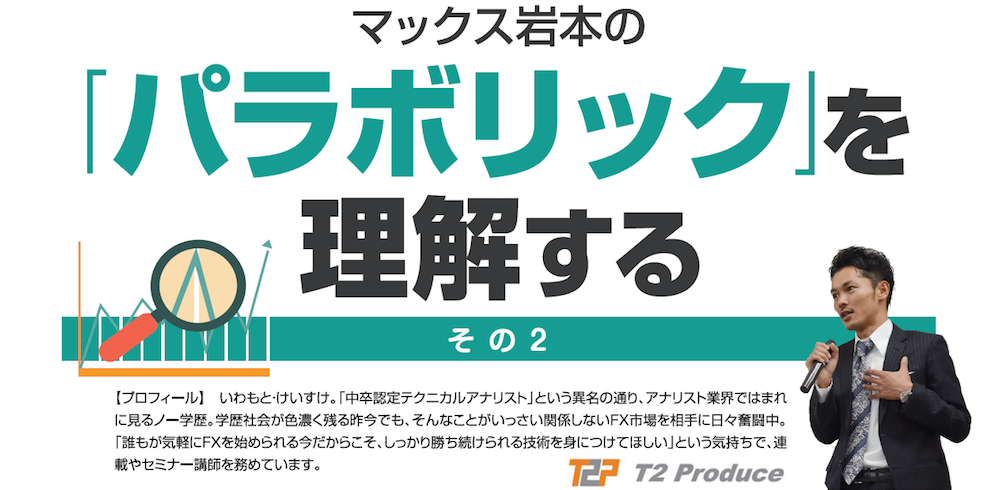
Max Iwamoto Profile

Iwamoto・Keisuke. As the alias “Technical Analyst with no middle school diploma,” he is strikingly uneducated for an analyst in the industry. Even in an era where educational background remains heavily valued, he continues to strive daily in the FX market, which is no longer concerned with such things. He serves as a serial author and seminar lecturer with the belief that, now that anyone can start FX easily, they should acquire solid skills to keep winning.
*This article is a reprint/edit of an article from FX攻略.com April 2019 issue. Please note that the price market information written in the text may differ from the current market.
Useful technical indicators to match market fluctuations
The Parabolic SAR (Stop And Reverse) tracks price by focusing on the highest price (lowest price) after a trend reverses, not only indicating the direction of the trend but also providing a closing line that accounts for both the y-axis (price) and the x-axis (time) to adapt to market movements.
Additionally, a representative method for chasing settlement timing while tracking price is the “Trailing Stop.” Like Parabolic, in cases where the trend continues, the stop level is gradually moved up (down) to minimize losses while expanding profits in line with the market. So what exactly is the difference between Parabolic and Trailing Stop? This is actually the most important point when utilizing Parabolic.