
Foreign Exchange Online · Masakazu Sato’s Practical Trading Techniques: Technical and Fundamental Analysis to Predict the Future of the Big Three Currencies [This Month’s Theme | From after the year-end plunge to April–May. What are the near-term scenario
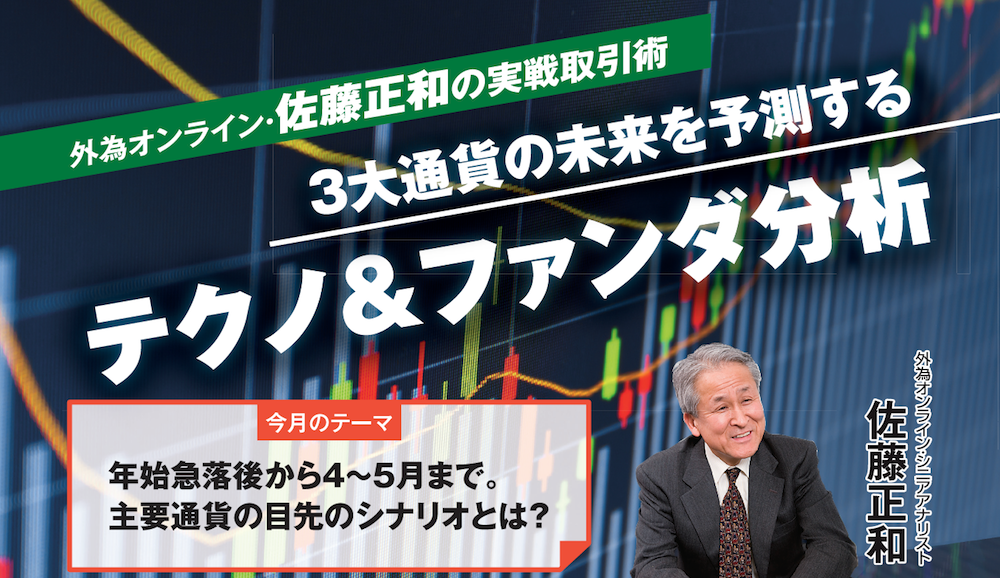
Profile of Masakazu Sato

Sato Masakazu. After working at Japanese banks, he joined French Paris Bank (now BNP Paribas). He has served as Interbank Chief Dealer, Head of Funds, Senior Manager, and more. He then became Senior Analyst at FXOnline, which boasts the highest annual trading volume. He has over 20 years of experience in the world of foreign exchange. He appears on Radio Nikkei’s “Comprehensive Stock Commentary! Stock Channel^,” and on Stock Voice’s “Market Wide - Foreign Exchange Information,” and regularly delivers market information on Yahoo! Finance.
The start of 2019 saw a volatile opening in the FX market, as predicted around February. Going forward, will the US-China trade war enter a new Cold War era and sustain a risk-off yen appreciation trend? Or will it remain in a gradual downward-sloping range that has persisted since 2017? It is certain that the ultra-optimistic scenario has likely faded due to the sharp drop in foreign exchange at the start of the year. Here, we re-examine the major currency movements through around April–May.
※This article is a republished and revised excerpt from FX攻略.com April 2019 issue. Please note that the market information described in the text may differ from current market conditions.
A new era of US-China Cold War theme; risks of a stronger yen as earnings deteriorate in companies beyond Apple
In this January issue, the main scenario for USD/JPY in 2019 was that “the price would remain in a very narrow range based on the high around 118 at the end of 2016 and the low around 104 thereafter, staying flat within this range.”
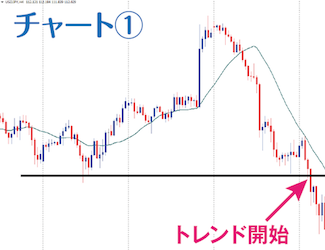
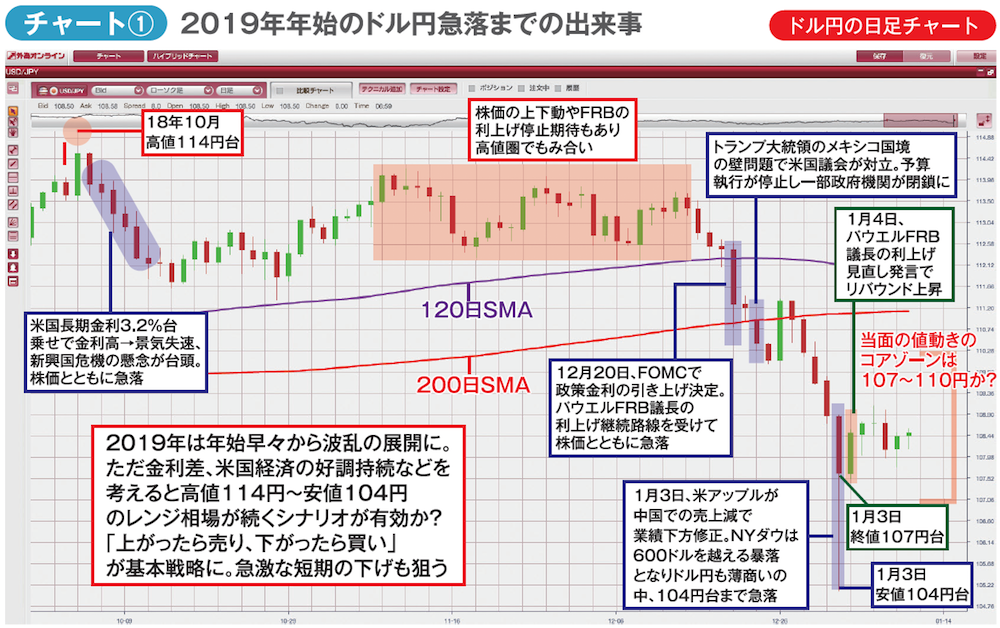
However, as shown in Chart ①, at the very start of the year on January 3, USD/JPY was swept up in Apple’s downward revision of its Q4 2018 results, causing a plunge in the Dow (a drop of about 660 points). In just two trading days from the year’s start, it touched the lower end of the expected range, around 104.
Nevertheless, intraday it rebounded, and by the close of January 3 USD/JPY was back to the mid- to high-107s. By mid-January, it seemed the decline had been halted.
In Chart ①, I summarize the events during the year-end to New Year’s movement; behind the early-year plunge in FX and the risk-off yen strength lie:
- The Fed’s rate hike on December 20 of the previous year
- The partial U.S. government shutdown due to the dispute between President Trump and Democrats over the border wall (began December 22)
- The tariff increase on Chinese-made goods that is due on March 1 (from 10% to 25%)
- Apple’s downward revision signaling a slowdown in China’s economy
- The ISM Manufacturing Index in January deteriorating for the first time in about 10 years, raising concerns about a global economic slowdown
These are among the factors.
Regarding the Fed’s rate hikes, after Chair Powell suggested on January 4 that a rate hike might be paused temporarily, there is growing reassurance. Also, while a compromise over the government shutdown is likely to be reached, the impact of this theme on financial markets such as stocks and forex is not expected to be large.
However, the “Pandora’s box” opened by President Trump—the US-China trade war—could spill over into intellectual property rights infringements and a struggle for dominance in high-tech fields like semiconductors and IT, hinting at the possible arrival of a “new Cold War era.” If a new Cold War occurs, some say Japan, aligned with the U.S., could benefit. Still, concerns about a slower world economy in the post-Cold War era could become a major theme with lasting negative effects on stocks and forex markets.
Against this macro backdrop, first, let’s consider how USD/JPY will move into spring (April–May) by referencing Chart ②, a weekly chart from September 2017, and outlining three scenarios: rise, flat, and decline.
USD/JPY fell through the lower end of the prior range around the 111 yen level (the October 2018 low) in the week of December 20 when Powell’s Fed rate hike occurred, briefly dropping to the 104 level around January 3 after the year-end and New Year’s break. However, the closing price of Candlestick A for that week was about 108, nearly four yen higher, and the following week saw only a small range of movement around 107–109 yen.