

Translate the provided HTML to English (keeping the HTML format, no markdown code blocks, do not insert extra line breaks). The text should be decoded before translation. Original: ?カリスマ皆無、演説力ゼロ、魅力ゼロ…なぜ習近平は最高指導者になれたのか? Decoded and translated: ?Charism
“Why is Xi Jinping the top leader of China?” Do you feel that sense of mismatch?
He doesn’t captivate people with speeches, nor win sympathy on social media, nor make a strong presence in diplomatic negotiations, doesn’t appear to be financially or emotionally deep, and he doesn’t seem to have broad popular support. Most of all, he isn’t popular with the people. He seems rather inorganic, with a stern face, and emotions are hard to read.
And yet, a person with such an impression holds overwhelming power in a country with the world’s second-largest economy. By any measure, this diverges from the “leader image” many people aspire to. That is Xi Jinping. So why did he become a dictator? This incongruity feels natural.
In fact, this phenomenon has little to do with personal charm. Let’s follow the chain of fortunate events.
Selling well!A highly functional trading practice tool that feels like the real thing?9,800 yen?
?FX New Generation: One-Click FX Training MAX
? Irony of the “safe” man being chosen
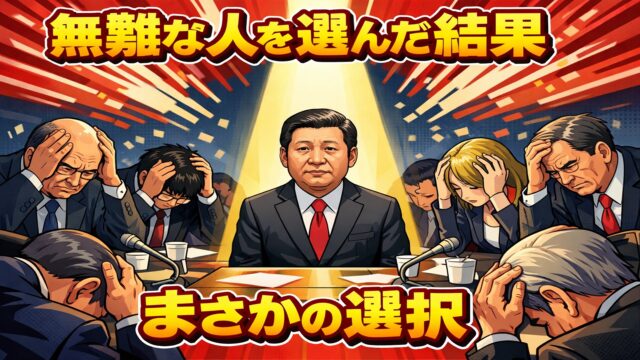
In 2012, when Xi Jinping was chosen as the top, the evaluation was not high. Rather, he was seen as unobtrusive, with little factional color, and a cautious, safe impression.
China at that time was in the late Hu Jintao era, with factional clashes and decision-making stagnation becoming serious. If a too-strong figure were chosen, conflicts would intensify.That’s why the sense of security—“this person won’t go off the rails”—was prioritized.
The reasons a seemingly ordinary person was chosen are actually quite rational. So why was he ultimately chosen? The points are as follows.
- Orthodoxy through bloodline as a princeling (son of a revolutionary hero)
- Practical experience from administrative roles in Fujian, Zhejiang, and Shanghai
- Low factional color, a balanced figure acceptable to various forces
- decades of modest demeanor that prevents making enemies
The experience of his father falling from power in the Cultural Revolution and Xi being sent to the countryside helped him develop internal survival strategies rather than outward strength. As a result, he came to be seen as “not strong but easy to handle.”
Xi Jinping was elected as the successor at the 18th Party Congress in 2012, but initially he was not seen as a “strong leader,” rather as a moderator who would not rock the boat.
? The dictatorship that no one anticipated
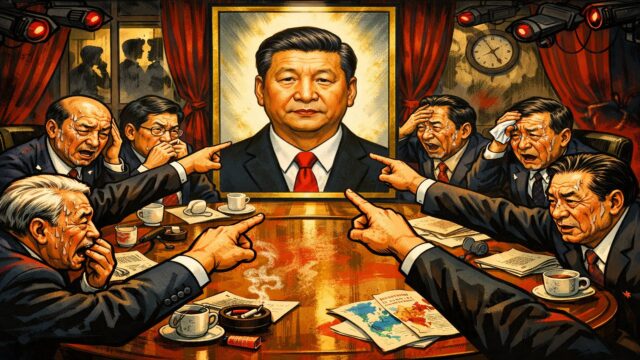
At that time, China had a system designed to prevent dictatorship—term limits, collective leadership, and factional balance. If these worked, personal dictatorship would not occur.
But in reality, that “safety device” gradually came off one by one.
First in 2017, Xi Jinping Thought was written into the party constitution, placing the individual’s ideology at the core of the organization. Then in 2018, the presidential term limit was abolished, changing the system so the top leader could retain power for a long term. And in 2022, the Politburo’s key members were entrenched as close allies, making power consolidation decisive.
What becomes visible is not that the dictatorship arrived all at once, but that escape routes were removed step by step. Small changes piled up until they became irreversible.
And importantly, all of this was pursued from within, not from outside the system. It wasn’t that rules were broken, but that the rules themselves were rewritten. That’s why it could not be stopped midway.
Although one would expect a strong leader to be avoided, the strongest ruler was produced. This outcome is not a coincidence; it could be said that the limits of the system were exposed.
? Cleaning out under the banner of anti-corruption
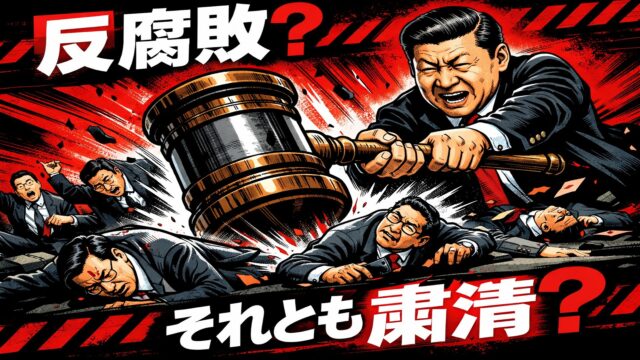
The turning point was the anti-corruption campaign. Under the slogan “Hit both tigers and flies (discipline for officials high and low),” it is said that more than 23 million people were punished by 2023. Even in raw numbers, that greatly exceeds ordinary discipline enforcement.
What’s key to understand is that corruption existed in many forms within China’s bureaucratic apparatus. In such an environment, the authorities who decide who is corrupt hold overwhelming power. In other words, they can apply the same standard to different targets. As a result, personnel shifts in the Party, government, and military occurred rapidly, and a clear signal of “loyalty or downfall” spread throughout the organization.
This process is publicly described as “cleansing corruption” and justice, but it also functioned as a device to accelerate the centralization of personnel authority. Instead of debate or consensus, the atmosphere of risk avoidance began to govern the organization.
? Control of the military, a shift since 2012
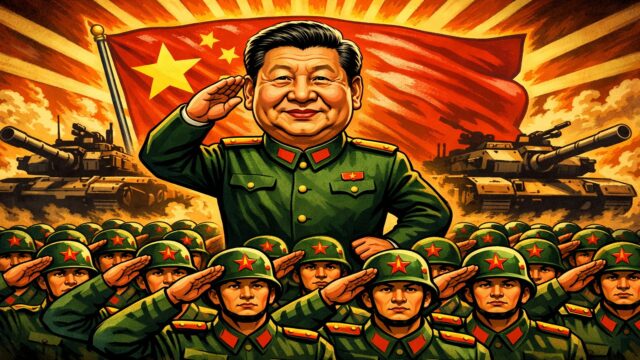
In China, ultimate power rests with the military. Xi Jinping, as Chairman of the Central Military Commission, advanced political and organizational restructuring of the military, building a system centered on loyalty.
Thus, no matter how much internal discontent existed, taking concrete action became difficult. Controlling the military almost settled the political game.
Movements around the Diaoyu/Senkaku Islands also changed significantly in this period. Before, incidents involved mainly fishing boats; after 2012, organized activity by coast guard ships and maritime militias intensified.
There were years when access to territorial waters exceeded 300 days, and activity became normalized rather than temporary. In other words, it became a standard operation, not just an incident.
This is a form of gray-zone warfare—pressuring without going to war. It can be described as continuing pressure without using military force.
? Strong on the outside, quiet inside, and no one can speak up when they notice
Showing a strong external posture translates into clear domestic support. The image of “a strong China” and “an uncompromising stance” is an easy metric for the people to understand.
Moreover, focusing outward against foreign foes can serve to direct domestic discontent outward as well. This structure is highly rational.
As surveillance and censorship advanced, the white paper movement emerged as a symbolic event. Protests with blank sheets of paper express the reality of not being able to say what you want.
The protests spread, but were quickly suppressed and participants were tracked. There is discontent, but it cannot be openly shown. This is the current characteristic.
? A leader who seems not to be giving speeches
In truth, Xi Jinping does give lengthy speeches at party congresses. Yet his style centers on reading from a script, with little modulation, making them less memorable on screen.
Looking back, the starting point was choosing a safe, uncontroversial figure, then exploiting institutional loopholes to concentrate power, eliminating rivals through anti-corruption, seizing control of the military, adopting a hardline external stance to gain support, and strengthening internal control. This is the flow.
As a result, a dictatorship that does not rely on charisma or presentation power was established. It’s hard to imagine that someone chosen for being non-charismatic could become such a dictator; no one predicted this at the time.
Carefully consolidating power, the cold ruthlessness to purge enemies. And the later terror governance functioned. Perhaps there was also the wind of the era—luck—that helped.
Given the risk involved in criticizing the government, frank opinions are less likely to surface. Can the people honestly support this leader? How do you feel about it?
Completely risk-free trade simulator for free practice and verification!
Details page for One-Click FX Training MAX