

Why did the year-end stock slump, yen depreciation, and Bitcoin crash occur? The March 2026 market sways due to Middle East tensions and rising crude oil prices
Why has the market become so difficult to read? The Nikkei Average is falling, the yen is strengthening, and Bitcoin is collapsing. Moreover, it cannot be explained by a single factor. The market at the end of March 2026 was exactly in such a state.
What was significant in this market was the intensification of Middle East tensions. The risk of closing the Strait of Hormuz, and rising crude oil prices. Continued Israeli attacks, Iran's counter stance, and President Trump's repeated bullish statements make the situation look far from resolved, with no clear end in sight.
In this context, crude oil hovered around $100, with moments approaching $110. A rise in crude oil is not just a gasoline-price issue; it cascades into corporate costs, inflation, interest rates, exchange rates, and stock prices.
Furthermore, the year-end factor unique to Japan piled on, making market volatility natural. Now, let's organize how this movement connected.
Selling well!A high-function trading practice tool that feels like the real thing?9,800?
?FX New Generation: One-Click FX Training MAX
?Why does oil alone cause the market to unravel this much
The Middle East situation is a non-negligible factor in this market movement. Attacks on Iran by the US and Israel, reciprocal retaliation, and tension over the Strait of Hormuz.The market did not treat this as a regional conflict but as a global risk to energy supply.
As a result, oil stayed high around $100, with a possible rise toward $110. Higher oil prices push up costs for transportation, manufacturing, and electricity, squeezing corporate profits.The impact is especially large for energy-importing countries like Japan, creating headwinds across many industries such as manufacturing and logistics.
Furthermore, higher oil prices amplify inflation concerns. If inflation strengthens, expectations for rate cuts by the Fed retreat. A difficult combo for the economy, with rates not easily falling. The market sensed this undesirable pairing.

?Why did the yen appreciate at the same time as the stock market fell
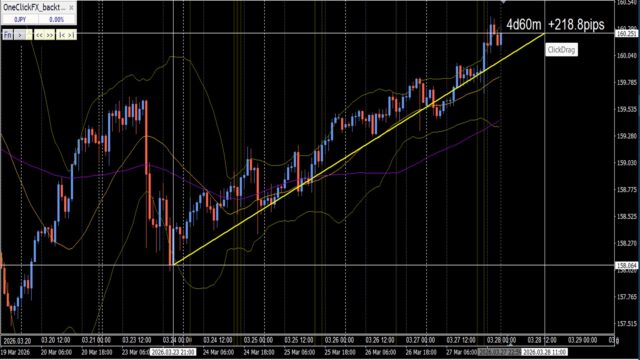
This time, not only did stocks fall, but the yen also rose above 160 per dollar. A stronger yen tends to squeeze domestic corporate earnings and is a headwind for small businesses. The background to this yen strength was a risk-off sentiment that arises when geopolitical risk increases. When markets become unstable, investors reduce their long positions and unwind carry trades.
Generally, the yen has been viewed as a safe asset in such situations. But this time, higher oil prices weighed negatively on the Japanese economy and dampened expectations for additional Bank of Japan rate hikes.In other words, yen-buying and yen-selling factors were intertwined. Nevertheless, ultimately the overall market tension prevailed, and risk-off buying of dollars dominated.
?Why did Bitcoin collapse along with everything else
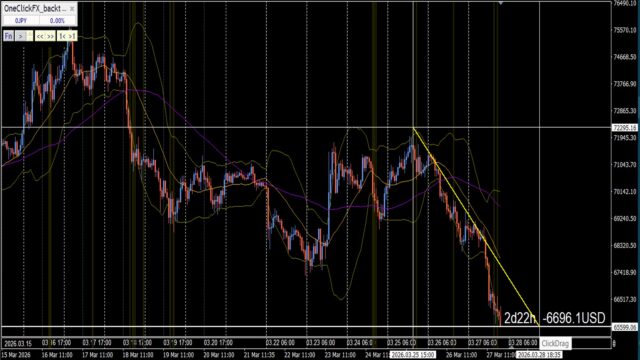
What stood out this time was Bitcoin's decline. It fell below $70,000, with instability around $60,000–$70,000 in view.Previously it was sometimes called "digital gold," but in reality it still retains a tendency to be sold as a risk asset.
The backdrop to the decline included a risk-off flow that also affects stocks. Worsening Middle East tensions, rising oil prices, inflation concerns, and Federal Reserve rate-cut expectations fading. In this flow, both stocks and crypto assets tend to be sold simultaneously. In particular, Bitcoin is characterized by accelerated declines due to forced liquidations in leveraged trading.
Additionally, rising mining costs pushed downward pressure. Higher oil prices raise electricity costs, pushing up Bitcoin mining break-even points and increasing miners' selling pressure.As costs rise, it becomes easier to sell your BTC to secure funds. On top of worsening supply-demand, geopolitical risk, expectations for monetary policy, and a decline in investors' risk tolerance all contributed to pushing prices down.
?Why does year-end selling accelerate to this extent
The market this time also carried Japan's year-end phenomena. At the end of March, rights to dividends and shareholder benefits are settled, after which there is a tendency for window-dressing selling and profit-taking selling.For stocks that had been profitable, the tendency to "convert to cash for now" becomes stronger.
For overseas and institutional investors, year-end is a timing point for portfolio rebalancing. In a backdrop of uncertainty, many participants do not want to carry large positions into the new fiscal year. If more participants think this way, demand-supply deteriorates.This time, Middle East tensions created uncertainty, and year-end selling amplified that uncertainty.
The market says "cash is king," and that atmosphere was indeed present. With no sign of a ceasefire, oil prices not cooling, and stocks and crypto assets unstable, it is natural to pull funds back and observe.
?What is realistic for this market moving forward
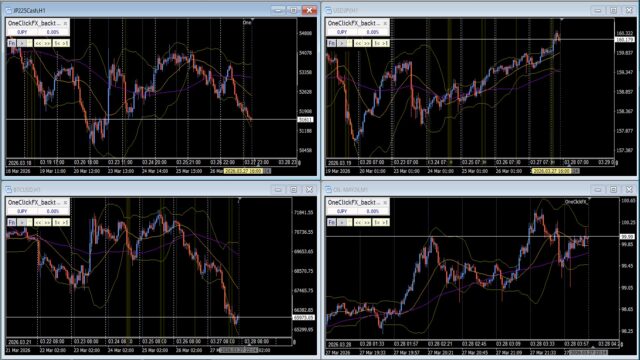
In such a scenario, it is risky to move with large sums of money all at once. Therefore, a gradual approach buying the Nikkei 225 and global stock indices on dips is natural.Aim for long-term recovery rather than short-term gains. Be mindful of the possibility of a crash and avoid forcing it.This stance is quite realistic.
It is hard to pinpoint the exact bottom. Therefore, spreading out time, diversifying funds, and creating a state less driven by emotions is meaningful. Keeping cash, mixing in some gold or bonds,and continuing regular investments mechanically. These methods work especially well in volatile markets.
On the other hand, attempting to recover quickly in the short term or trading with leverage is a difficult position. In the current market, it suits better to focus on reducing losses rather than trying to win.

?Is now a time to take on risk, or should we stay still
As of March 2026The volatile market was caused by a combination of worsening Middle East tensions, higher oil prices, inflation concerns, fading expectations for Fed rate cuts, risk-off-driven dollar strength, and Japan's unique year-end supply-demand dynamics.The decline in the Nikkei, the yen's depreciation (note: I translated as yen depreciation but original says 円安 which is yen weakness), and Bitcoin's decline are separate but deeply connected.
Particularly significant were the Middle East tensions including the Hormuz Strait and the oil price hovering around $100 to near $110. This pushed up corporate costs and inflation expectations, making the market cautious.With the addition of year-end window-dressing selling in March, a "difficult-to-predict market" was created.
In such a market, even experts would find it difficult to predict correctly. Even though it feels like a buying opportunity when prices fall, entering large sums to chase profits carries the risk of further crashes.Even temporary sharp declines can trigger forced liquidations. Therefore, rather than forcing a trade, priority should be given to risk avoidance. Will you trade in this volatile market or stay on the sidelines?
Completely no-risk trading simulator to practice and verify freely!
Details page for One-Click FX Training MAX