

【Systemic Composition Theory】TARGET_SEARCH Public

Increasing win rate is not about “precision” but about “selection.”
— The meaning of a design that responds only to opposite signals —
We have公開 the Ensemble Structure Theory Indicator “TARGET_SEARCH.”
This time, the setting is restricted to respond only to opposite signals. What is important here is that this setting is not intended to take a retrace. The sole objective is to delay the entry timing.
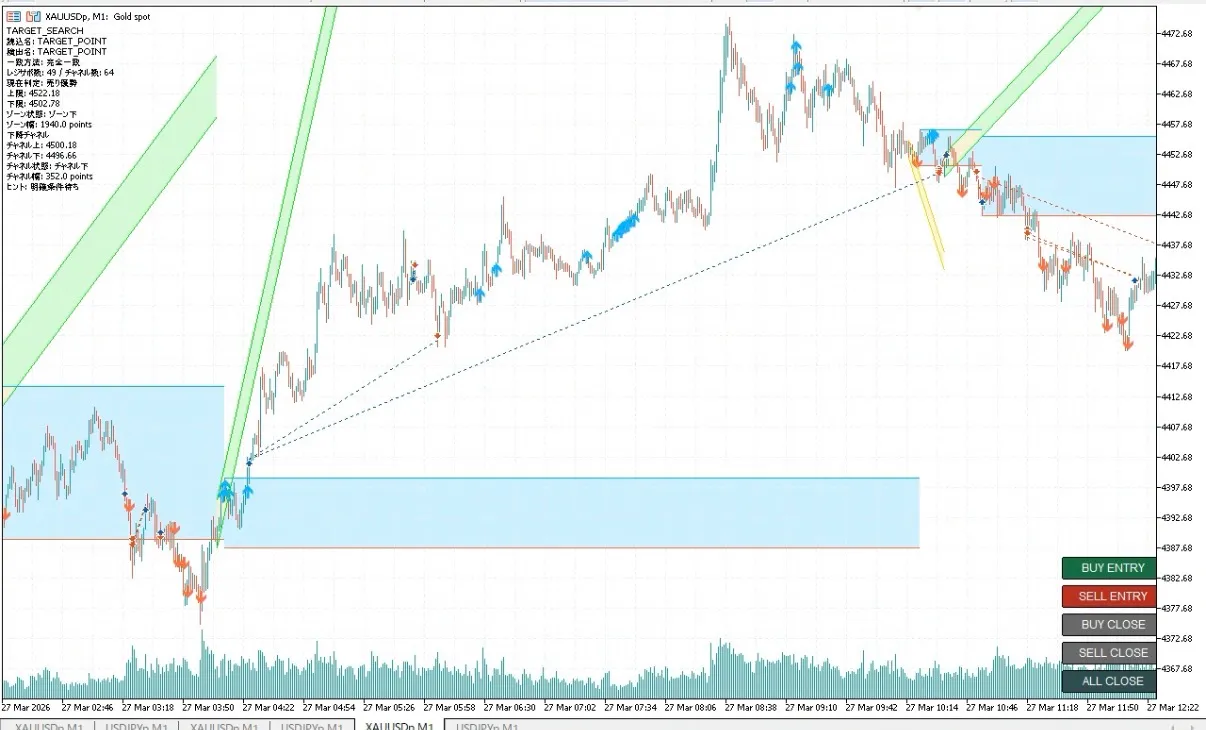
A signal is a trigger, not a confirmation of direction. At the moment a signal appears, the price is often still undergoing adjustment, and market consensus has not yet formed sufficiently. Entering at this stage, even if the direction is correct, tends to suffer a retest, resulting in more stop losses and wasted trades.
By restricting to opposite signals, even when a signal appears, you cannot enter immediately. Prices inevitably go through adjustment or stalling, and as market participants’ positions swap, the structure gradually clarifies. In other words, you deal only with stage that is already organized, not with an unresolved one.
If you use the signal as-is, different phases such as trend, range, and reversal mix together, making judgments prone to subjectivity. On the other hand, by incorporating opposite signals, conditions are restricted, and the phases you deal with align, making results converge more easily. It’s not about increasing precision; it’s about narrowing the target.
Most trading losses come from unnecessary entries. This setting structurally eliminates that unnecessary part, reducing variability in judgments. While the number of entries decreases, conditions align, and reproducibility improves.
The quality of trading is determined not by where you enter, but by how long you can wait. The rule of restricting to opposite signals enforces that “waiting,” naturally eliminating unfinished phases.
The manual is currently in progress, but all parameters have been configured in Japanese. Start by actually adjusting the parameters and observe how the structure changes. Doing so alone should provide a sufficient understanding of the intention behind this design.