
Foreign Exchange Online - Masakazu Sato's Practical Trading Techniques | Techno and Fundamental Analysis Predicting the Future of the 3 Major Currencies [This Month's Theme | How to Compare Multiple Currency Pairs to Understand the Power Dynamics of the F

Masakazu Sato Profile

Sato Masakazu. After a career at a domestic bank, he joined BNP Paribas (formerly Paribas Bank of Paris). He has served as Interbank Chief Dealer, Head of the Funds Department, Senior Manager, among other roles. He later became Senior Analyst at FX Online, which boasts the No.1 annual trading volume. He has been involved in the world of currencies for over 20 years. He appears on Radio NIKKEI’s "Live Stock Commentary! Stock Channel↑", Stock Voice's "Market Wide - Foreign Exchange Information," and regularly provides market information on Yahoo! Finance.
In 2019, the currency market is seeing a clear reversal from the year's early plunge. This time, by comparing multiple currency pairs, we will try to unravel the factors driving the current FX market. The dollar remains generally strong through 2019, but toward the middle of the year, the main trends may become a “weakling comparison” such as “euro weakness” and “rebound of emerging market currencies.”
*This article is a reprint/edit of FX攻略.com May 2019 issue. Please note that the market information written in the body may differ from the current market.
The Shadow Lead Is Not a Strong Dollar, but Euro Weakness. The Forex Market in Stalemate Has Entered a “Weakling Comparisons” Phase!?
The year 2019 opened with a sharp drop in foreign currencies at the start of the year. Since then, indicators such as the Federal Reserve’s rate-hike path, calm in the US-China trade war, and the reopening of the U.S. government have reduced risk-off flows. There is even an impression of risk-on. In particular, postponing the tariff increase deadline in the US-China trade talks is expected to be a major favorable factor not only for the Chinese economy but also for the US and Japan.
The recovering US economy, which has been a driving force behind the “strong dollar” trend in the FX market, remained positive in February with favorable employment data and a manufacturing index from the NY Fed. Although some indicators like February’s Industrial Production, Retail Sales, and weekly jobless claims worsened unexpectedly, the probability of an outright recession in the US economy is very low. Compared with Japan and Europe, the US shows stronger fundamentals.
On the other hand, Europe is full of concerns. Germany’s economic slump is believed to be dragging down growth in the euro area. Italy’s growth rate was revised from 1.2% to 0.2%. Political instability in Germany and France is also evident, resulting in a chart where the dollar is strongest and the euro is weakest in the currency market.
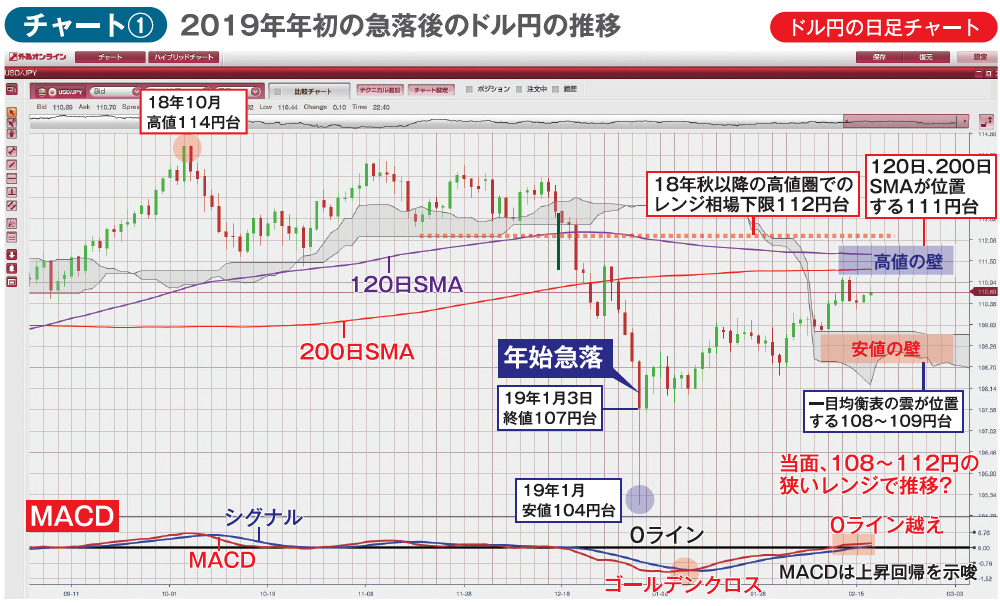
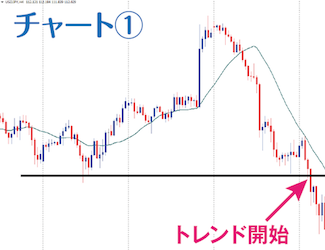
Chart ① shows the USD/JPY daily chart, peaking around 114 yen per dollar in October 2018 and briefly dropping to the 104 yen range at the start of January 2019. From the January 3 low of 104, it recovered to the 107s that day. Then, from January to February, it slowly advanced in the 108s, 109s, 110s, and 111s, like a turtle.
However, as of late February, the 120-day and 200-day moving averages sit in the upper 111s, forming a resistance belt that could hinder further rise. The 112 yen range above also sits as the lower bound of a range from last October’s high—acting as a resistance belt.
Meanwhile, in the lower 109s, the Ichimoku Cloud has been significantly shifted lower due to early-year declines. Unless a major negative shock such as the US-China trade war erupts, the pair is likely to trade in a very narrow 108–112 yen range for the time being.
MACD remains below the zero line, but has produced a signal and a golden cross. It crossed above the zero line in mid-February. In a sense, the early-year plunge has resolved into a more clarified situation, and if asked “up or down,” the reasonable expectation is a continued upward-biased range trading.
As always, the foreign exchange market remains in a stalemate, but FX rates are like a web where the movements of multiple currencies influence each other in complex ways. Even with the same dollar strength, if, for example, the EUR/USD weakens sharply, the USD/JPY may rise gradually as other currency movements exert hidden influence on different pairs.
Therefore, this time we will look at the price movements of various currency pairs simultaneously to explore the full picture of currency-to-currency “tug-of-war” in the foreign exchange market.