

Is 11 trillion yen an investment or a donation? The fork in the road: Takai Trump talks and the small modular reactor SMR strategy
“Is the 11 trillion yen investment into the United States a tribute to America?”—If asked this, how would you judge it? Will you view it as an excessive burden, or as a necessary move in the Takai administration’s growth strategy? Opinions may be divided.
On March 19, 2026, at a summit at the White House between Prime Minister Sanae Takai and President Donald Trump, the discussions were not just a diplomatic event but connected to Japan’s growth strategy itself. Media assessments generally describe it as a “modest success,” butbehind the scenes, energy investments of about 11 trillion yen were being advanced.
At the core of this is small modular reactors (SMRs) and natural gas-fired power generation.Power shortages, a surge in electricity demand due to AI, infrastructure development in emerging countries… Considering these, this investment is a central part of the Takai administration’s growth strategy. Can Japan take the lead in this U.S.-oriented investment?
?“Success or failure?” The summit split opinions
In coverage of the summit by U.S. media, voices praising Prime Minister Takai’s handling were prominent. The New York Times described it as “barely damaged, managed to ride through,” and Bloomberg reported that she “showed agility.”AP News and Reuters also labeled it a “positive start.”
Meanwhile, opinions in Japan are divided.In particular on social media, opinions on success vs. failure are almost evenly split, with about 45–50% leaning successful and about 50–55% leaning toward failure. Supporters of success view it as “diplomacy that secured practical gains,” while critics point to issues such as “subservience to the United States” and “excessive flattery.”
The gap in values seems to translate directly into evaluation. However, diplomacy is evaluated not only by outcomes but also by how events unfold afterward. The true value of this summit will be tested going forward.
?“The 11 trillion yen entity” SMR and gas-fired power: breaking down what’s inside
The core of the agreement is an energy investment of about 11 trillion yen. Specifically, it comprises the following:
- ・Construction of SMRs (small modular reactors): about $40 billion (about 6.3 trillion yen)
- ・Natural gas-fired power generation (Pennsylvania): about $17 billion (about 2.7 trillion yen)
- ・Natural gas-fired power generation (Texas): about $16 billion (about 2.5 trillion yen)
In total, up to about $73 billion, exceeding 11 trillion yen.
Among these, the most notable is the SMR. A joint project by GE Hitachi Nuclear Energy and Hitachi, Ltd., it is primarily aimed at supplying power to AI data centers.In other words, this investment is not merely infrastructure development but a preface to an “AI era power race.”
?“Who controls the power wins” SMR holds the next-generation leadership
SMRs, unlike traditional large reactors, are small, manufacturable in factories, have shorter construction times, and higher safety, making them easier to adopt in developing countries. Currently,the spread of AI is driving a surge in power demand.
Data centers, in particular, consume enormous amounts of power, so stable power supply is indispensable. Given this, SMRs are being positioned as a next-generation main power source. Market size projections suggest $10–15 billion in 2030, expanding to over $40 billion from 2035 onward.
If Japan can gain leadership in this market, long-term revenue from components, maintenance, licenses, and other services could be realized.In that sense, the 11 trillion yen amount can be understood as “seed money.”However, this assumes things go well.
?“If we team up, can we win? Or will we become dependent?” The reality of Japan-US collaboration
The energy sector is a typical power-dominated global arena. It is difficult for Japan to carve out a market alone; partnering with the United States to secure market access is a realistic strategy. This SMR project is also a joint development by Hitachi and GE Hitachi Nuclear Energy.
Japanese companies can play important roles in design and equipment supply and participate in the supply chain. Building a track record in the U.S. market can also facilitate expansion into developing countries.In short, the structure is “difficult to do alone, but possible if we cooperate.”
But there is a behind-the-scenes issue. The biggest concern remains who will lead. The United States has overwhelming advantages in capital and market size. If the project succeeds, it could be branded as “U.S.-led technology,” andJapan could end up only supplying components.
?“Will the same thing happen again?” Toshiba’s lessons and a looming shadow
A recurring topic in these discussions is the problem of Toshiba and Westinghouse.In 2006, Toshiba acquired Westinghouse for about $5.4 billion, but cost overruns in subsequent nuclear projects led to bankruptcy in 2017. Toshiba booked about 1 trillion yen in losses. As a result, Japanese companies carried the risk and suffered in the U.S. market.
From this, the view that “the ladders could be pulled away in America” carries some persuasive weight.This SMR project is not a takeover but a joint venture, with a different risk structure, but it cannot be guaranteed to be entirely safe. There is no guarantee it won’t unfold similarly.
?“Win or have it taken away” The moment of truth is here
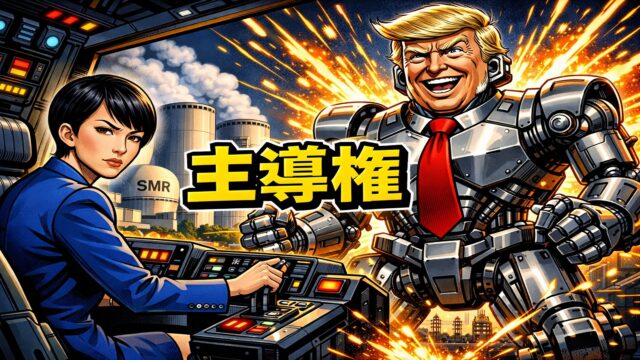
So, will this investment succeed? The key point can be summarized as: “Can we maintain leadership while taking the market and avoid unfavorable terms?” If this condition is met, the 11 trillion yen investment can be recovered, but if any part collapses, it may end up as a mere “investing in the United States.”In other words, this project is not about success or failure, but about what position Japan can secure.
Prime Minister Takai and President Trump’s talks are superficially judged as a safe success. However, the energy strategy underway behind the scenes could be a major turning point for Japan. The 11 trillion yen investment is indeed colossal, but considering the SMR market expansion and surging electricity demand driven by AI,it can be seen as a long-term return-focused strategy.
On the other hand, there are realistic risks of losing technological leadership and being “taken away.”Considering Toshiba’s lesson, a cautious view is necessary. The energy sector is a domain where big powers are strong. How Japan positions itself in this context is up to everyone. Now, how would you evaluate this 11 trillion yen?
Completely risk-free trade simulator to practice and verify freely!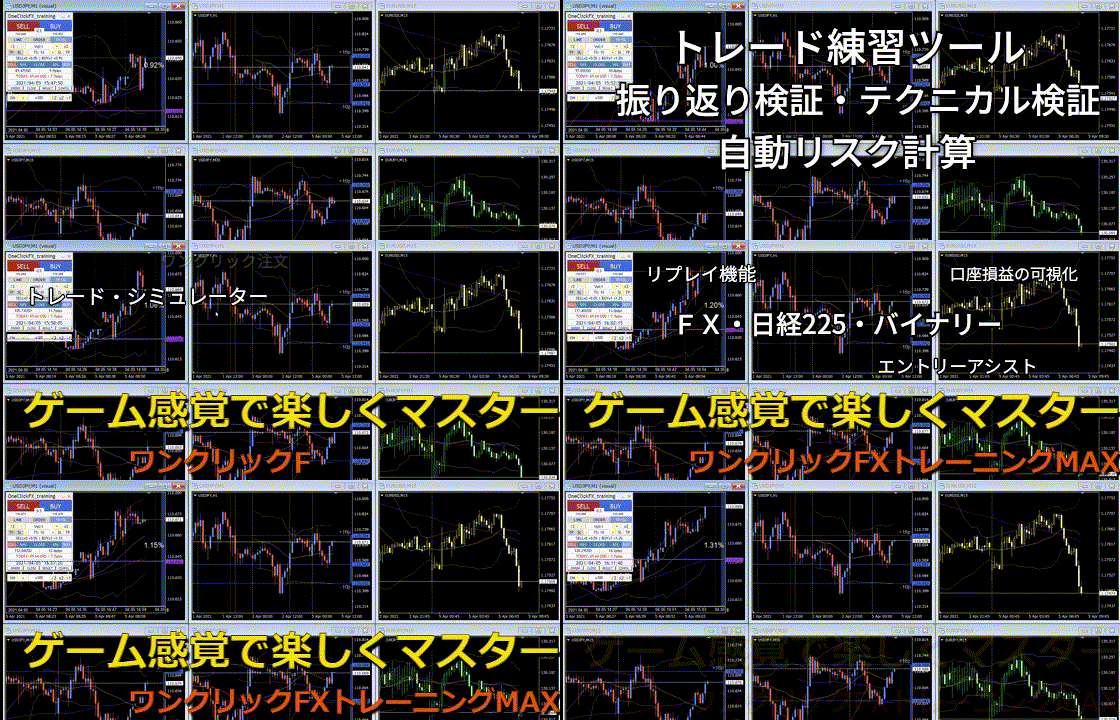
Details page for One-Click FX Training MAX