

What is the truth behind the simultaneous drop of stocks, gold, and Bitcoin? Interpreting the dollar strength and where funds are flowing
“Stocks are falling, gold is falling, Bitcoin is falling... so where did the money go?” Many readers may have wondered this. Typically, when the stock market dips, a traditional safe asset like gold is bought.
However, as of March 2026, both the Nikkei 225, the S&P 500, and even gold have fallen simultaneously, a somewhat unusual development.In such a scenario, one might feel that “assets have vanished,” but in reality, funds have simply moved somewhere else.So, where is that capital headed?
In this article, based on the market environment as of March 22, 2026, we will整理 (organize) “why stocks, gold, and crypto assets are declining at the same time,” “where funds are flowing,” and “how Japanese investors should think.” How do you view this situation?
? An unusual structure where stocks and gold fall together
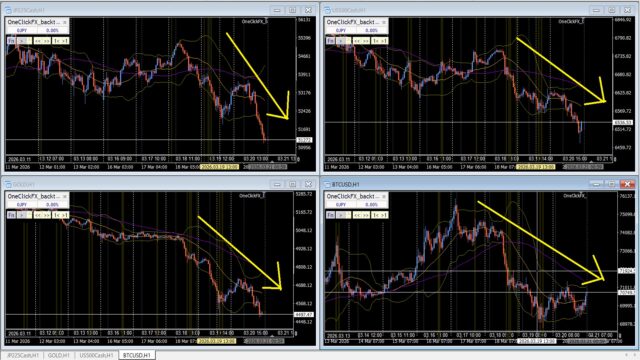
In the current market, in addition to the Nikkei 225 and the S&P 500, gold prices are also dropping. In particular, from around March 18–20, gold briefly fell to around the 4,500-dollar level, marking a retreat of more than 10–20% from its peak.The background to this movement is the rapid deterioration of Middle East tensions.
Attacks by the United States and Israel on Iran, disruption of the Strait of Hormuz, etc., pushed crude oil prices up to around 110–120 dollars. This heightened concerns about inflation resurgence and broadened expectations that the Federal Reserve will maintain high interest rates for an extended period. As a result, real interest rates rose, reducing the relative attractiveness of gold, which does not yield interest.
Furthermore, the dollar’s strength exerted downward pressure on gold traded in dollars.Additionally, risk-off sentiment in the stock market intensified, and profit-taking in AI-related stocks that had previously risen also contributed. As a result, both stocks and gold were sold simultaneously.
?Where has the money disappeared to?
When the market as a whole falls, one might feel that “money has disappeared.” However, money itself does not actually vanish. Prices fall simply because there are more sellers than buyers. So where are the sold funds flowing? The largest destination is “cash.”
In risk-off phases, liquidity-rich assets attract capital, hence the saying “cash is king.”In particular, investors using leverage need to secure cash to meet margin calls. Next, inflows into high-grade bonds such as U.S. Treasuries, especially short-term government bonds, are observed. In a high-interest-rate environment like today, yields appear attractive.
Also, with rising crude oil prices, some energy-related assets may attract funds, but in a broad risk-off scenario like this, such effects are limited.In other words, much of the capital is in a “holding pattern.”

?The structural force of a strong dollar pushing everything down
The essence of the current market is not a weaker yen, but a global dollar strength. The dollar index (DXY) surged in March, hovering around 99.5–99.8. From the start of the year in the 95 range, this is an increase of over 5%, indicating a clear dollar-strength phase. This dollar strength is not merely a currency issue; it is altering the flows of capital itself.
During crises, the dollar is chosen as the most liquid and trusted currency.The United States, as the world’s reserve currency, has a huge sovereign debt market and, as a net energy exporter, has a relatively strong position even under oil shocks.
On the other hand, the eurozone, Japan, and emerging markets face energy import dependency and fiscal risks, making them comparatively weaker. As a result, capital concentrates in dollars, leading to the selling of risk assets such as stocks, gold, and Bitcoin. Furthermore,the dollar’s strength itself exerts downward pressure on risk assets, creating a negative cycle.
?Why is everything being sold?
A notable feature this time is that, before asset-by-asset selection is even made, a broad-selling phase occurs. This is due to forced selling aimed at securing liquidity. Leveraged investors and institutional investors sell even profitable assets to adjust positions and cover margin calls.As a result, even gold—traditionally a safe asset—is sold.
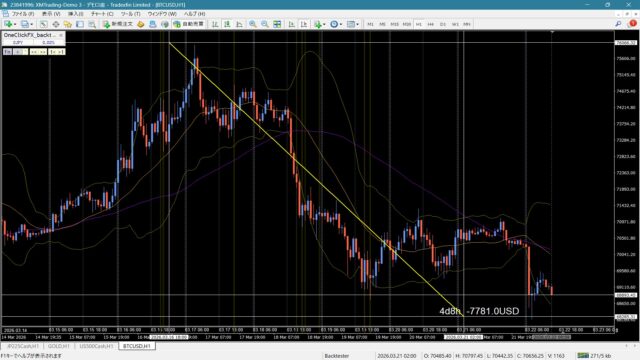
Bitcoin, as a risk asset, tends to move in tandem with stocks, and during corrections is prone to selling as well. Some occasions saw Bitcoin temporarily outperform, but overall it corrected to roughly the 66,000–70,000 dollar range, reaffirming its risk-asset nature.
In such phases, the priority is not “what to buy” but “what you must sell.”Isn’t this easy to overlook?
?How should Japanese investors think?
In the current environment, many investors are moving funds not merely into cash, but into “dollar-denominated assets that pay interest.” U.S. short-term interest rates are around the mid-3% range, a substantial difference from Japan’s policy rate of 0.75%.Thus, dollar deposits, money market funds, and short-term U.S. Treasuries are favored.For Japanese investors, it may seem advantageous to hold assets in dollars rather than yen.
However, one should be mindful of exchange-rate risk.USD/JPY is in the high 150s to around 160, where intervention risk is also contemplated near 160. If Middle East tensions ease, there is a possibility of rapid yen appreciation. Therefore, a practical approach is to diversify about 20–40% of assets into dollar-denominated holdings while ensuring daily living funds remain in yen.
Additionally, considerations such as whether to hedge currency exposure and tax treatment (foreign-currency deposits’ exchange gains are miscellaneous income) should be evaluated carefully.In this situation, determining how much risk to take is a challenging question, isn’t it?

?Can the dollar be deemed king?
This market movement is the result of a confluence of factors—reignited inflation, continued high interest rates, and geopolitical risks—leading to broad selling. Stocks and gold falling together is unusual, but the underlying driver is dollar strength and liquidity-seeking behavior.Funds have not disappeared; they have mainly shifted into dollar-denominated cash and short-term safe assets.
The current market is characterized by a period of wait-and-see and cash-holding until a clearer direction emerges. Depending on Middle East developments and the Fed’s trajectory, funds could return to risk assets. Conversely, extreme scenarios such as further oil-price surges could intensify recession fears and lead to more complex outcomes.
Right now, one could say “the dollar is king,” but that won’t last forever.It will be important to monitor calmly and avoid excessive bias. How do you view this market?
Fully risk-free trade simulator to freely practice and verify!
Details page for One-Click FX Training MAX