

Nikkei Plunge? What Is the True Nature of the Volatile Market!? Sorting Out the "Composite Risk Market" with Hidden Causes
“Do you feel this is a market where it’s hard to tell why prices are going down?”
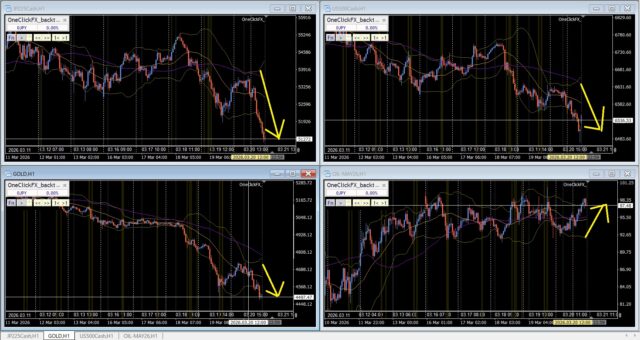
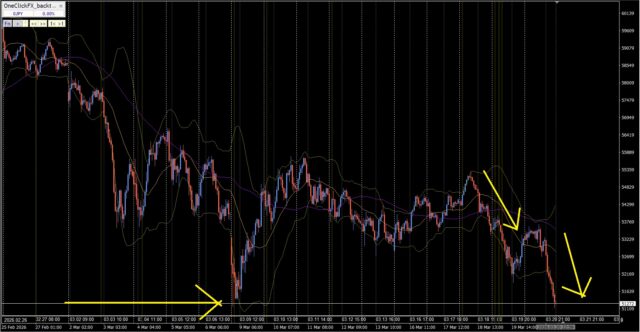
Over the weekend (Japan is on a holiday and markets are closed), trading was mainly limited to CFDs, but the market exhibited even greater instability here. The Nikkei 225 CFD fell to the low 51,000 yen range, and the S&P 500 also dropped to around 6,450 at one point. It later recovered to the upper 6,500s by close.
With price movements leading while the cash market was closed, the experience was that the “plunge → rebound” looked even stronger.It has become clear that Japan’s stock prices are being dragged by the U.S. stock market adjustment, and the previously observed “relative firmness” is showing signs of a change.
Interest rates, crude oil, geopolitical risk, supply and demand, and political events. The overall structure of multiple factors acting simultaneously has not changed, but in the short term the risk-off environment tends to prevail.
So, based on the current movements, let’s reorganize and summarize once again.
?U.S. stock market adjustment and Japan’s stock market resilience
Looking at the latest movements, the S&P 500 briefly fell around 6,450, then recovered to the early 6,500s, entering a volatile adjustment phase. The background is the stance of the Federal Reserve. Although policy rates were kept unchanged at the FOMC, the outlook for rate cuts this year was revised lower to “about one,” and the market perceived the stance as more hawkish.With the rise in U.S. 10-year treasury yields, there is increased downside pressure on growth stocks in particular.
Regarding Japan, the prior relative resilience was underpinned by yen weakness and shareholder return programs, butCFDs during the holidays fell to the low 51,000 yen range.While the cash market was closed, selling had already advanced, and it appears that weakness in U.S. stocks spilled over into Japanese stocks.
Nevertheless, the level represents a correction from the year-to-date high in the 59,000 yen range, and it is not yet a point where the trend can be deemed completely broken. A weaker yen and corporate shareholder returns continue to support prices.
However, the notion that “Japanese stocks are relatively strong” needs some adjustment at this stage.In the short term, it is important to be aware that it is increasingly tied to U.S.-led risk-off moves.
?What is the real cause of the decline
Regarding this decline,some believe “the Bank of Japan’s interest rates are the cause,” but this is not the direct factor.The Bank of Japan left its policy rate at 0.75% at its March meeting, which was in line with market expectations.
Rather, a combination of factors moved the market.Post-FOMC U.S. stock declines, rising crude oil due to Middle East tensions, and position adjustments from high levels all occurred simultaneously. In addition, concerns about tariffs, China’s export controls, and European uncertainties also overlapped.
The important point is that there is no single cause.With multiple risks present at the same time, investors become prone to considering the worst-case scenarios, and risk-off tends to cascade. This structure appears to be the core reason for the market’s lack of clarity this time.
?The influence of AI traders
Watching the recent markets, do you feel that the moves happen too aggressively the moment news breaks?In today’s market, AI systems detect news in real time and execute automated trading.
Many hedge funds and major securities firms monitor news, SNS, and official statements continuously using natural language processing (NLP). When keywords such as “Iran attack ongoing” or “Strait of Hormuz blockade” are detected,they quantify sentiment into a score in seconds to tens of seconds, and if a threshold is exceeded, trading is automatically executed.
As a result, crude oil and energy-related stocks, and the broader stock market are affected instantly. Today, around 60% of U.S. stock trading is attributed to AI and high-frequency trading, making the market react far faster than humans.

⚙️ Amplification through algorithmic trading
Even more importantly, an “imitative” bot rides on this initial move. Algorithmic trading refers to mechanical buying and selling based on predefined rules or formulas, often placing orders at high speed without human input, andis used by individual traders as EAs (expert advisors) on MT4/MT5, etc.
Among them, momentum-type algorithms have a trend-following logic of “buy when price is rising” and “sell when price is falling.” When the initial AI trades and moves price, momentum-type algos detect that movement and increase positions in the same direction.
This chain strengthens the trend and broadens volatility.
In short, it creates a scenario where AI-to-AI collective behavior causes the market to swing excessively. In Middle East–related news, this is particularly pronounced, with sharp oil price spikes and stock declines occurring in a short time due to this mechanism.

?Summit talks and future market outlook
Amid this unstable environment, President Trump and Prime Minister Takai Sanae’s summit meeting took place.The market had warned it would be a major risk event, but the meeting passed without incident.Trump praised Prime Minister Takai, and there was no confrontational stance observed.
The content confirmed roughly 11.5 trillion yen of U.S.-Japan investment, cooperation in energy sectors such as oil, LNG, and rare earth development, and coordination in security. The anticipated pressure or strong demands did not surface, and in the short term, it was seen as a positive factor.
However,fundamental uncertainties such as the Middle East situation and crude oil prices remain.Going forward, the supply and demand of crude oil, U.S. interest rates, and the Japanese stock market will be important. The current market is not a trend but is likely to be event-driven and prone to fluctuations based on news.

?This lack of clarity cannot be pinned down to one cause
This week’s market showed U.S. stocks soft and Japanese stocks resilient. Behind this were multiple factors: monetary policy, Middle East tensions, higher oil prices, and supply-demand factors.
However, the reality is that future prospects are uncertain, and it is difficult to pinpoint one cause. The fact that you cannot say “this is the cause” in itself is a characteristic, and the presence of multiple risks at once is the single biggest point.
Furthermore, AI-driven news reaction and algorithmic follow-through have created a market structure where moves are amplified. As a result, investors are more prone to pricing in worst-case scenarios, making risk-off easier to cascade.Yesterday’s sharper drop and the following day’s rebound show that price movements are larger than the underlying reality and that the market continues to have low directional clarity.
With volatility high, it is important to define a time horizon. Will you aim for short-term gains or adopt a long-term stance? In any case, it is crucial not to be swayed too much by unstable markets; set assumptions and rules, and respond calmly when appropriate.
A completely risk-free trading simulator to freely practice and verify!
Details page for One-Click FX Training MAX