
Episode 5: The Reason Prices Return to the "Gap" - How to Use FVG (Fair Value Gap) [SMC Basics ⑤]
Hello,nao here.
Last time we explained order blocks (OB). By identifying where big players placed orders, the accuracy of entries on pullbacks and retracements improves.
This time we will cover “FVG (Fair Value Gap)”——A concept also called “Fair Value Gap” or “Supply and Demand Gap” in Japanese.
Along with OB, it is one of the most commonly used entry rationale within SMC.SMC.
What is FVG (Fair Value Gap)?
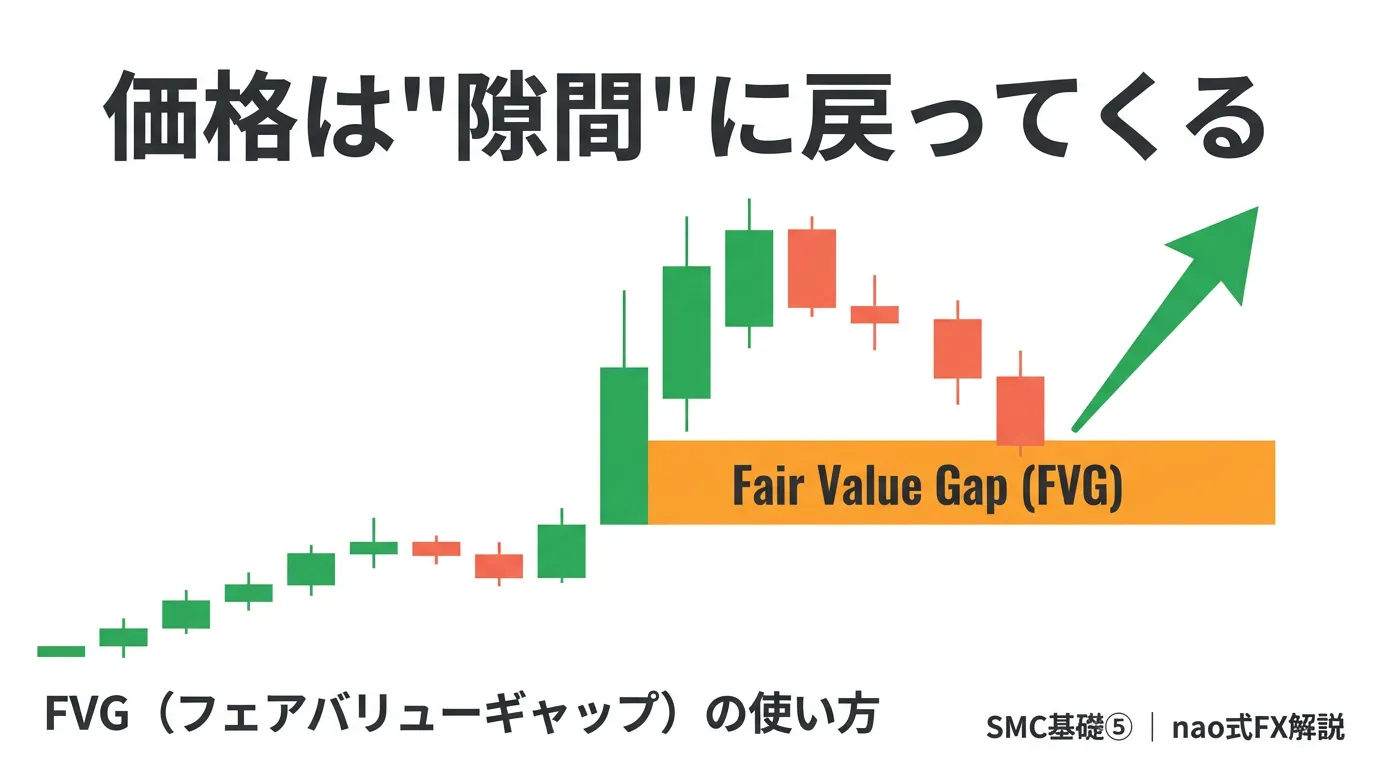
FVG is the “gap in price” that appears when price moves sharply.「gap in price」 is created when price moves rapidly due to big news or large orders, leading to a price range where trades did not occur.
FVG.
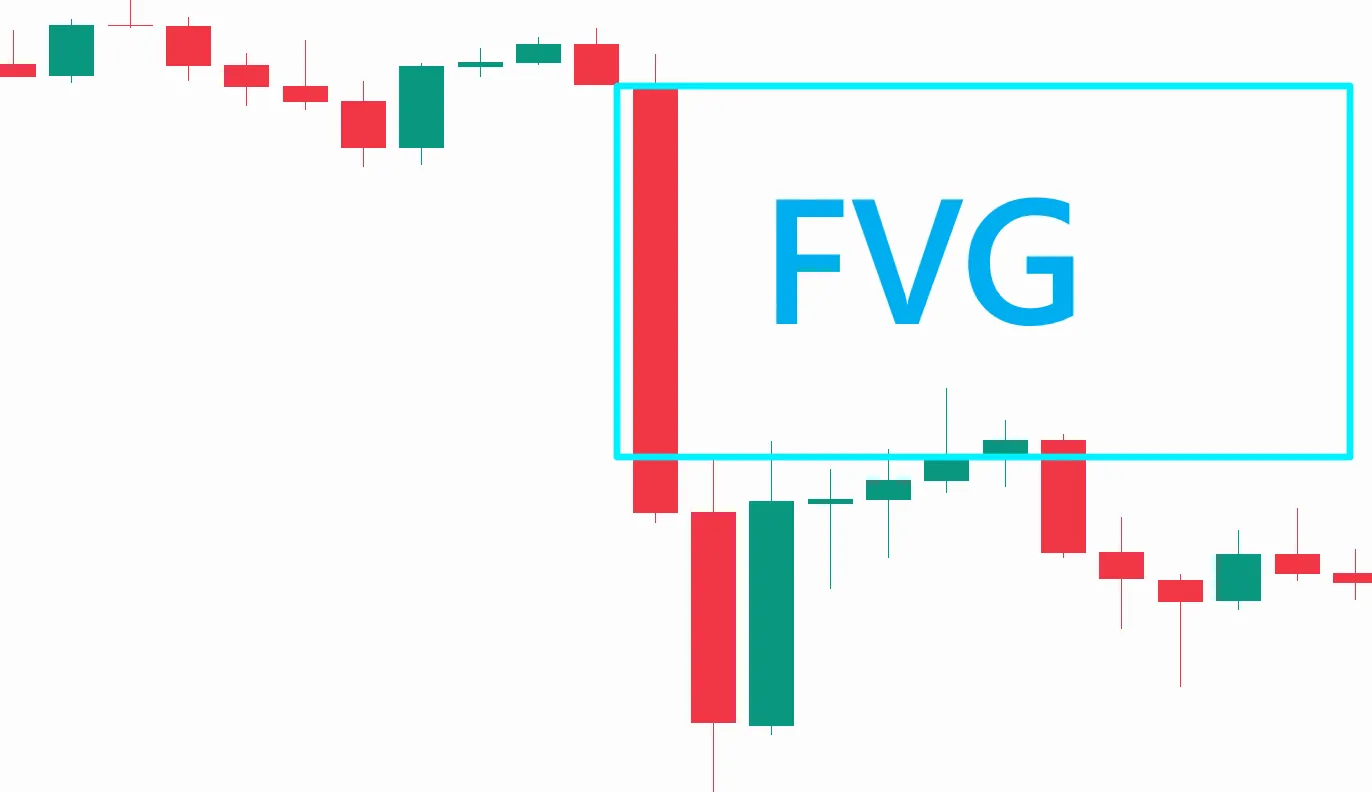
To confirm on the chart, usethree candles.
【UpwardFVGConfirmation】
・1st candle high (top of the upper wick)
・3rd candle low (bottom of the lower wick)
・If there is price gap between thesetwo points → FVGconfirmed
【DownwardFVGConfirmation】
・1st candle low (bottom of the lower wick)
・3rd candle high (top of the upper wick)
・If there is price gap between thesetwo points → FVGconfirmed
Why does price return to FVG?
“Gaps get filled when they occur”——This is also known in stock gap theory, and there is a similar principle in FX.
When a sudden move occurs, there hasn’t been enough trading in that price range.Because there are unfilled orders in the “untraded price range,” price tends to be drawn to it.
From the perspective of big players,——a large player who could only partially open a position during a sharp rise tends to add more at the price level that returns.
Moreover, in the English-speaking SMC community, there is frequent discussion about “algorithm design.”ICT proposesIPDAInterbank Price Delivery Algorithm) concept, where interbank markets use algorithms to deliver price efficiently, andFVG represents a price band that is not yet processed, so the algorithm naturally moves to fill gaps like——. This interpretation is not universally proven, but it is widely shared in English-speaking circles as one possible background for why FVG functions repeatedly.
Returning to FVG and Rebound Probability — The Importance of the 50% Line
When price returns to an FVG, how far back it retraces significantly affects rebound potential.
From my experience, there is a tendency like this.
Touch with the wicks and close outside the zone → →the most reliable pattern for a strong rebound.FVGis the most trustworthy form as proof of its function.
Even if the body enters the zone, if it closes below the midpoint (50%) the rebound potential remains, but you should carefully watch the next candle.→If it closes above the midpoint, confidence increases.
If the body closes above the midpoint (50%) In my experience, 80% or more will continue toward the next fill. If you cross this line, you can consider the FVG function largely finished.
In the English-speaking world, this midpoint is calledCE(Consequent Encroachment). The idea is, “the wick is okay; if the body crosses CE, it becomes invalid” as a common understanding in the SMC community, which aligns with my experience.
When using FVG, if you view it as a rebound origin, the best approach is “wick touch ~CE or lower body closure” as the decisive moment.CE
Differences Between Effective and Ineffective FVGs
FVG forms all over the chart, but not all work the same way.
【EffectiveFVG】
・Occurs within impulsive (strong) price movesFVG
・OB or liquidity sweep overlapping in the same direction / same zoneFVG
・Can be observed on higher timeframes (4H and daily)FVG
・Not-filled (price has not returned yet)FVG
・Aligns with the major trend directionFVG
【IneffectiveFVG】
・Small FVG formed in range marketsFVG
・Already touched/filled onceFVG
・Isolated FVG only visible on lower timeframesFVG
・Opposite direction to the trendFVG
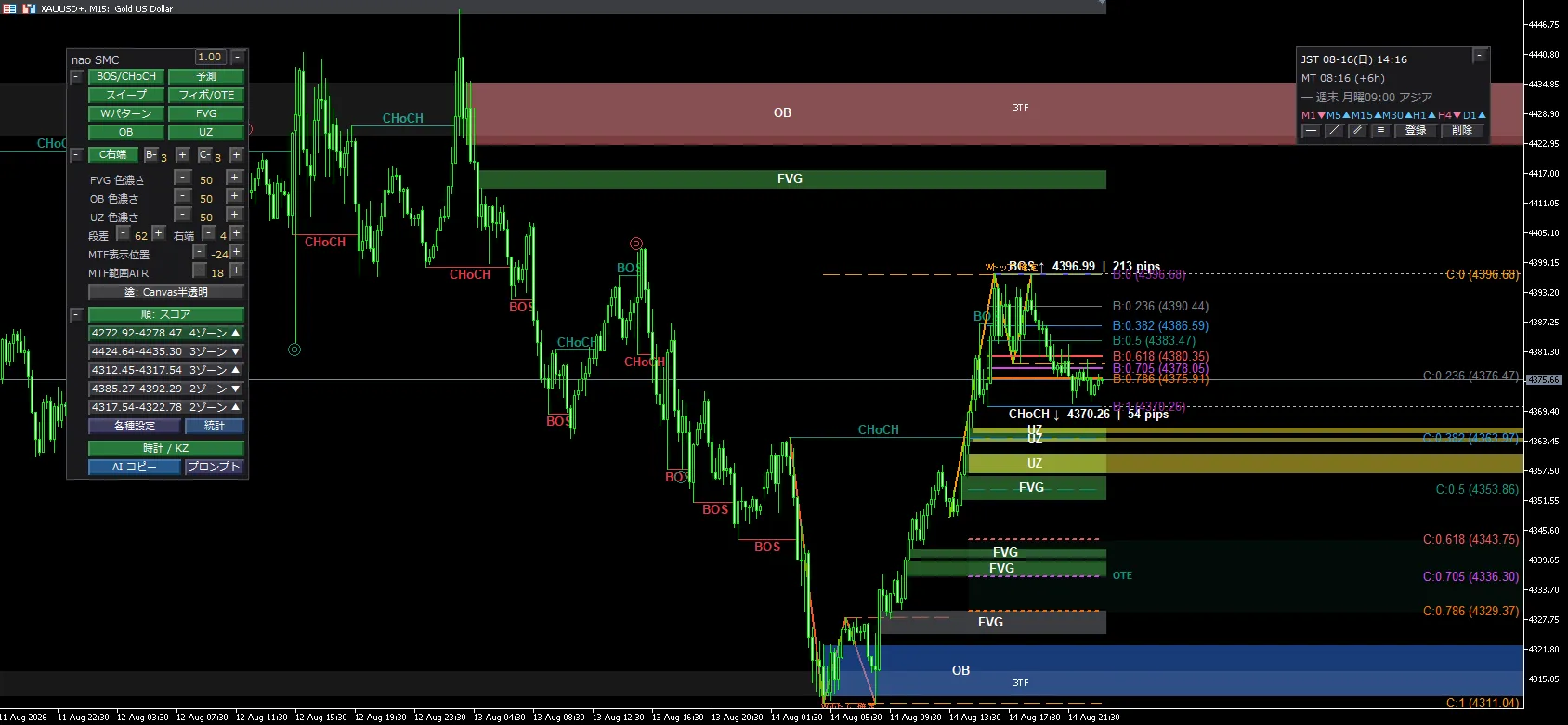
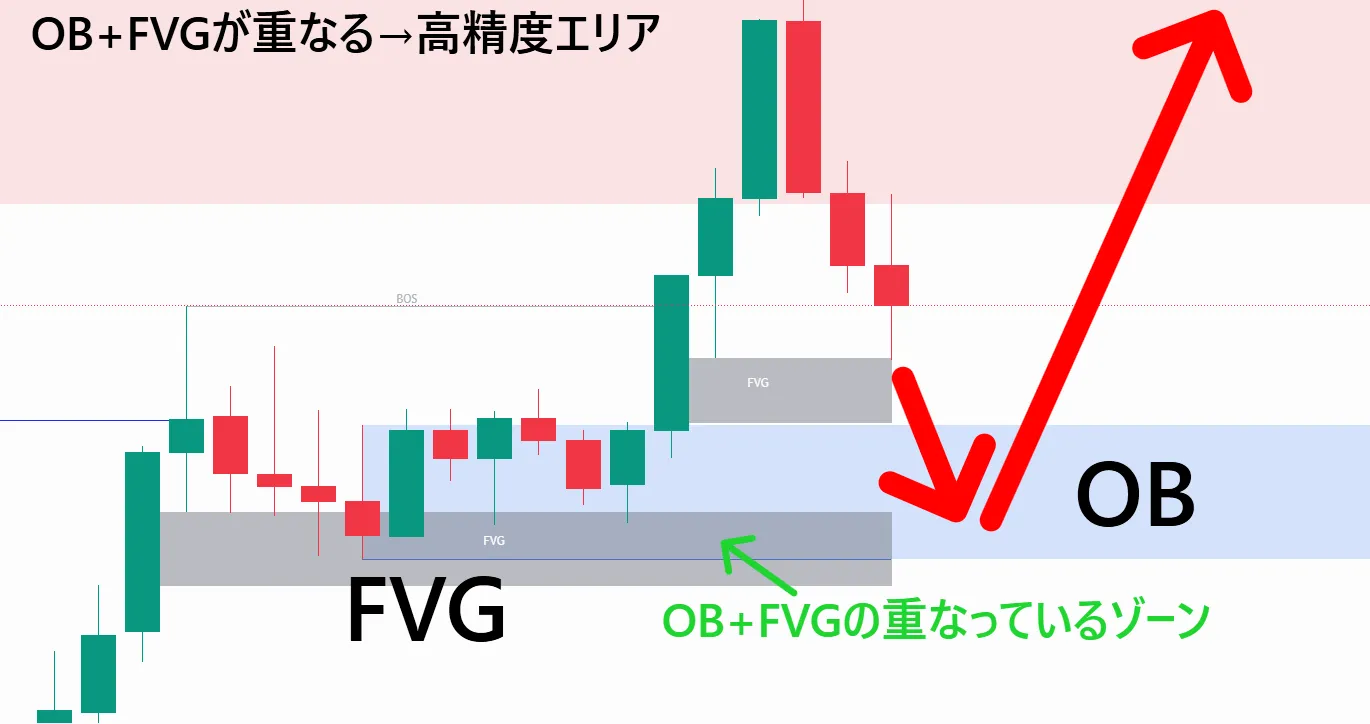
What I particularly emphasize is「OB and FVG overlap (overlap area)」. Where big players’ order placement (OB) and untraded price band (FVG) coincide, the reaction reliability increases dramatically.
Practical use: combining OB and FVG
To summarize the four steps so far,4 pieces of evidence form the SMC entry rationale as follows.
①Identify the major trend direction in market structure (first leg)
②BOS/CHoCH (second leg) determine trend continuation or reversal
③Using liquidity/sweep (third leg) identify where big players are targeting
④OB (fourth leg) +FVG(fifth leg) to pinpoint precise entry zones
Entry image:
“On higher timeframes, confirmOB→Near there, FVG overlaps→When price returns to that zone, verify on lower timeframes CHoCH/BOS→Enter”
If this logic stacks, you won’t enter simply because “it seems to rebound”; you’ll decide based on multiple foundations converging.“Enter because multiple grounds overlap”.
Nao’s Real Talk: FVG’s "Resolution of how to use" determines everything
FVG differs from OB, as it’s a concept learned after studying SMC. At first, I tried reading only that “gaps will fill” idea, but often price still moved through, so I doubted it for a while.
What I realized through practice is that,fifteen minutes and 1-hour FVG entrances tend to work well. And another thing——FVG: when a candle closes inside the FVG zone, that FVG is very likely to break out.I haven’t numerically proven it, but it’s a clear pattern from watching charts over time.
By the way, in the English-speaking SMC community this phenomenon is known as “IFVG (Inversion Fair Value Gap) and is considered a real concept. It was a personal finding that was later corroborated.
That’s why now I don’t just say “enter when FVG comes,” but rather watch “how price reacts when FVG arrives.”If price closes inside, I no longer trust that FVG.
However, when OB overlaps with FVG, it’s exceptional.An isolated FVG’s reaction strength is nowhere near as strong as when OB and FVG coincide. If the big players’ order placement (OB) and supply-demand gap (FVG) align, reliability is dramatically higher.
Summary: Today’s 3 Key Points
① FVG (Fair Value Gap) is a price range where trades did not occur created by sharp price moves.3 candles’ gaps can confirm it.
②EffectiveFVG conditions are “occured within an impulse,” “not filled yet,” “confirmed on higher timeframes,” and “overlaps with OB.” The more conditions, the higher the reliability.
③ OB andFVGSMC enters its core here.
From next time, based on these foundations, I will explain more practical entry methods, time-frame analysis, and the combination with tundere【R】.
Foundation5 steps to imprint SMC’s map in your head. This is where the real work begins. Thank you for your continued support!
─────────────────────
nao|FX Specialist Trader・EA Developer