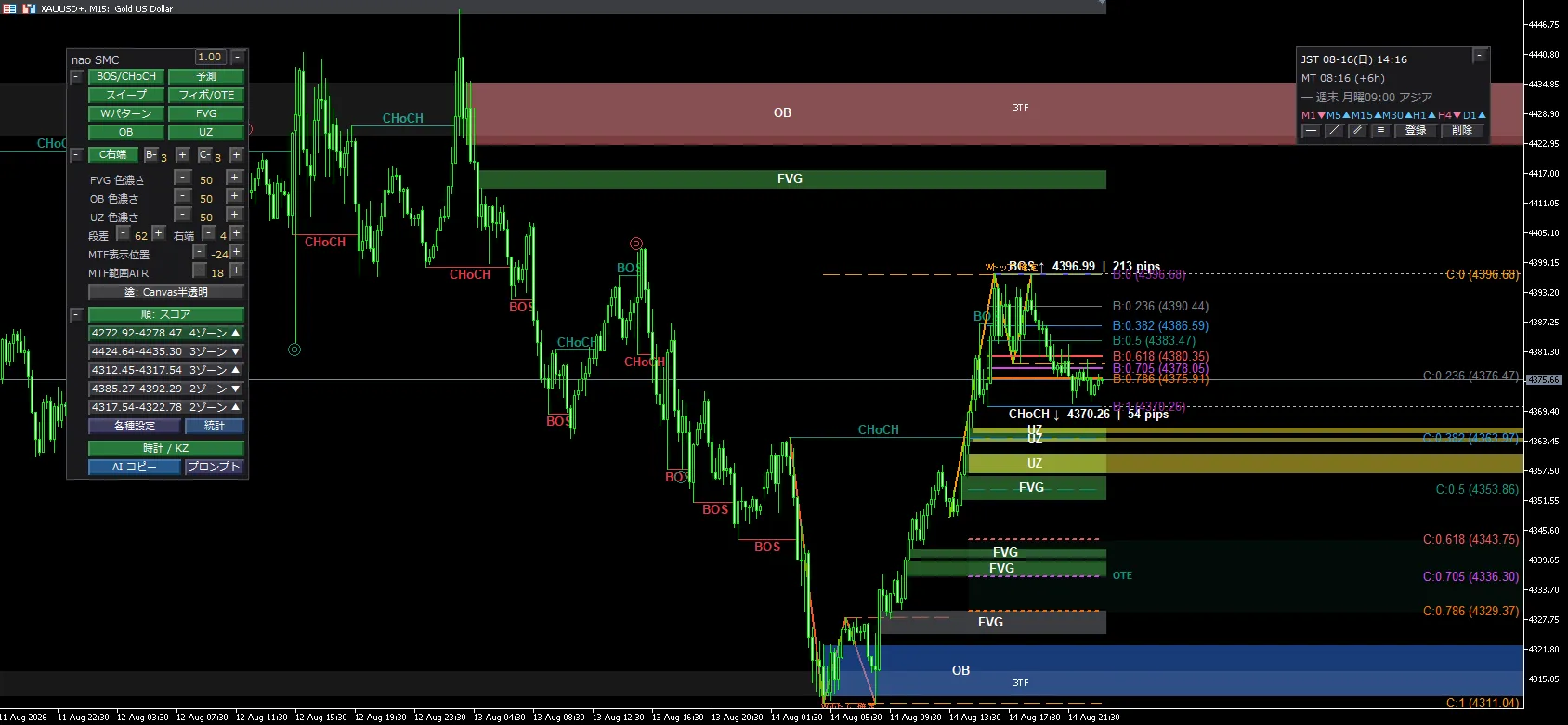

Identify the location where Oda-kuchi planted it in the 4th installment. How to distinguish Order Blocks (OB) [SMC Basics ④]

Hello,naohere.
Last time I explained “liquidity and stop hunts.” Large players cut losses and accumulate positions at favorable price ranges for themselves——I think you can now see that flow.
This time is a continuation, the explanation of “Order Block (Order Block / OB).”
This isSMC—one of the most important concepts—“the place where big players actually placed their positions”.If you can identify this, the accuracy of entries at pullbacks and retracements greatly improves.
What is an Order Block?
Order Block (OB) refers to“a price range where large orders were placed”.
On the chart, you can confirm it as“the candlestick just before strong price movement begins”.
For an upward OB:
→the preceding downward candle just before a large rise (impulse) begins(or a small bearish candle)as a reference
For a downward OB:
→the preceding upward candle just before a large drop (impulse) begins(or a small bullish candle)as a reference
Why is that important——because big players will buy again (or sell again) to protect the positions they have placed when price comes back to that level.
In other words“the place where the big players’ bids remain”and price often reacts from there.OBis essentially that.

Difference from ordinary support/resistance
This is the point where beginners first question when learning SMC.
“What’s the difference from a normal support line?”
The difference lies in the depth of the rationale.
General support/resistance marks lines where price has repeatedly reacted. In contrast,OBis identified from the fact that there are large orders remaining at that place.This is the core distinction.
Conditions for a strongOB:
・There is liquidity sweep immediately prior
・Displacement (displacement) accompanies the impulse
・It is untested (price has not yet returned)
・Can be confirmed on multiple timeframes (higher timeframes OB is stronger)
The more these conditions align,the higher the trust that the price will come back to defend it as a price level.
Displacement—the “evidence” that makes OB effective
When you find an OB candidate, you need to confirm whether the price movement that started from there was truly institutional trading. This is calledDisplacement.
Characteristics of price movement with Displacement:
・Candle body is large with very short wicks (a decisive move in one direction)
・Within that moveFVGis formed(the price moves very fast)
・Power strong enough to trigger a BOS.
Conversely, candles with long wicks in both directions showing hesitation are not Displacement.Displacement is different from a big candle with indecision.A big candle and a institutional-style one-move action are not the same.
An OB formed without Displacement is just""that looks like a place—2024〜2025 English-speaking SMC communityconsiders this standard approach to select OBs.
How to distinguish strong OB from weak OB
There are several places to judge an OB, but not all function equally.
【StrongOB】
・OB that formed immediately after a liquidity sweep
・Start point of price movement that caused BOS (structure break)
・Can be confirmed on higher timeframes (4H, daily, etc.)OB
・OBzone is revisited for the first time (first touch)
・With displacement impulse origin
【WeakOB /Difficult OB】
・Touched and broken multiple times
・No liquidity rationale just prior
・Isolated OB detectable only on lower timeframes.
・Prior impulse is weak (no Displacement)
In my actual trading, I combine“higher-timeframe OB with precise entry on lower timeframes”.Use OB locations on 4H, 1H, and M15 to identify, and time entries on M15, M5, M1.
Another usage in the English-speaking world is asCEConsequent Encroachment).Use OB zone center (50% line) reaction as a concept, where the wicks reach 50% and the body returns inside the zone is a living OB; if the body closes below 50%, it is considered a crumbling OB. The Killzone (London, NY open time) combined with this will be explained in future chapters.

4H and daily chart are not the only tools. I actually use M5, M15, and 1H as well, but higher timeframes tend to be more effective.
Nao’s honest opinion: OB is not a place that “hits” but a place to “take on risk”
Trading with awareness of price ranges where big players are placing orders has been practiced even before I knew the word SMC. The sense that it would be interesting if price returned to around the candles where a surge or plunge begins naturally comes from staring at charts for a long time.
After learning the concept of “Order Block” in SMC, what changed was that—the criteria were verbalized.Where OB is, what conditions are valid, and when it becomes invalid. The moment names and definitions were created, judgments that were only intuitive could be explained by rules.
At the same time, I realized that OB is not a magical place where price always rebounds. There were many times when price could break through despite meeting the conditions. The pretty rebounds seen in tutorial videos are the result of thousands of pried-through moments.
So why use OB?——
I am narrowing down decisions further now.Only OB where Displacement is confirmed is treated as the main signal.By making these two rules, the quality of entries improved.
Rather than chasing the perfect OB, it is more sustainable to enter small with conditions met and ride the move as it develops.
Summary: today's three main points
①Order Block (OB) is a price range where large traders placed large orders. The area just before strong price movement (impulse) is the guideline. The impulse withDisplacement (institutional-style one-move) is evidence ofOB
②Strong OB has conditions: “immediately after a liquidity sweep,” “origin of a BOS (structure break),” “untested,” “confirmable on higher timeframes,” and “Displacement confirmed.” The more conditions, the higher the trust.
③ OB should be used as a basis to limit risk when entering. If the price breaks the 50% CE line in the OB zone, stop trusting it. Confirm direction on higher timeframes and enter precisely on lower timeframes.
Next time I will explain “FVG (Fair Value Gap)”—the so-called “gap” that forms when price moves rapidly, and why price returns to those gaps. When combined with OB, entry accuracy improves further.
Please look forward to the next installment!
nao | FX-only trader and EA developer