
Episode 3 Title: Why does it work “there”? The true nature of liquidity and stop-hunt【SMC Foundation③】
Hello,naohere.
Last time we explainedBOSandCHoCH
This time's theme is “Liquidity” and “Stop Hunt.”
Understanding this will answer questions like “Why did it suddenly move against me?” and “Why was my stop taken?” What looked like an “irrational move” on the chart will actually become visible as a result of rational actions by market participants.
What is Liquidity?
Liquidity, in short, is“the aggregate of orders accumulated in the market”.
In FX, there are price ranges where many sell orders and buy orders cluster. Those arethe places with high liquidity.“High-liquidity areas”.
So where do orders tend to cluster?
The answer is “where everyone uses often.” Specifically——
・ Recent highs and lows with small deviations
・ Upper and lower boundaries of ranges
・ Round numbers(e.g.,: 2000.00 dollars, 150.00 yen, etc.)
・ Previous day’s high and low
In these price zones, many traders place orders like “if this breaks, cut losses” or “take profits here.”
Reality of the FX Market — The Battle Among the Big Players
Here’s a more precise discussion.
FXmarket shares are roughly as follows.
・ Interbank (bank-to-bank transactions): about40〜50%
・ Institutional investors and hedge funds: about30〜40%
・ Corporates (real demand): about10〜15%
・ Retail traders like us: about2.5%(BIS April 2025 survey)
In other words, the majority of the market moves because of“battles among the big players”. Banks, hedge funds, and institutional investors clash with their own agendas, and prices form as a result.Small retail traders are swept up in that battle
So why do big players target high-liquidity locations?——
Big players (institutions and banks) execute orders in the hundreds of billions to trillions of yen. Placing such large orders at once would move the price themselves (slippage). Therefore,“a place with sufficient buy and sell orders clustered” is necessary to build large positions at favorable prices.
Places where liquidity gathers——near highs/lows, round numbers, previous day highs/lows——are places where all market participants (big and small) can place orders. Big players push the price there to execute orders. As a result, small traders who had placed stops there get swept up too.
“Stop-hunting causing small traders to be taken” is technically true in one sense, but more accurately“Big players moving liquidity for their own order execution causes small traders to be swept in as a byproduct”.
Do big players synchronize? Difference between “cooperation” and “convergence”
You might wonder, “Do big players talk to coordinate their moves?”
The answer isNo. Overt cooperation (collusion) is prohibited by law, and in fact2013〜2015, major banks like Barclays and JP Morgan Chase were charged with FX rate manipulation and paid fines in the hundreds of billions of yen.
Then why do big players sometimes appear to move in the same direction?——
It’s because not cooperation but“convergence”“convergence”
They are looking at the same economic indicators, analyzing the same central bank statements, and focusing on the same technical levels. Even among big players, humans make judgments, so independent conclusions can converge. Not collusion, but“the majority forms as a result of rational judgments”.
And the trend is typically“the majority-big players move in the direction they are leaning toward”.
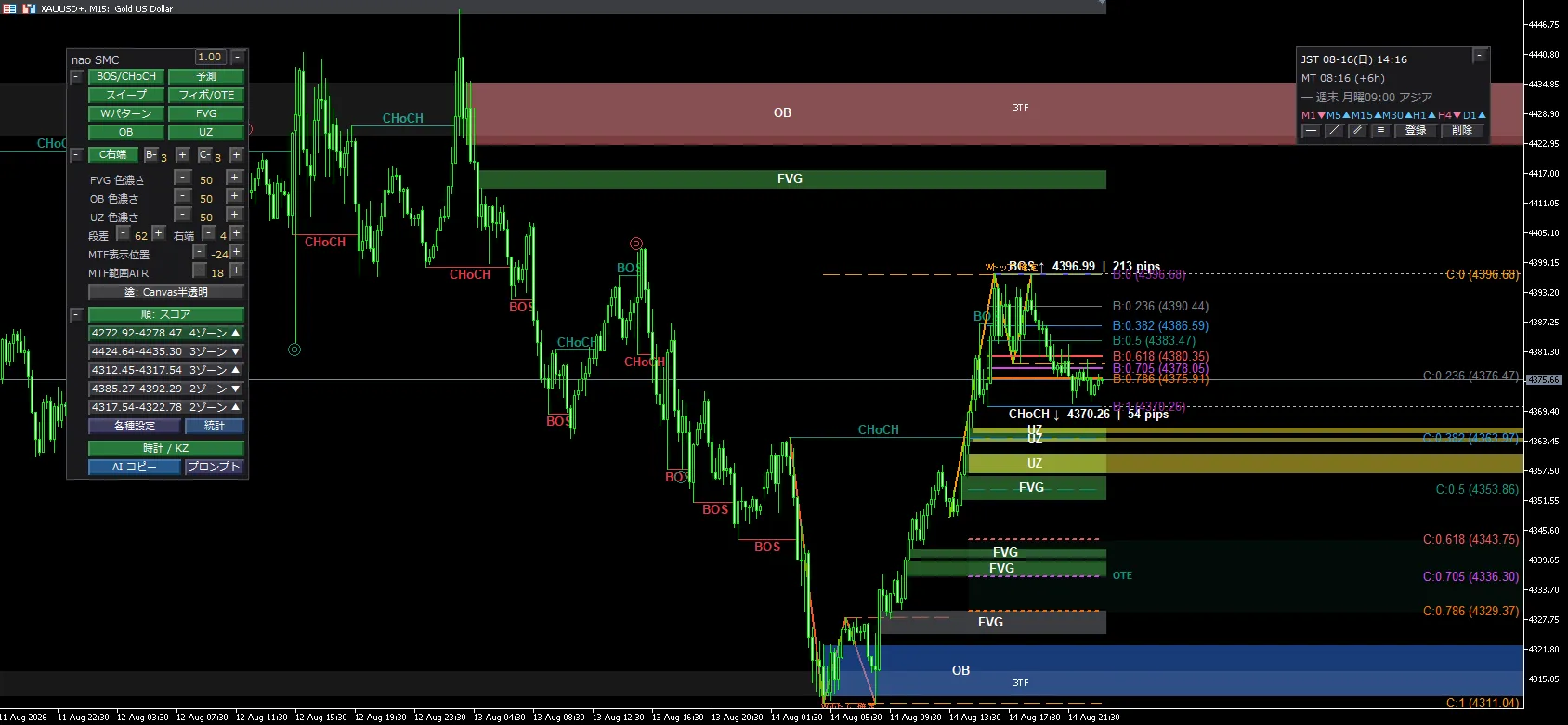
There are times when trend-following funds and mean-reversion funds clash, or central banks intervene with overwhelming force to push one side down. The essence of top-level analysis is reading“which big player is the majority now”, and tools likeSMCOBFVG are tools to track those traces.
What we small traders can do is not to directly challenge the big players, but“read the direction the majority is leaning toward and ride on the same boat”.

Mechanism of Stop Hunt
Stop hunt is“a temporary move of price to a high-liquidity area where stop orders are gathered, followed by a reversal after those orders are consumed.”
The concrete flow is as follows.
①Many participants (big and small) have orders around the high/low
②Big players move the price to that level to execute orders (spike)
③The accumulated orders are all consumed at once (mixed stops, profits taking, new orders)
④After orders are filled, price moves in the opposite direction
⑤As a result, a chart pattern of“a quick breakout followed by an immediate reversal”“a quick breakout followed by an immediate reversal”emerges
“Why did it go slightly beyond the high and then reverse sharply?”——that is the result of this mechanism. Prices move due to big player order execution, and small traders who had placed stops there get swept in as well.
“only the wick extends and then reverses”also often fits this mechanism.
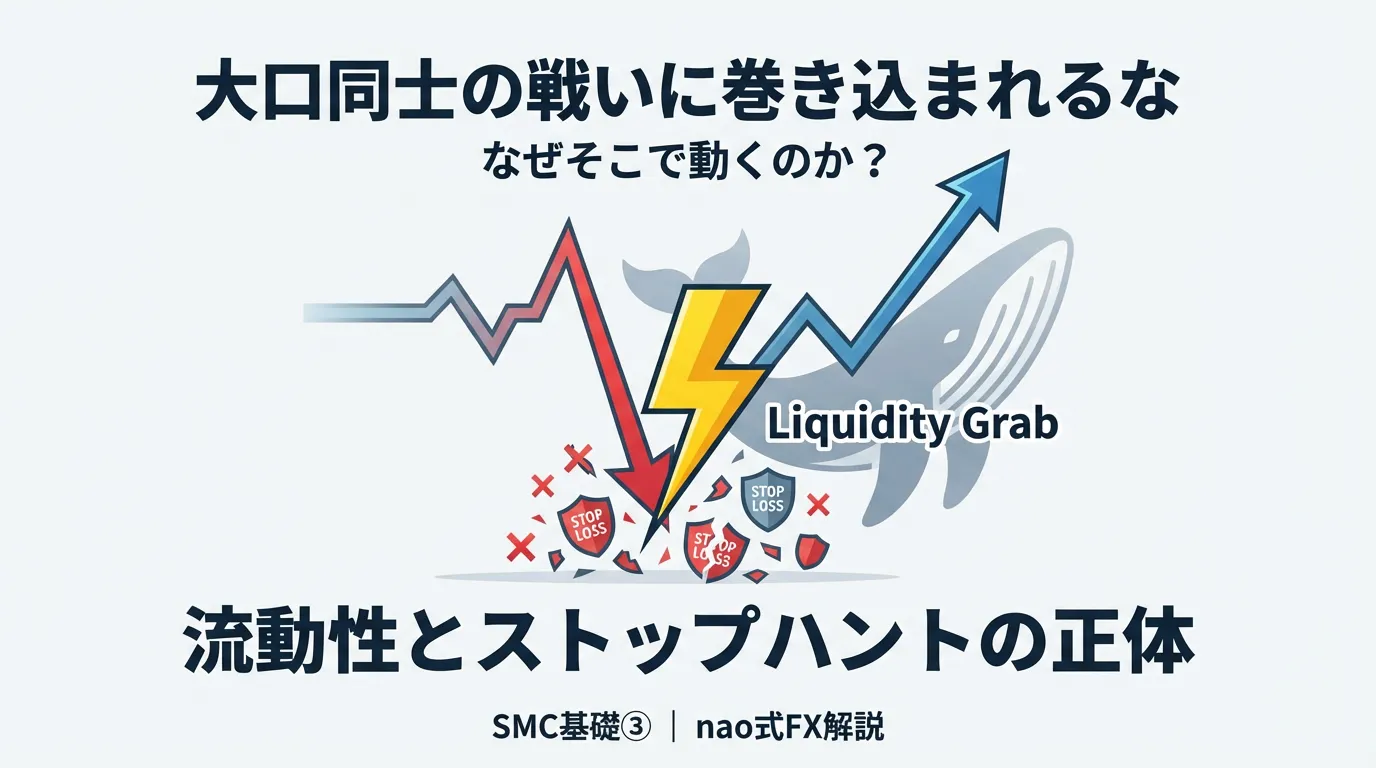
Liquidity Grab (Sweep)
In SMC terms, stop hunt is called “Liquidity Grab” or “Sweep.”SMC.
It means “grabbing liquidity,” a pattern where price briefly goes beyond highs or lows to shake out stops and then reverses.
Chart-ready features:
・Candles with long wicks and reversal shape
・Brief break of recent highs/lows and quick return

How to use this in actual trading
Understanding liquidity changes how you read charts.
“Prices don’t rise even after slightly crossing the high”→Possibility of a stop hunt
“Prices don’t fall even after slightly breaking the low”→Possibility of a stop hunt
When this move appears, consider entering in the mean-reversion direction.
However,entering solely on a sweep is premature.In the next parts we will explain Order Blocks (OBFVG, which will greatly improve accuracy when combined.
First, start by viewing the chart from the perspective that “prices are drawn toward high-liquidity areas.” When you can see where you stand in the big players’ battle, you’ll be less likely to get swept up.
Nao’s honest take: I learned SMC later
To be honest.
I started using Sweep before I knew the term SMC.SMC.
“Buy a little beyond the high/low, then reverse direction without chasing it.”——I picked this up on my own and it became a winning pattern. I shared it with trading peers, but at the time there was no name for it, so I struggled to explain it.
The turning point came from a trading friend’s remark: “Nao, isn’t that the concept of SMC?”naoさん、それってSMC
Half-believing, I researched and found that what I was doing was exactlySMC, and I was honestly astonished. “Sweep,” “Liquidity Grab,” “OB——As soon as it had a name, a sense of being able to explain what I had only felt emerged.
SoSMC
And at that moment I was sure——Entering only on a sweep is not as effective as waiting for supporting evidence from OB andFVG
The correct use is to understand why the move happened.
まとめ:今日の3大ポイント
①Liquidity is the aggregate of orders accumulated in the market. They tend to cluster around highs/lows on the outside, and near round numbers.FX2.5% (BIS April 2025 survey).
②The true nature of stop hunts (Liquidity Grab) is “big players move price to high-liquidity areas to execute orders.” Small traders’ stops are taken as a side effect. The typical chart pattern is a long wick with a quick reversal.
③With the liquidity concept, you can read why price moved there. Understanding the structure of big-player battles helps you avoid being swept in.
Next time we will discuss “Order Blocks (OBOB). It’s where big players actually placed positions—what makes it different from ordinary support and resistance will be explained.
Please look forward to the next installment!
nao|FX full-time trader and EA developer