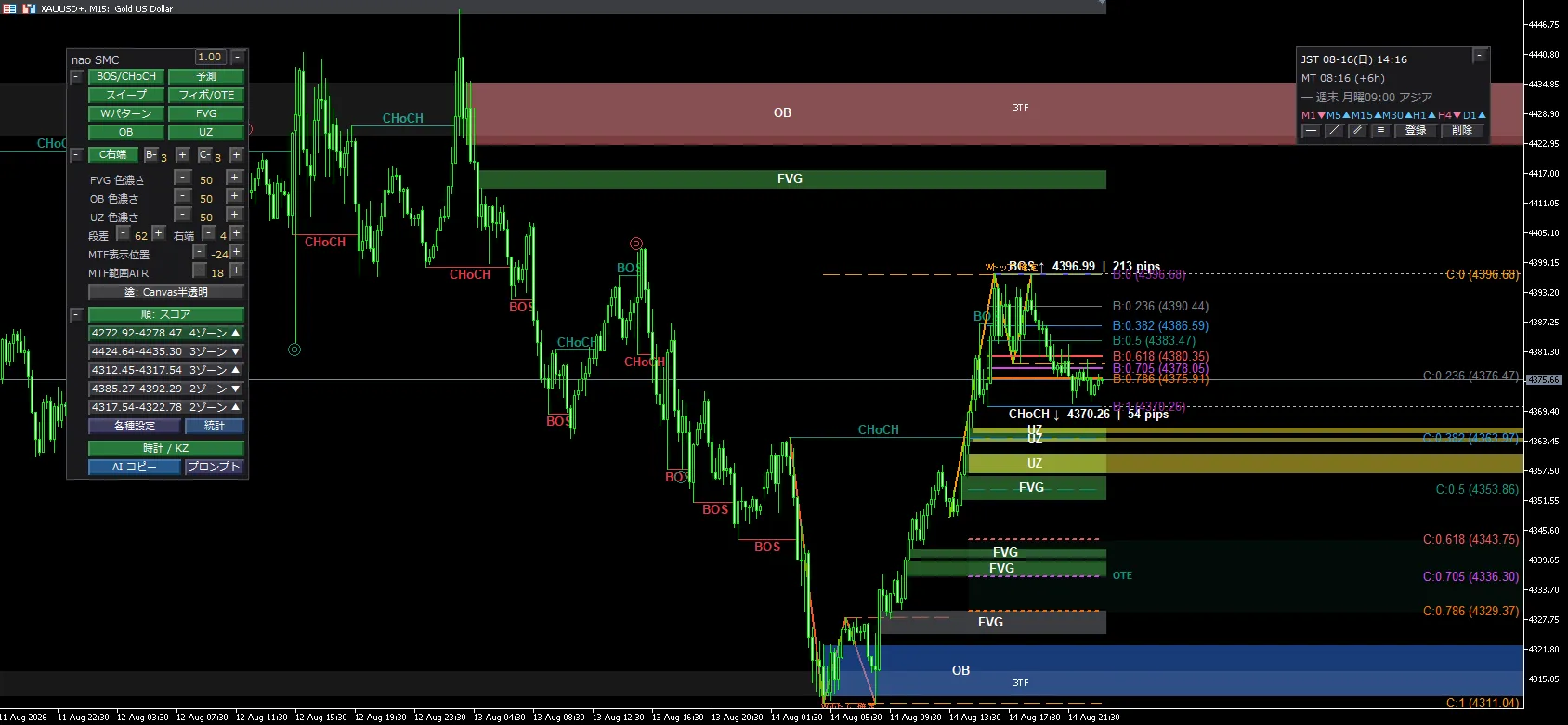

Episode 0: Why can't you win with indicators? The story of FX and SMC [Series Start]
Nice to meet you, I’m nao.
In this series, I will explain “SMC (Smart Money Concept)” from zero.
This article is being rewritten.
In the previous version, I wrote that “the big players harvest individual stop losses.” It’s an easy-to-understand explanation, and I wouldn’t call it a mistake. However, if you stop at that explanation, some people will get stuck. Since this is the entry to the series, I’m rewriting the most important part from the ground up.
A common explanation is that the calculations don’t add up
“The big players come to harvest individual losses”—when you start learning SMC, you will inevitably encounter this explanation.
At the beginning of the series, to be honest, I went along with what others said.
But I’ll write what I’ve thought since then.
Forex trading worldwide is about $9.6 trillion per day. Among that, retail trading accounts for about 2.5% (BIS April 2025 survey). The big players move hundreds of billions, even trillions of yen. Even if you collect all the individual stop losses, it will be far from that order volume.
In other words, the explanation that “the big players target individuals” is misaligned in scale. Even if they target us, it wouldn’t be worth it for the big players.
So what is really happening
First of all, big players are not one single creature.
Banks, funds, pensions, central banks. Each has different objectives, timeframes, and sizes of funds. These big players are sometimes allies, sometimes enemies. We individuals are largely ignored.
Then, are the big players invincible? Not necessarily.
This is where it gets interesting: as soon as big players buy, they become unable to move freely.
If they try to exit by selling, their own selling pushes the price down. If the price drops, the value of their remaining positions falls as well. Therefore, big players have to either defend that area or gradually escape. Moreover, large orders leave traces on the chart. If other big players see those traces, they can read where they intend to defend.
Being big is a vulnerability in itself.
In the market, it’s common for big players to eat other big players. In 2022, one of the world’s largest nickel producers couldn’t exit its short position, and in three trading days the price rose 3.7 times. In this story, there isn’t a single individual involved.
The real reason indicators can’t win
So how does this story connect to indicators?
In the first place, we use indicators to decide “where to look.” Moving averages, RSI, horizontal lines—these tools narrow down the spots worth paying attention to within price movements.
Highs and lows that anyone can understand. Everyone sees them, regardless of which tool they use. Then moving averages overlap, neat numbers align, and Fibonacci overlaps can occur. The more the basis aligns, the stronger the conviction, and the more orders are placed there.
And big players cannot handle large orders unless the orders have piled up somewhere. So big players will set up there.
There are places you think, “This is absolute.” You enter with conviction, get a quick move, and take a loss. Right after, the price returns in the direction you thought—“What, the direction was right after all?” You lose the stop, then it comes back.
The direction was right. However, the places people consider absolute are where many people’s losses line up just a little ahead. That’s one of the few places where big players can handle a substantial amount. So the “absolute” places tend to mislead before a genuine reversal.
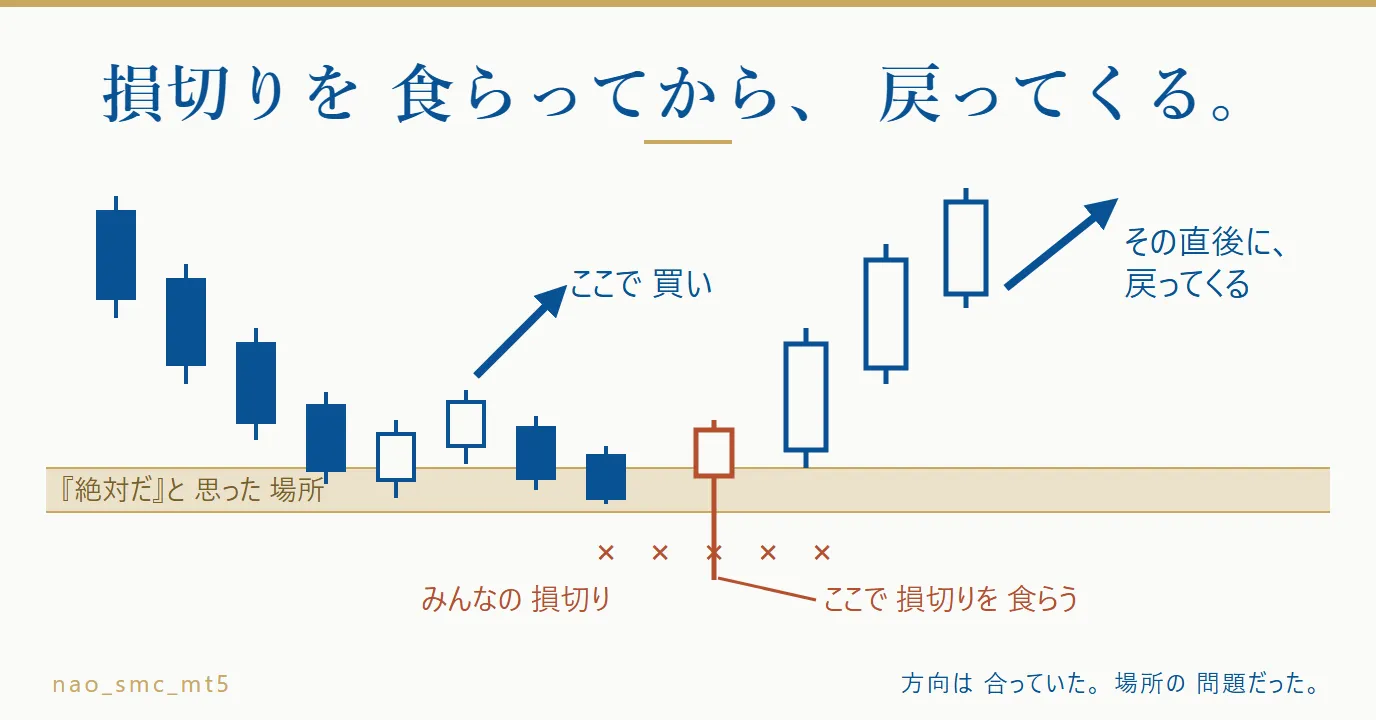
The reason you can’t win with indicators isn’t the tool’s performance. It’s that entries and stops are placed in the same places as most people.
You aren’t even being targeted
In academia, there is the term “predatory trading.” However, to become prey, three conditions must be met: the position must be large, you must have no choice but to exit, and that fact must be known to the other party.
Our lot does not meet any of these three. There is no reason for big players to target us.
There are traps, though. Not for us, but for big players. They just happened to have their stop losses in the same place as ours. Not a target, but stray bullets.
Until I realized this, I went around in circles. When you think you’re being targeted, the market seems like an attack. After realizing you are standing in a place of battle, you shift to choosing where to stand.
SMC is reading the traces
Who targets whom cannot be read from the chart.
What can be read is that traces of large funds have left a mark.
However, the same trace can lead to different outcomes depending on whether the big player who left it ends up defending it or being dragged down. So traces are “readable to a degree”—the accuracy comes from stacking discernment, which is what this series will discuss from here on.
SMC builds from those traces—market structure, order blocks, fair value gaps, liquidity—to anticipate what will happen next. Instead of responding after move-like indicators (RSI, Bollinger, MA), you prepare before the move. This shift in thinking is the essence of SMC.
It sounds difficult, but if you understand it step by step, you will surely be able to use it.
As understanding progresses, the view of the chart changes gradually. It’s about how the chart appears to you, lol.
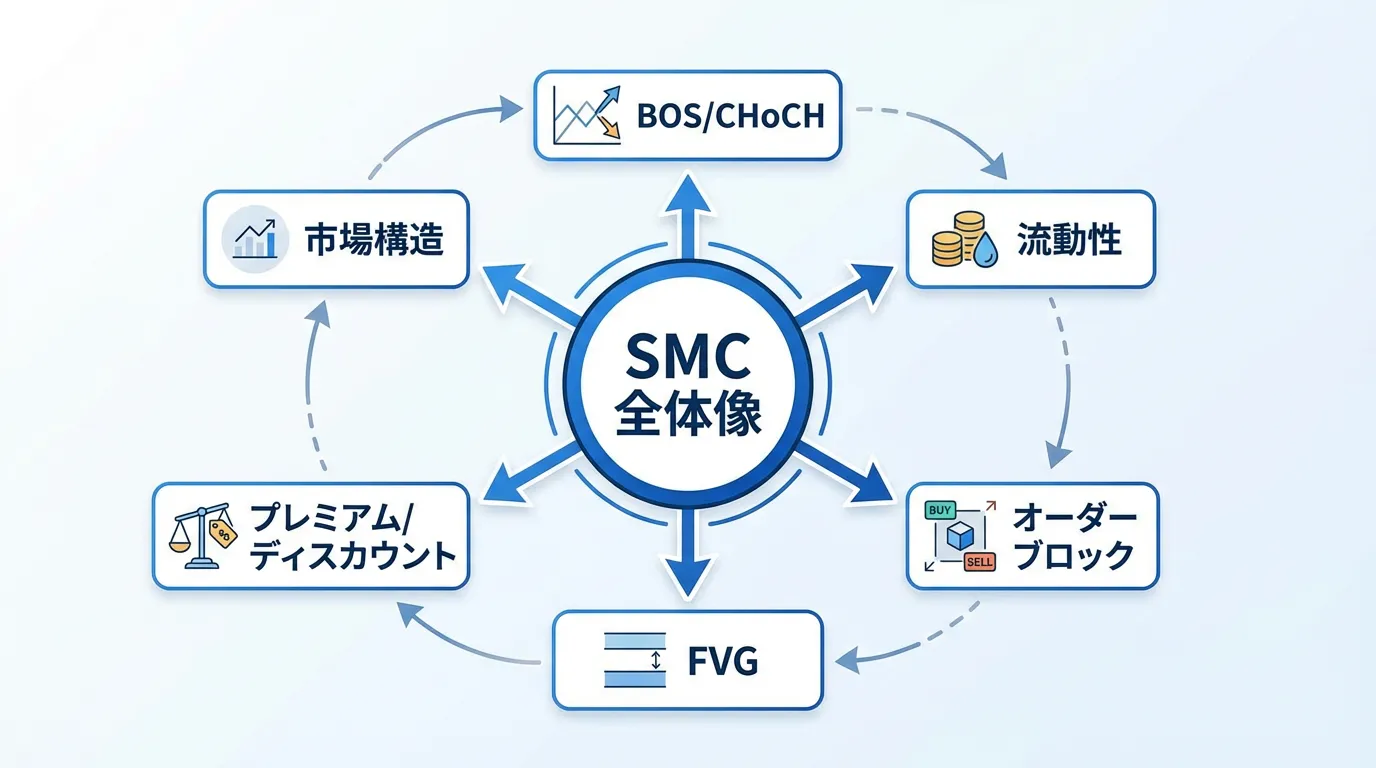
Summary: Today’s three key points
① Individuals are about 2.5% of the market. What big players are targeting is not individuals, but the “place” where orders have piled up.
② Not winning with indicators isn’t due to their performance, but because you place entries and stops in the same places as many others, making you vulnerable to traps.
③ SMC is a method to read the traces left by big players and prepare before moves.
Next time, I will explain how to read market structure (HH, HL, LH, LL). Knowing where you are standing on the chart right now—that is where it starts.
─────────────────────
nao | FX full-time trader and EA developer
I started promoting SMC after realizing that my self-taught winning pattern was later called “SMC.”
Specializing in GOLD scalping and day trading. While selling EA “tundere series” on GoGoJungle,
I developed the SMC visualization indicator “nao_smc_mt5,” which draws the same judgment criteria as this series directly on the chart.
From structure, zones, 0.705, to next break prediction—on the chart the moment you open it.