

Is zero consumption tax on food really advantageous? Things to consider about a 5 trillion yen annual hole and the LDP-Hoc Administration's transitional link to a "refundable tax credit"
“If the consumption tax on food is zero, will your life really become easier?” Could you immediately answer “yes” to this question? 8% disappears from receipts. On television, voices saying “it helps” are broadcast, and street interviews are filled with hopeful comments.But what happens behind the scenes, how much can we imagine?Who pays the tax for manufacturing companies? What is a refund?
And how should we organize the relationship with Prime Minister Sanae Takai’s centerpiece, “tax credits with benefits”?There is about a 57,000 yen gap for low-income households and about 118,000 yen for high-income households, and a comparison with a 30,000 yen per person grant.
Furthermore, the burden on businesses, the confusion for consumers caused by the line between 8% and 10%, emotions and systems, clarity and sustainability, short-term reassurance. In that context, what criteria are we using to judge now?
Selling well!A high-functionality trade training tool that feels like the real thing?9,800 yen?
?FX New Generation: One-Click FX Training MAX
?Current status of the reduced tax rate of 8%
Currently, a reduced tax rate of 8% applies to groceries. When manufacturers purchase raw materials, packaging, electricity, fuel, etc., they pay consumption tax, and when they sell the finished products to wholesalers or retailers, they charge with 8% added. And the tax paid to the government is the amount after deducting the tax on purchases and expenses from the tax on sales, i.e., the post-input tax credit amount.
The cost is passed on to prices, and the final consumer bears the burden. The system itself is relatively simple in that tax is paid by each business based on the consumption tax they received minus the consumption tax paid at purchase. However, when a reduced tax rate is introduced, the situation becomes complex.
Among purchases, some are 8%, and some are 10%, such as electricity used in food production, and tax rates are mixed. This category management is a big burden for businesses. In retail, it is necessary to check the tax rate for each product, and cash registers and POS systems are not simple. Furthermore, even if the rate is set to zero, price displays and system upgrades are required. The reality is that regime changes themselves carry appropriate costs for businesses.
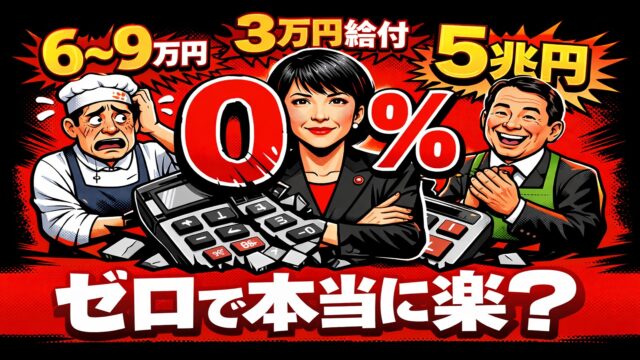
?What is zero tax rate? Industry unfairness and 5 trillion yen of funds
Currently, the central topic of discussion is the “zero tax rate method.” This treats exports the same, setting the sales tax rate to 0% while treating the transaction as taxable. When manufacturers sell food, the sales tax amount is 0 yen. However, at the time of purchase, the 10% consumption tax applies as usual. As a result, subtracting the 10% input tax from the 0% sales tax yields a negative amount.That difference is refunded by the state.
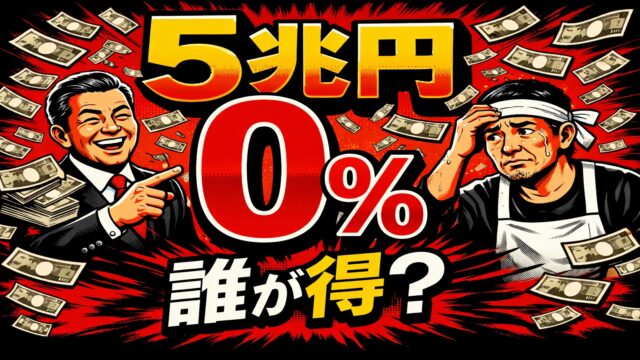
There are also concerns about the so-called “ramen shop collapse.”From a fiscal perspective, a tax revenue decline of about 5 trillion yen per year is anticipated. There is also skepticism about the political hurdle of reverting to 8% within two years being extremely high.
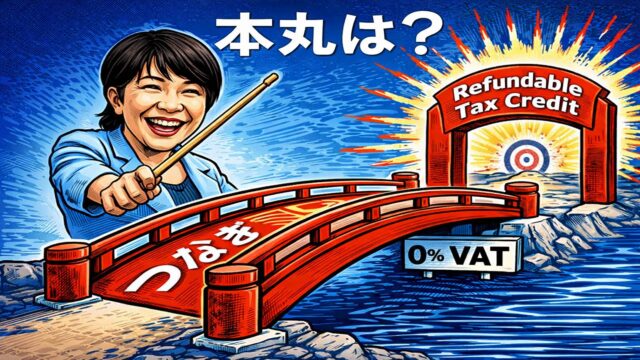
?Prime Minister Sanae Takai’s “bridge” concept
As of February 2026, Prime Minister Sanae Takai stated that zero consumption tax on groceries would be “a bridge to the introduction of a guaranteed refundable tax credit.” The main issue is the refundable tax credit.A system that deducts a fixed amount from income tax, and provides cash for the portion that cannot be deducted, with the aim of permanently increasing take-home pay for low- and middle-income households.However, it will take time to design the system.
It is discussed in the National Diet, and an interim report is planned before summer, but some point out that it will be difficult to implement legally and systemically within the 2026 fiscal year.There is a possibility that the bridge could be prolonged.Nevertheless, since Prime Minister Takai’s core is the refundable tax credit, there is also a possibility that consumption tax cuts could be achieved by another method.
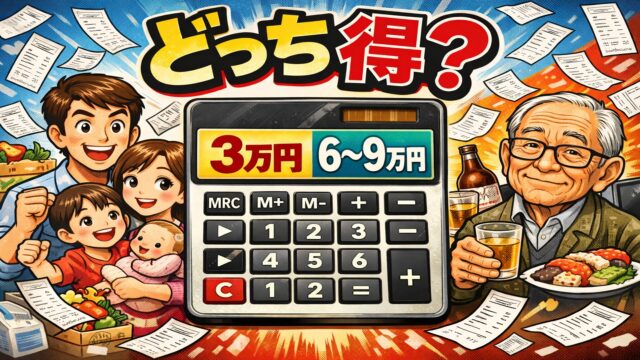
?Compared with giving 30,000 yen per person
Estimates by Daiwa Institute of Research and others show that the household relief from zero groceries amounts to an average of about 60,000–90,000 yen per year. For low-income households, about 57,000 yen per year, and for high-income households about 118,000 yen, with differences. For single elderly households, it may remain around 40,000–50,000 yen per year.If a 30,000 yen grant per person were implemented, a single person would receive 30,000 yen, and a four-person family would receive 120,000 yen. For households with growing children, grants may be more advantageous.
From the perspective of marginal propensity to consume, grants may have a higher stimulative effect on consumption.In television interviews, voices saying “zero would help” stand out, but how do they compare when you compare actual amounts?If there is a grant of 30,000 yen per person and zero groceries for food consumption, which do you think is more beneficial? Do emotions align with numbers?
?Abolishing reduced tax rate and the case for a uniform 10% rate
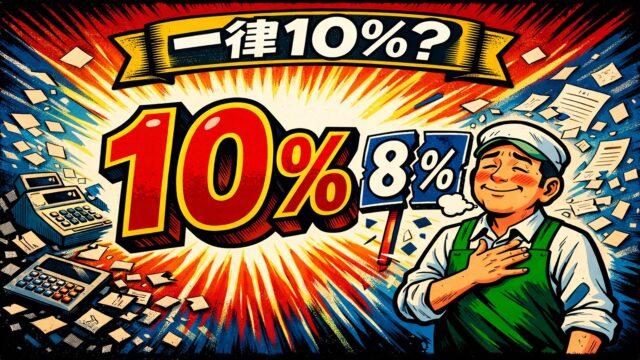
Some experts point out that it would be more rational to abolish the reduced tax rate, revert to a uniform 10%, and strengthen the basic deduction and refundable tax credit. Abolishing the reduced tax rate would increase tax revenue by about 5 trillion yen annually, and that revenue could be redirected to income-side support. The system would be simplified, and the burden on invoices would also be reduced.
The practical costs of mixed 8% and 10% management, category accounting, and cash register modifications would be eliminated in retail and other sectors.Originally, the reduced tax rate is criticized as a system that increased administrative costs and workload despite only an 8% vs 10% difference.
Moreover, with the Liberal Democratic Party’s coalition partner Komeito having withdrawn, the political necessity to maintain this system has relatively diminished.However, since the reduced tax rate was introduced as a key policy of Komeito, political hurdles remain in light of party realignments and public opinion.
?Is consumption tax really advantageous to high earners?
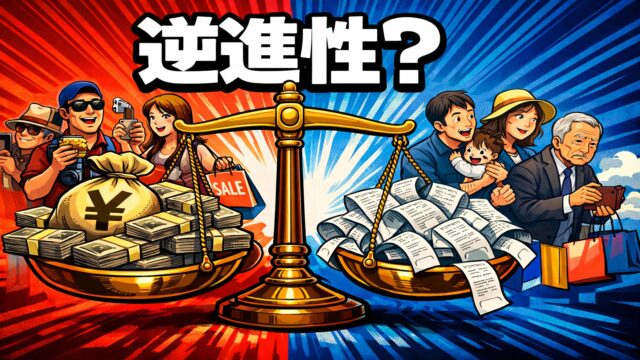
Consumption tax is regressive and some say it benefits higher earners. Indeed, looking at the burden as a share of income, lower-income groups bear a higher burden. On the other hand, consumption is somewhat controllable, and the standard of living tends to converge to a level appropriate for income.Also, consumption tax is paid not only by domestic residents but also by inbound foreign tourists visiting Japan.
There are other means besides reducing consumption tax, such as revising the progressive structure of income tax, expanding basic deductions, or returning excess tax revenue via benefits.Some argue that adjusting on the income side offers a simpler and more transparent system than moving the consumption tax rate.Where do you think the best place to address regressivity is?
?Reduced tax rate is difficult and burdens on businesses are large
Zero consumption tax on food is simple and has a strong psychological impact. However, when looking at the details, there are issues such as corporate refunds, industry fairness, and a roughly 5 trillion yen annual funding problem, as well as other complex challenges. Prime Minister Takai has indicated a temporary measure of zero consumption tax and a transition to a refundable tax credit, but in practice, there are non-negligible burdens on businesses like cash register upgrades and accounting changes. Consumers may also face confusion over item coverage and distinctions for eating out.
In recent elections, parties like Team Mirai have gained support without emphasizing consumption tax cuts.This shows that voters do not necessarily see consumption tax cuts as the only answer. Tax systems are not only fiscal stimulus but also social security funding. Clarity is important, but it cannot be the sole deciding factor.
There are also ways to support households without changing the consumption tax rate, such as revising the progressive structure of income tax or returning excess tax revenue via benefits.From the perspective of simplicity, reducing the burden on businesses, and avoiding consumer confusion, a multi-faceted approach should be considered. What method do you think is appropriate?
Completely risk-free trade simulator to practice and verify freely!
Details page of One-Click FX Training MAX