

Cryptocurrency Market Analysis [February 24]
Current State of the Cryptocurrency Market and Reignited Uncertainty from Tariff Threats
The cryptocurrency market today faced another sharp downturn as investors and traders reacted sensitively to the shocking news of a new series of global tariff threats from U.S. President Donald Trump.
With the outlook for global trade once again clouded and geopolitical risks rising, funds have been flowing out of the crypto asset market, which has risk-asset characteristics.
The total market capitalization of current crypto markets has fallen by more than 3% in the last 24 hours, shrinking to about $2.29 trillion. In particular, Bitcoin (BTC), which serves as a market indicator, dropped from around $67,600 in the late Sunday US Eastern Time to as low as about $64,400.
On Monday morning at the start of the week, there was a short-lived rebound, pushing toward around $66,000, but later selling pressure pushed it back, and trading has continued around an unstable level of about $64,600..
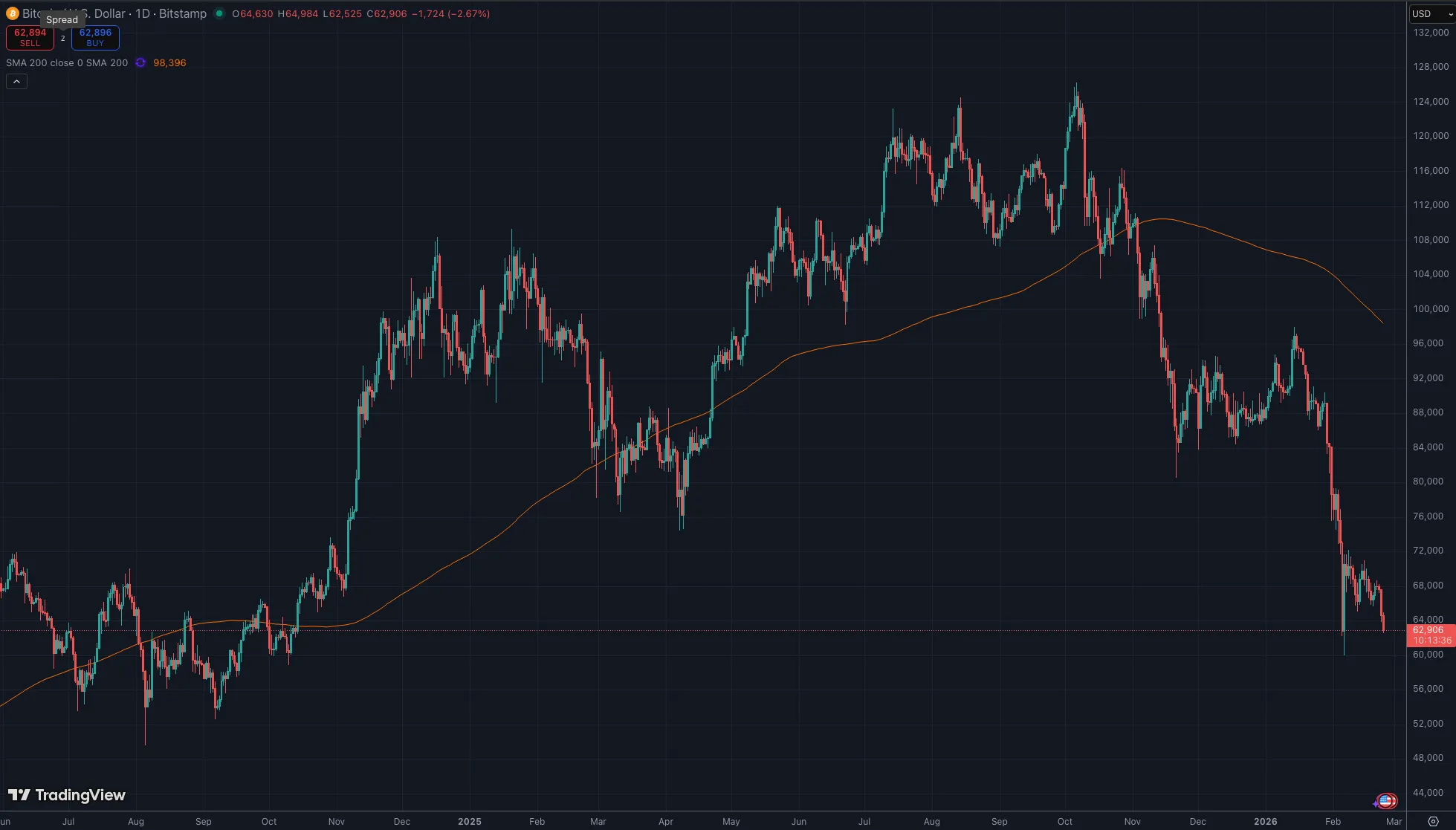
Bitcoin daily chart
Notably, Bitcoin is facing the longest consecutive downtrend pace since the historic bear market of 2018. Market selling pressure shows no signs of abating, and if the monthly close for February is negative, Bitcoin would mark five consecutive months of declines. This would set a record for the longest decline in the past seven years, and the current price level is about 50% below its all-time high, indicating a severe situation.
Meanwhile, Ethereum (ETH), the second-largest by market cap, is also dropping in price in step with Bitcoin. ETH fell more than 4% in one day and is currently trading around $1,850.
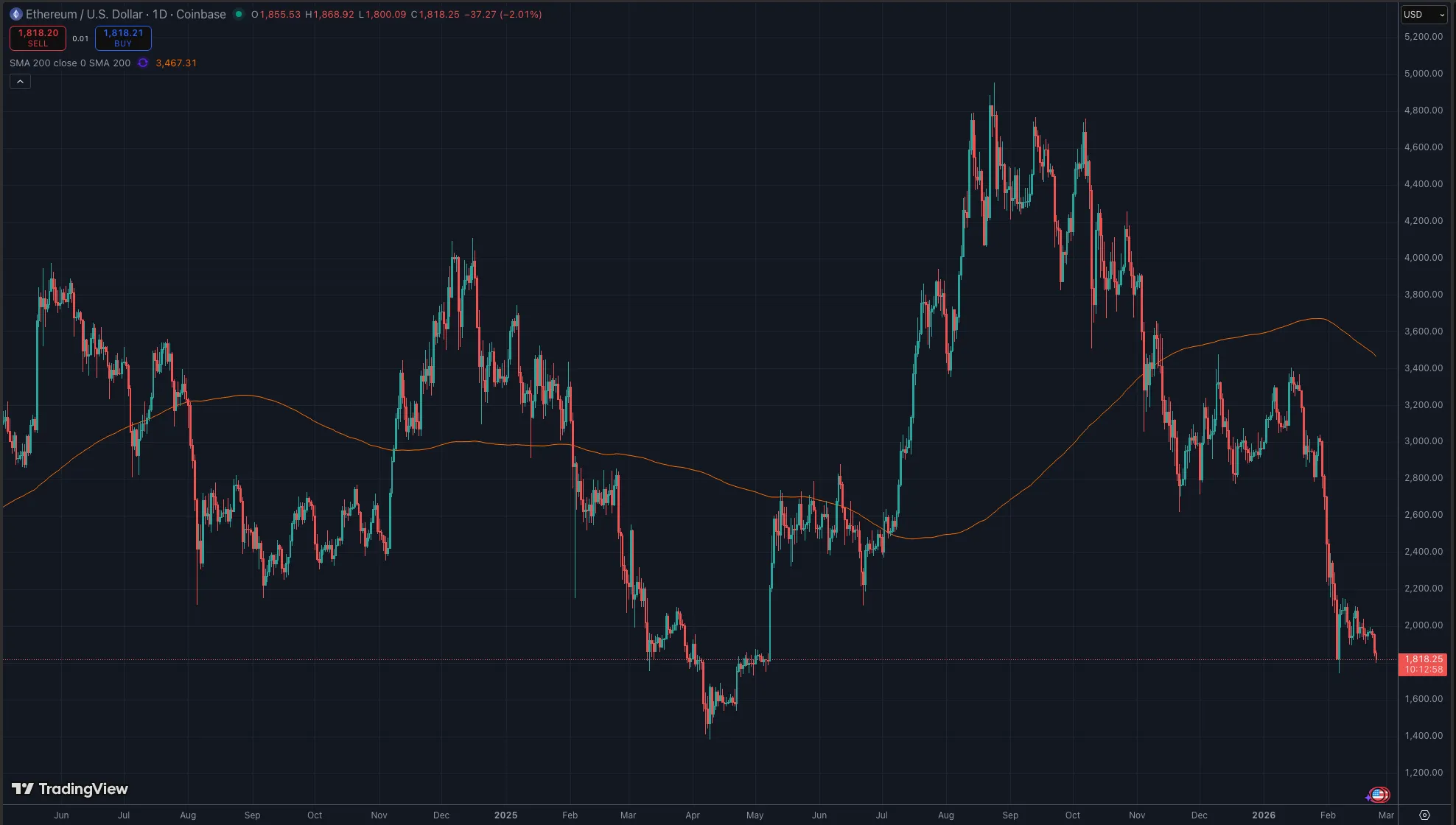
Ethereum daily chart
Regarding other top 10 market cap coins, a gradual but steady decline of about 2% to 6% over 24 hours continues. Among them, Dogecoin (DOGE) has held relatively firm within the top market cap cohort, with a drop of only 1.3%, but on a weekly basis it has lost more than 7%, indicating ongoing tough conditions.
Market analysts are focusing on the recently observed "7-day realized net profit/loss average." As of February 6, this data showed a daily loss of $1.24 billion, but has since narrowed to $480 million per day.
However, this does not imply a bottom; it still shows that investors who bought at the base are forced to sell due to unrealized losses.SoSoValue’s latest statistics show that in the week up to February 20, 2026, there was an outflow of $318.6 million from spot Bitcoin ETFs. In addition, spot Ethereum ETF funds recorded a net outflow of $102.37 million, signaling a clear withdrawal by institutional investors.
In the overall digital asset investment products, last week saw a net outflow of $280.8 million. Among individual assets, Bitcoin (BTC) accounted for most of the outflow, about $210.15 million, and Ethereum (ETH) also saw $36.5 million outflows. In contrast, Solana (SOL) saw inflows of $3.3 million and Ripple (XRP) $3.5 million, suggesting investors are becoming more selective.
2026 Market Predictions and Investor Sentiment
According to traders' predictions on the forecasting platform Polymarket, the probability that Bitcoin will perform best in any given month in 2026 is currently 17% for December, second only to November’s 18% forecast. Since 2013, November has been known as Bitcoin’s most profitable month, with average returns of 41.13% according to CoinGlass data.
Outlooks vary among experts. Michael van de Poppe, founder of MN Trading Capital, remains cautiously optimistic, expecting Bitcoin's price to turn positive next week. In contrast, legendary veteran trader Peter Brandt offers a contrary view, suggesting Bitcoin’s true bottom may not be reached until October 2026.
The Crypto Fear & Greed Index, which quantifies investor sentiment, dropped to a very low score of 9 on Sunday. This indicates the market is dominated by "extreme fear," and this level of tension is near a historical low for markets without a full-blown systemic collapse.
Meanwhile, some platforms show different movements. Johan Kerbrat, head of the crypto division at Robinhood, noted that users are viewing the current price drop as a prime investment opportunity. He told Cointelegraph that Robinhood customers are aggressively buying at lower price ranges, diversifying beyond major coins like Bitcoin and Ethereum into a broader crypto asset portfolio. A price decline appears to stimulate investor curiosity and buying interest in an interesting phenomenon.
Bitcoin News and Whale Activity
Behind Bitcoin, there are ongoing large movements by early holders and large corporations. First, a long-standing whale who has held Bitcoin since the Satoshi era surprised the market by selling all of their holdings: 18,400 BTC (worth about $1.24 billion) today. After more than 15 years of holding, this complete withdrawal has sent a strong shock to the market.
Meanwhile, corporate accumulation continues. MicroStrategy purchased an additional 592 BTC at a price of about $67,286 per BTC, totaling approximately $39.8 million. This brings the company’s total holdings to 717,722 BTC, with a current value around $54.6 billion (cost basis about $46.4 billion).
On the other hand, some companies are shifting strategy. Bitdeer reported reducing its Bitcoin balance to zero. It is currently evaluating several non-binding land acquisitions and has determined that selling Bitcoin and converting to cash is prudent for funding those investments.
Trump's Strategy: Put Crypto Leadership in the U.S.
U.S. President Donald Trump positions crypto assets as a key element of national strategy. He states, "America should lead in cryptocurrency and cannot hand it over to China," with an ambitious aim to make the U.S. the world’s center of crypto assets.
As for concrete achievements, last year he signed and passed the Genius Act. Currently, the U.S. Congress is considering a bill on the regulatory framework for the crypto asset market that would cover a wide range of assets including Bitcoin. Trump has indicated he will sign this bill promptly once it passes Congress, aiming to enhance U.S. competitiveness through clear regulatory guidelines.
Domestic Trends: 20% Taxation and ETF Formation
In Japan, notable movements are also taking place. In a keynote report at the Digital Space Conference, attended by Sakurako Katayama of the Liberal Democratic Party, there were forward-looking remarks regarding crypto tax reform.
Currently, crypto income is generally classified as "miscellaneous income" and taxed under the comprehensive tax system, combined with other income, at a top rate of 55%. In response, Katayama suggested moving toward a 20% separate taxation. If this tax reform is realized, the hurdle for individual investors would be significantly lowered, potentially stimulating market activity.
Additionally, major domestic financial institutions such as Nomura Holdings and SBI Holdings are reportedly considering forming Japan’s first crypto ETF. If tax reform and ETF realization align, massive inflows from institutional investors could significantly boost domestic market liquidity.
Arthur Hayes’ Warning: AI-Driven Unemployment and Fiat Currency Crisis
Arthur Hayes, co-founder of BitMEX, analyzes the market from his own perspective. In a recent blog post, he discussed the decoupling between Bitcoin (BTC) and the Nasdaq 100, driven by high-tech stocks. Hayes warns that this decoupling could signal a coming credit crisis driven by AI, and that Bitcoin may be most sensitive to government credit supply as a free-trading asset.
He describes Bitcoin as a "fire alarm for global fiat liquidity," emphasizing Bitcoin’s value as a freely traded asset most responsive to government credit injections. According to Hayes, to adapt to AI-driven employment shifts and changes in the economic structure, governments will be forced to further increase fiat issuance and rescue banks. The resulting surge in credit creation could decisively push Bitcoin out of its current low range and drive a new all-time high.
Ethereum Trends: Vitalik Buterin’s Sales and Major Holdings by Bitmain
Within the Ethereum ecosystem, there are contrasting moves among founders and major players. Ethereum co-founder Vitalik Buterin has continued selling his ETH holdings. In the past three days he sold about 3,765 ETH worth around $7 million, and since February 2, he has sold a total of about 10,723 ETH valued at roughly $21.7 million. He states that these sales, as previously indicated, are to fund multiple ecosystem projects.
Conversely, mining hardware giant Bitmain has adopted a bullish stance. The company announced adding 51,162 ETH to its asset portfolio last week, bringing its ETH holdings to about 3.66% of the total supply. Bitmain reports that about 69% of its ETH—specifically 3,040,483 ETH—are staked, with expected annual revenue of about $107.0 million (2.89% yield).
[Paid subscription notice]
In the paid subscription area, we offer deeper, valuable analyses of individual stocks.
"Bitcoin and Ethereum aren’t everything; I want to invest in the next big gainers beyond those."
"Understand the fundamental flow and future of the crypto market, and surely ride that wave."
If this is your thinking, please consider subscribing. Continuous high-quality research is the key to substantial success.
(This report has been delivering at the forefront of the market since its launch in 2016)