

Shan Peak Finance Minister × Bessent Coordination Create a Sweet Spot of Yen Appreciation and Stock Rally! Why did “Koichi’s overwhelming victory = yen depreciation” miss the mark?
“Why didn’t the yen weaken?” Following the historic landslide victory of Ms. Sanae Takaichi and the LDP, everyone anticipated a “yen depreciation straight line.” Yet the market moved in the opposite direction. At the start of the week, the foreign exchange market swung sharply toward stronger yen, while stock prices hit record highs.The market’s development went completely against the consensus.Was this seemingly mismatched movement a coincidence? Or was it a calculated landing?
What emerges here is the presence of Finance Minister Katayama.Close coordination with the U.S. ambassador Bessent, rapid market warnings, and the deliberate messaging that created a clear invisible wall at around 160 yen through rate checks and jawboning. The difficult balance of containing yen depreciation while sustaining rising stock prices may not be mere market whim; it could have been shaped by a buildup of diplomacy and policy.
In this article, we analyze how this rise in the yen and stock prices was guided, by looking at the backstage.
?️Historical landslide victory and the market’s pre-consensus
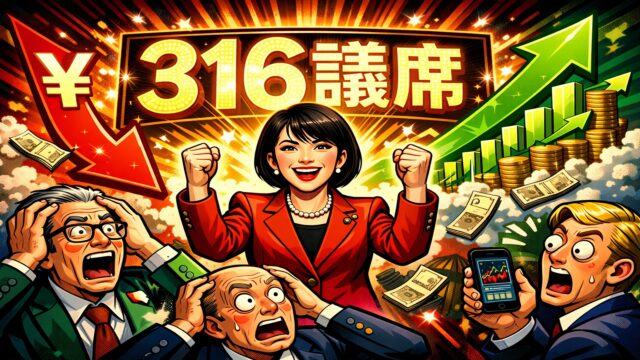
As of February 11, 2026. In the House of Representatives election held on February 8, Prime Minister Sanae Takaichi’s Liberal Democratic Party won 316 seats, exceeding one-half of the 465 total seats and achieving a historic landslide. This enables constitutional amendment proposals and reapproval of rejected bills in the upper house, making the administration’s foundations stronger than any postwar period.
Before the election, the market’s consensus was very clear: “Takaichi landslide = stock price rise, yen depreciation, and bond prices fall.”If fiscal expansion is easy to implement, tax cuts (especially zero tax on food and beverages), and the Bank of Japan adopting a cautious stance on rate hikes, it was believed that yen would be sold due to fiscal expansion concerns. The so-called “Takaichi trade” was expected to re-emerge.
? The market’s initial reaction defied expectations
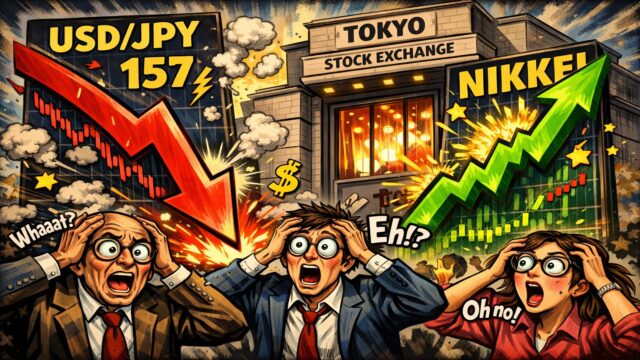
But the market reality defied those expectations. The Nikkei Stock Average easily surged beyond 50,000, rising toward around 57,650 to set an all-time high. Meanwhile, USD/JPY fell from the high 157s to the low 154s, marking a yen appreciation of about 3–4 yen.Retail sales in the United States on the 10th missed expectations (month-on-month 0% vs. 0.4% expected), fueling concerns about a slowdown in U.S. consumption and contributing to USD weakness.
Reports that Chinese authorities guided restraint on U.S. Treasury holdings also prompted dollar selling (yuan strength), with spillover to the yen. Expectations of lower U.S. interest rates (renewed hopes for earlier rate cuts) helped as well.The result was a combination of “rising stock prices + rising yen (at least, yen depreciation stopped),” the opposite of prior predictions.
Why didn’t the yen depreciation accelerate? By organizing the background in chronological order, it becomes clear that multiple factors overlapped.

? The yen rise born from the unwinding of speculators
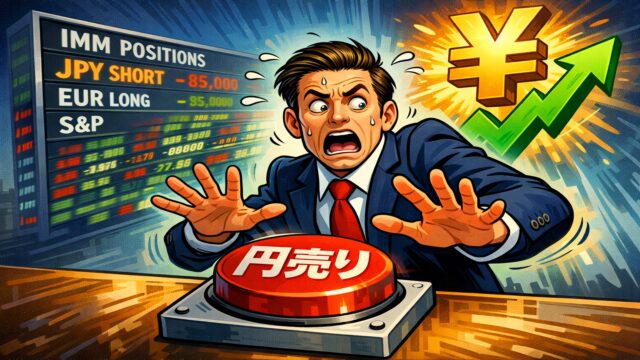
First and foremost, the immediate factor was the unwinding of speculative short yen positions. Before the election, overseas short-term players anticipated “Takaichi’s landslide = yen depreciation” and piled into short yen positions. However, the IMM data from the CFTC showed that as of the week ended February 3, net short yen positions had shrunk to about 19,000 contracts, down more than 14,000 contracts from the previous week.The landslide beyond expectations exhausted the market’s catalysts, and the accumulated yen-selling positions were unwound rapidly, directly driving yen appreciation.
Analyses from Everis FX and Nomura Securities pointed out that: “The ruling party’s landslide leads to volatility due to authorities’ warnings,” “Speculative yen-selling positions are being unwound,” and “The narrowing of net selling heightens yen appreciation risk.”Investors had built positions anticipating yen depreciation before the election, but the landslide was more than expected, leading to a peak in fiscal expansion expectations and a broader belief that fiscal policy would be more conservative (avoiding reliance on red-backed bonds and ensuring funding), reducing the incentive to keep selling the yen.
? The practically upper limit at 160 yen
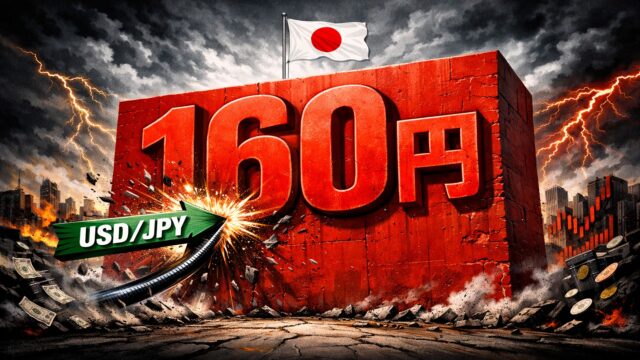
Next important is the explicit ceiling at 160 yen.On January 23, there was a rate check coordinated by the U.S. and Japan, which saw a sharp drop from the upper 159s to the low 152s.
Remarks by Simura, the finance official, about “high alert and close watch,” Katayama, the finance minister, about “ready to talk even on Monday if needed,” and Kishihara, the chief cabinet secretary, about “concern over sudden moves” continued, forming a market-wide recognition that “going beyond 160 yen is dangerous.” Even without actual interventions, the mere possibility acts as a strong deterrent.
? The collaboration between Katayama and Bessent
At the center of this market is the collaboration between Finance Minister Katayama and U.S. Secretary of the Treasury Janet Yellen (Bessent). Based on their September 2025 joint statement, they have held multiple meetings and share the view that excessive exchange-rate fluctuations are undesirable.The Trump administration did not welcome a strong dollar, i.e., excessive yen depreciation.
If the yen were to depreciate further, it would directly affect the U.S. trade deficit and could spread to Japan’s fiscal deterioration and higher long-term interest rates in U.S. debt markets, which the U.S. side is wary of.In other words, there is an implicit consensus that 160 yen is not a desirable level for either side.
Even in situations where Prime Minister Takaichi’s “Hawkish foreign exchange stability” comments could be interpreted as yen depreciation tolerance, Katayama quickly followed up to quell concerns about fiscal expansion. The impression that the exchange rate is being controlled is born from this ongoing collaboration.

? The U.S. dollar factor and external environment
Moreover, factors on the U.S. dollar side piled on. Weaker-than-expected U.S. retail sales and concerns about slowing consumption led to expectations for lower U.S. rates and dollar selling. Additionally,President Trump views dollar strength (yen weakness) as a contributor to a widening trade deficit and has maintained a stance of restraint toward Japan.
Given past tariff tightening and dollar-weakness-oriented rhetoric, there is a framework where excessive yen depreciation invites U.S. dissatisfaction. The Takaichi administration’s aggressive fiscal stance (e.g., tax cuts) raised concerns about yen depreciation, but the implicit coordination between U.S. and Japanese authorities (including rate checks) created a conducive environment for coordination.Under the Trump administration, tolerance for yen depreciation toward Japan was limited, and there were voices warning that Japan’s fiscal deterioration and rising long-term rates could spill into the U.S. Treasury market.
As a result, the U.S. side tends to brake around the 160 yen vicinity, and even with residual U.S.-Japan interest-rate differentials, there is awareness of political and diplomatic upper bounds. This trend of dollar weakness helped support the yen.

? Why is stock price still rising?
On the other hand, why are stock prices so strong? The reason is relatively clear. With the LDP’s two-thirds majority, policy execution power has surged.Accelerated investment in “17 strategic sectors” such as AI, semiconductors, defense, and shipbuilding is spreading, and overseas investors are valuing Japanese stocks.JPMorgan Chase suggested the possibility of as much as 10 trillion yen of overseas fund inflows over three months, implying a premium for policy continuity.
Historically, after the LDP’s landslide victories in 2005 (Postal Election) and 2012, stock prices remained high.Resolving policy uncertainty itself is a positive factor for buying. Additionally, the Takaichi administration’s fiscal stance was “surprisingly pragmatic.” On tax cuts, it was stated that fiscal expansion would be avoided with reliance on deficit-financed bonds, ensuring funding for two years and aiming for a mid-year consensus before summer.
While the landslide enabled bold policy execution, fiscal discipline was also emphasized, reducing the incentive for continuous aggressive yen selling.
? Orcan and Japan’s mid-to-long-term scenario
In the mid-to-long term, a plausible scenario is an increasing share of Japanese stocks in MSCI ACWI (the so-called All-World index).From 2025 onward, there will be more instances where the Nikkei average outperforms MSCI ACWI and the S&P 500, highlighting Japan’s stock performance advantage.
With governance reforms, stronger shareholder returns, and growth hopes in AI, semiconductors, and defense sectors, Japan’s stock market capitalization share is rising globally. Since MSCI regularly adjusts weights based on free float market capitalization,if ROE improves and share buybacks raise free float value, Japan’s weight naturally increases.Currently, it is generally around 5–6%, but if stock prices stay high, it could exceed 7%.
Additionally,if the All-World index attracts substantial passive funds through the new NISA program, funds will be automatically allocated to Japanese stocks via index rebalancing, potentially creating a virtuous circle of stock-price rises, market capitalization expansion, and weight increase.
In 2026, some expect the Nikkei to rise above 60,000, which would further raise Japan’s prominence within the All-World index.

? Focus going forward and range observations
Going forward, the focus will be on U.S. jobs data, CPI, the March BOJ meeting, U.S.-Japan summit, and concrete steps for tax cuts. For the time being, exchange rates are likely to move around the 153–157 yen range, with 160 yen remaining a political and intervention-related ceiling.While the structural yen depreciation factor due to U.S.-Japan interest rate differentials remains, cooperation between the U.S. and Japan and intervention vigilance should prevent extreme yen depreciation from reemerging.
In the coming period, the key is whether additional funding measures are shown during extraordinary sessions and the FY2026 budget discussions; the scale and method of tax cuts will cause long-term interest rates and exchange rates to react. If fiscal discipline is maintained, there is a possibility of continued yen appreciation pressure, though debates may see 1–2 yen moves in a single day.
Stock prices remain supported by policy expectations, but headlines can cause larger fluctuations, so the market is likely to stay sensitive and unstable for a while.

? Designed landing rather than unexpected
The market’s initial expectation of “Takaichi’s landslide = faster yen depreciation” was overturned by a combination of factors: the retreat of speculators, the clear ceiling at 160 yen, cooperation between U.S. and Japanese authorities, and a grounded fiscal path.The result is a landing where yen depreciation is restrained and stock prices are sustained—an outcome that carries no obvious negatives.
The 160 yen level functions as an effective ceiling, and within this framework of intervention vigilance and U.S.-Japan cooperation, speculators find it hard to re-build yen-selling positions. Meanwhile, the policy execution premium from the LDP’s two-thirds majority remains intact, and overseas investors continue buying Japanese stocks. Even in a yen-strengthening phase, exporters’ earnings remain in positive territory, and the risk-on climate remains intact.
Many observers also see Katayama’s diplomatic skill—close coordination with the United States and precise market warnings—as shining through.As a result of safeguarding currency stability with a responsible pro-active fiscal policy, the market has remained calm. The focus now will be the March BOJ meeting and concrete steps for tax cuts, but as long as this cooperative framework continues, a drastic yen depreciation is unlikely.
Overall, it can be said that a soft landing designed by policymakers is being realized.How far could you have predicted this market?
Practice and verify freely with a completely risk-free trade simulator!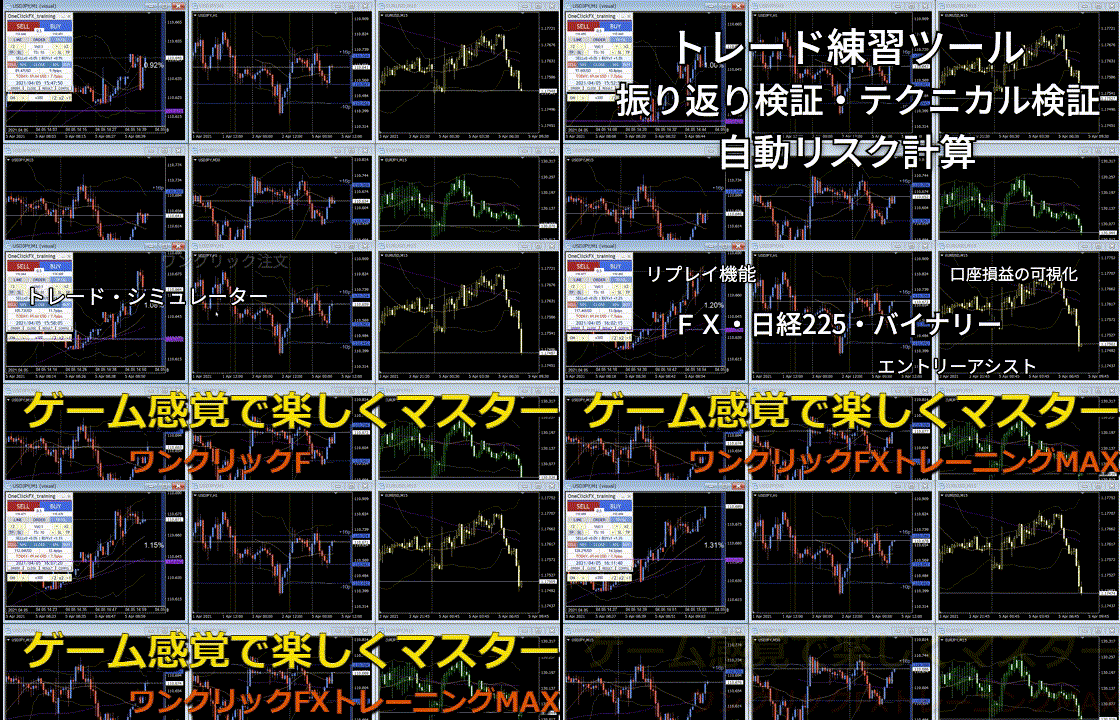
Details page for One-Click FX Training MAX