

Was the rumor that Japan-US coordinated intervention was fake? Yet the market moved! Exploring the dollar-yen around the election.
Regarding the rumors of “US-Japan coordinated currency intervention” spreading in late January, the latest data released by the Ministry of Finance confirms that no actual intervention was carried out.According to the monthly report compiled under Finance Minister Satsuki Katayama, the actual currency intervention from the end of December 2025 to late January 2026 was zero.
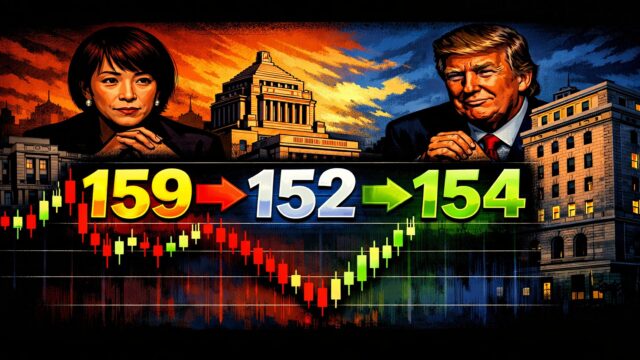
The sharp appreciation of the yen from the 159 yen level to the 152 yen level was not actually the result of dollar selling and yen buying, which is the first point to clarify.

? Why did the market move so much? Rate checks and psychological effects
So why did the market move so much? The background was rate-check observations and the psychological impact stemming from discussions about involvement by the Federal Reserve Bank of New York.
U.S. Treasury Secretary Janet Yellen? (Note: This likely refers to a U.S. official; translated as) Scott Bessement? (If this is a name in Japanese text, render as is) has clearly denied U.S. intervention in the currency market, and the market widely views U.S.-Japan coordination as limited to deterrence and coordination.
The fact that the yen could be temporarily restrained without actual intervention demonstrates the message effect on the Katayama Finance Minister and the Ministry of Finance side.

? Current levels and market expectations before the election
The yen is gradually weakening back toward the 154 yen range,it is unlikely to spike to 160 yen before the election, and around 157–158 yen seems to be a reasonable reference point.
However, depending on the election results, the yen could accelerate its depreciation again. There was no actual intervention, but the market was sufficiently unsettled.
⚠️ Precautions before and after the election and trading stance
Market conditions around the election are highly uncertain, and unexpected factors tend to emerge.Depending on how scandals or election outcomes are perceived, the USD/JPY could swing up and down rapidly in a short period.
The idea of aiming for profit from price swings is understandable, but larger moves also mean larger losses at the same speed. Rather than forcing positions, it is advisable to prioritize risk management, such as constraining position sizes and defining clear stop-loss criteria.
Practice and verify freely with a completely risk-free trading simulator!
Details page for One-Click FX Training MAX