

Was there a Japan-US coordinated intervention? Is the NY Fed rate check and yen depreciation a backing shot for the Takai administration?
“Did intervention come in?” Such a remark spread through the market, and the mood in the currency market clearly changed. After the dollar-yen approached the 159 yen level, it reversed to the 155 yen level almost without a breath.In this unusual speed, many must have felt, “Is this really just market participants buying and selling?” or “Did someone somewhere press a switch?”
Was there actual “live ammunition intervention,” or were there unshown pressures such as rate checks or jawboning that unsettled market sentiment? Moreover, with the moves of the NY Fed, rumors of US-Japan coordination, and a political timetable including Prime Minister Kishida’s dissolution election overlapping, the forex market entered a phase that cannot be fully explained by supply and demand alone.
Was it mere coincidence, or was it intentional restraint? We will read the signals behind the market from the chronological sequence, official remarks, and changes in market psychology.
?What exactly happened on that day? The anomaly of January 23
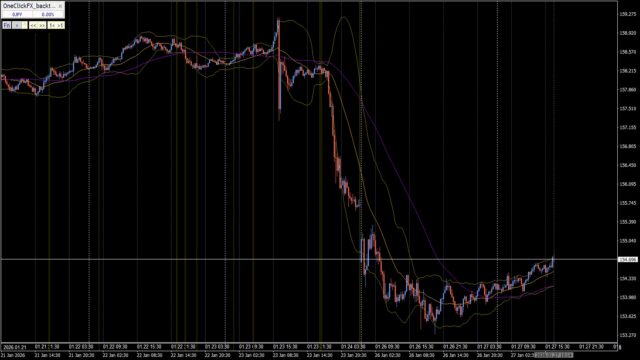
What drew focus was the price movement around January 23, 2026. In the market,From the moment after the Bank of Japan's (BOJ) Monetary Policy Meeting and Governor Ueda Kazuo’s press conference, the dollar-yen moved toward the yen’s depreciation, approaching the 159 levelOn the other hand, shortly afterward it was regarded as having sharply reversed to the yen appreciation. When New York time arrived, the yen reportedly strengthened further against the dollar, reaching around 1 USD = 155.66 yen.
At this point, market attention shifted rapidly to the idea that “this is not just a matter for Japan,” which became a characteristic of this episode.On the same day, the yen was moving toward depreciation (159 yen range) and toward appreciation (155 yen range) in succession, leading many market participants to feel that “normal factors alone cannot explain this.” This feeling formed the basis for observing potential intervention.
?Is live ammunition still to come? The “unseen intervention” of rate checks
The keyword this time is “rate checks.” This is when authorities ask financial institutions, among others, for the price at which they would trade,and is generally interpreted as a signal that there is readiness to intervene in the market.
What matters is that rate checks do not necessarily mean live ammunition intervention. Yet the market moves dramatically becausespeculators and short-term players presume “it may come next” and begin adjusting positionsin advance.
Have you ever suspected that when the market runs suddenly, the bias in positioning rather than fundamentals drives it? This time, observing more rate-check signals alone would suggest a scenario where losses are cut or positions are unwound in a market favorable to such dynamics.

?Why did the United States come into play? The decisive hint of the NY Fed
The rumor of “US-Japan coordinated intervention” intensifiedThe biggest reason is that the New York Federal Reserve Bank (NY Fed) conducted a rate check on the dollar-yen, reported.
The NY Fed functions as a “fiscal agent” for the U.S. Treasury in some respects, and if the NY Fed shows moves to verify rates with market participants, the market infers that “the U.S. side also has some intent.”
The structure of the rumor becomes simple here:
- In Tokyo time, an event at the BOJ (Ueda press conference) leads to a rapid market change
- In New York time, reports of the NY Fed’s rate check coincide
- As a result, a story that “not only Japan but the United States is involved?” tends to form
Coordinated intervention is not a frequently discussed theme, so simply the idea that “the United States moved” can cause the market to react more strongly.

?The weight of “not answering” remarks — Mituhito Mimura’s remarks and the US-Japan joint statement
Authorities typically do not clearly answer whether FX intervention has occurred. This time too, Deputy Finance Minister for International Affairs Jun Mimura said, “I have no intention of answering,” but in a sensitive market, this stance itself is easily interpreted as “not denying = leaving room.”The repeated references by the financial authorities to “excessive volatility” and “disorderly moves” also make the market consciously keep the 159–160 yen vicinity as an informal caution line, making it harder for the market to push higher.
Moreover, the joint statement by Japanese and U.S. finance ministers on September 11, 2025 confirmed that intervention is reserved for addressing excessive volatility, which raises the possibility of coordination. The overlap with the NY Fed rate-check reports created a market environment where the view that “the U.S. and Japan are coordinating to watch for yen weakness” becomes more prevalent.The sense that the U.S. and Japan are coordinating to guard against yen depreciation is rising
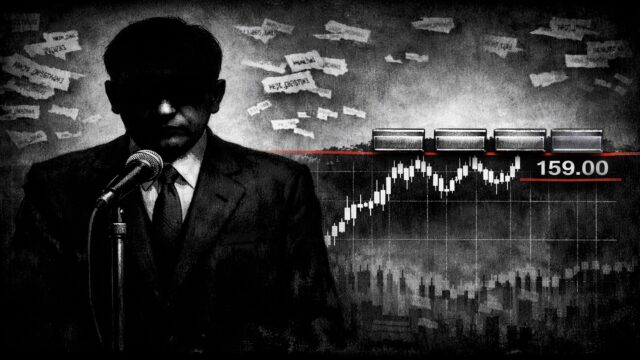
?Who does the United States want? The Kishida administration and the backroom of elections
In discussing this currency surge, political factors cannot be ignored.If the yen weakens rapidly during the election period, it becomes easier to criticize by linking it to rising pricesIn that sense, keeping the market around 158 yen may have helped dampen political backlash.
With the NY Fed’s moves overlapping, some in the market began to think that the U.S. favors the Kishida administration’s stability, but this is better understood as valuing the stability of Japan-U.S. relations and policy predictability rather than supporting a particular administration.After the election, how strong the reaction will be becomes the next focus.
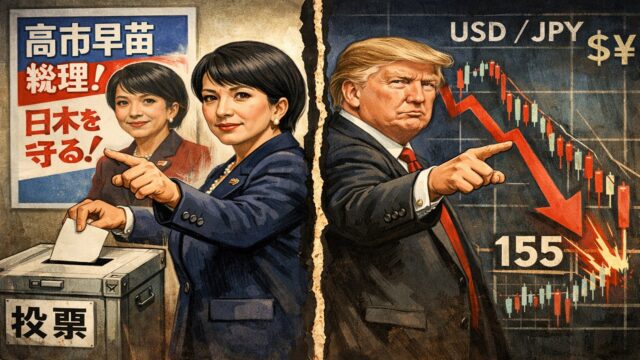
?In the end, whose agenda was at play?
This currency surge is better interpreted as not a phase where live ammunition intervention was confirmed, but rather as a result of rate-check observations and official remarks that prompted the market to anticipate and react ahead of time.The NY Fed’s moves and the existence of the US-Japan finance ministers’ joint statement strengthen the association with “US-Japan coordination,” creating a strong sense of caution around the 159–160 yen area.
As a result, during the election period, extreme forex volatility was avoided, and a structure of “buying time” emerged in both political and market terms. What the U.S. emphasizes is not a specific administration or individual, but the stability of the Japan-U.S. relationship and the predictability of policy.
After the election, if fiscal expectations rekindle, yen weakness could become even stronger, while intervention caution will simultaneously rise.The true test for the market is likely the post-election period that follows. How much do you think this movement was calculated?
Practice and verify freely with a completely risk-free trade simulator!
Details of One-Click FX Training MAX