

If you have any requests, we will add features — adjusting for the Casiopeia public release.

Good evening, this is Taro.
Regarding the ongoing project “Cassiopeia,”
we are moving forward with preparations for release aiming for next week.
⸻
■ Considering the form of release
For me, Cassiopeia has always been built with a consistent main goal of
“fully automatic operation as the main feature.”
However, in terms of how it will be released
• Register as EA (fully automatic operation as the main)
• Register as an indicator with a semi-discretionary tilt (leaving room for discretionary decisions)
We are currently weighing these two options.
The more it is fully automatic, the more its strength lies in being able to work the same in any environment, but
depending on market conditions and currency pairs
• Adjusting running time
• ON/OFF of conditions
• Choice of settlement and filters
these kinds ofcustomizations can directly affect results.
Therefore, should we lean toward “mainly fully automatic with adjustments available for those who need them,”
or alternatively, decide from the start to cater to those who settle trades themselves by treating it as semi-discretionary,
we are at the stage of deciding the final release format.
⸻
■ About the Entry Logic
As for the entry logic,
I feel that among the logics I have built,this is the best,
However, the direction is
a “composite decision-type” formed by combining multiple basic indicators,
designed to sort market phases.
Rather than talking about the inner logic,
I want it to be judged by its behavior and results.
⸻
■ If you have any requests, please contact us
• Hope to release as an EA
• Semi-discretionary is easier to use
• Would like a function like this
If there are people interested or with requests,
we would be glad if you could contact us within the “Trajectory to the Narrow Gap” community.
We will use the feedback as a reference to proceed with release form and final adjustments.
We will continue to share updates as progress occurs.
Thank you in advance.
Past article↓
Yesterday I couldn't monitor the chart in real time because it was during my sleeping hours.
However, upon waking and checking history,the entries and settlements had already completed.
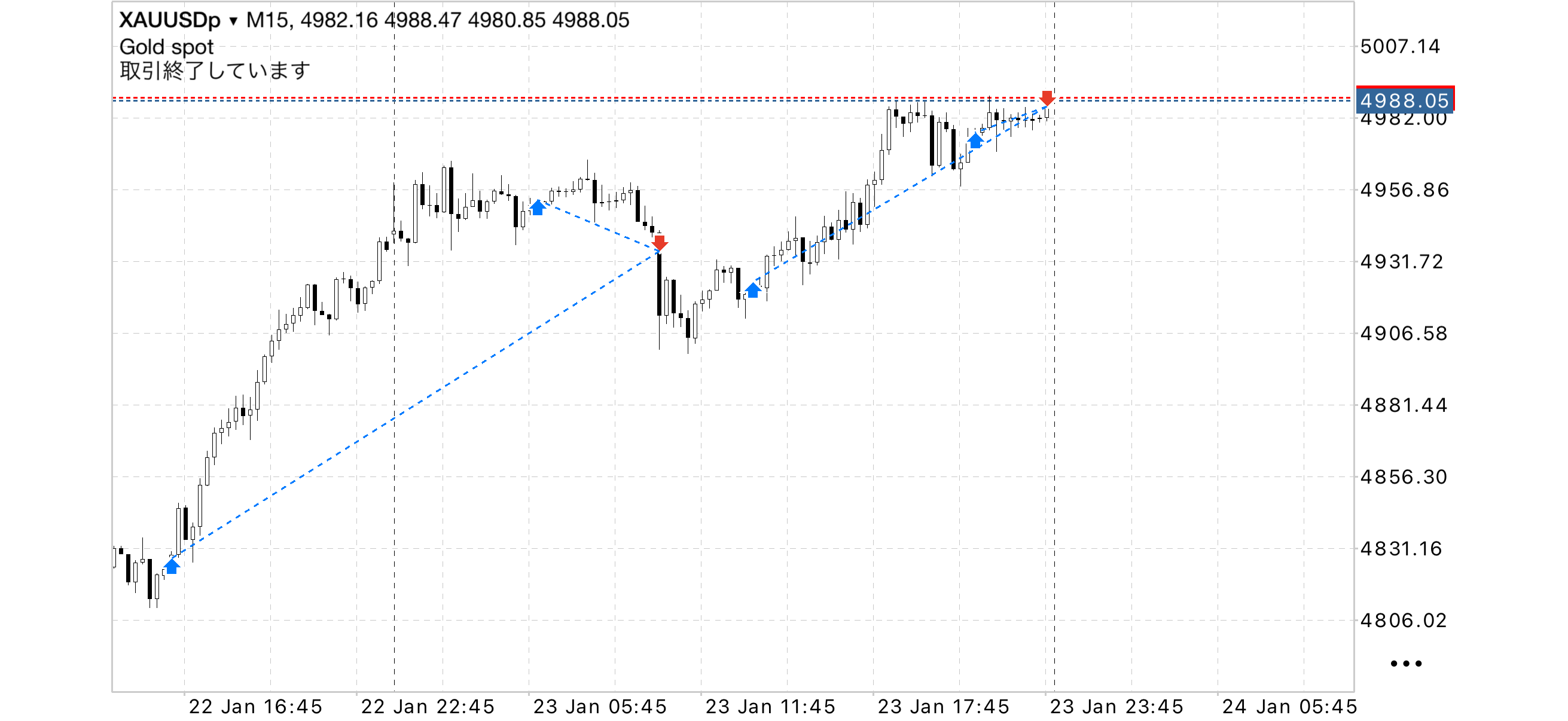
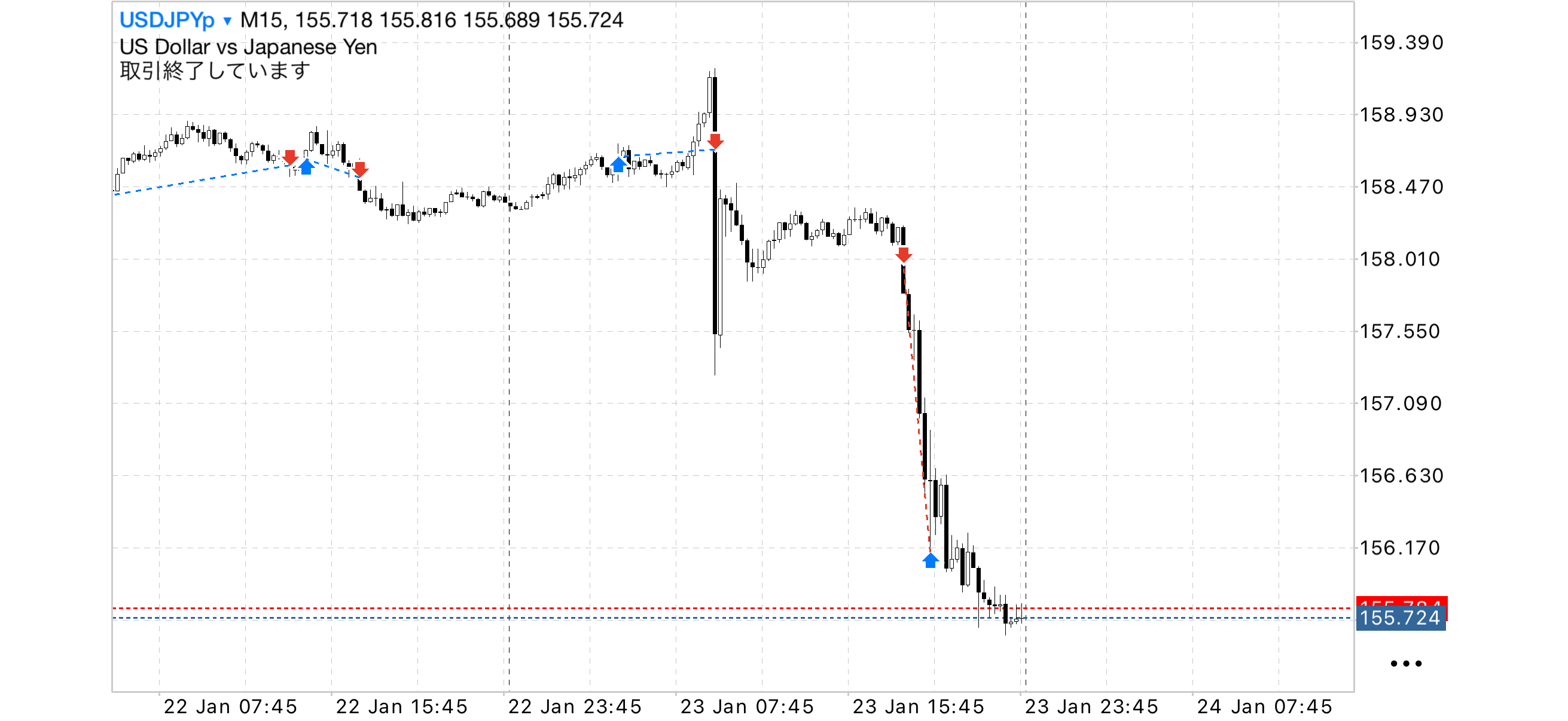
In this operation, basicallythe setting is to settle before the market closes on Friday,so
we avoid weekend risk and calmly capture only the market movement.
When I checked yesterday's GOLD position with that setting,
both USD/JPY and GOLD had entries,
and including the subsequent settlementsthey were processed smoothlyas planned.
+80,000 → +180,000

Being able to confirm such “markets moving while you sleep” is a major advantage of passive management.
Of course, it won't always go the same, but
at least in scenarios with sudden fluctuations like this,
the fact that it behaved as set is a big gain.
Past article↓


Operational design for beginners to keep going without anxiety
■ In this article,
whether it is the same logic with“multiple-position operation” or “single-position operation”, andrisk design including lot managementgreatly affects performance.
In short,
switching to a single-position operation decreased profits, but
that also significantly improved drawdownand made the operation more stable.
Before → After


⟲
■ So far: results of multiple-position operation
In previous tests, we ran with a design that held multiple positions.
Multiple-position operation tends to profit more when the market trend is favorable,
with the strength of “take profits all at once when possible.”


But on the flip side,
when entries accumulate and the market moves against, losses also accumulate.
In this test, the result was
• Drawdown: 17% (about 190,000 yen)
and
the winning periods were strong, but the capital curve became jagged.
⟻
■ Change: switch to single-position + risk management
Thus this time I changed the approach
• From multiple positions to single-position operation
• Strengthen risk management including lot size and number of positions
and ran the test.
Single-position operation is not advantageous in terms of profit efficiency.
Unlike multiple positions, the explosive growth when it happens is reduced.
However, the objective this time was not to maximize profits, but to build a form that does not break down in operation.
⟻
■ Results: profits halved, but drawdown dramatically reduced
As a result of switching to single-position operation,
• Profit is (subjectively) halved
• But drawdown improved significantly
This is the outcome.


Specifically,
• Drawdown: 17% (about 190,000 yen)
and
the amount of capital fluctuation markedly decreased.
This change is more about the mental burden than numbers.
The time spent hoping losses recover decreases,
reducing chances of making hasty judgments.
This is very important from a real-world operation perspective.