

?「What is “the Center”? The gap between Komeito and Constitutional Democratic Party! Does Leader Noda understand the “center”?
Do you notice a big difference between the “centrist” that the Komeito advocates and the “centrist” voiced by Noda, the leader of the Constitutional Democratic Party, etc.? The coallition proposal that has surfaced now emphasizes the easily understandable word “centrist” in the foreground.
However, although they use the same word “centrist,” the centrist advocated by Komeito is an ideology rooted in Buddhist teachings, whereas Noda, who speaks of a centrist that sits between the right and left, speaks a shallow word.By hastily lining things up, the gap in ideals seems to have become more noticeable.
Here, we will separate the “centrists” spoken by Komeito and by Constitutional Democratic Party and Mr. Noda Yoshihiko, clarify their differences, and outline the parts that barely overlap.
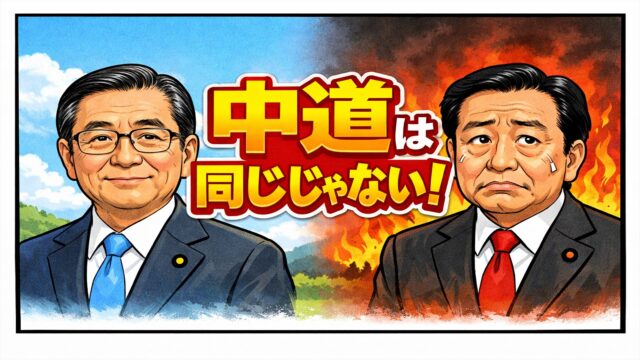
?Komeito’s Centrist — Humanism Based on Daisaku Ikeda’s Thought
Komeito’s proclaimed “centrism” is not a concept referring to a political middle ground between left and right. Its source lies in the Buddhist centrist ideology and humanism advocated by Daisaku Ikeda, the honorary president of Soka Gakkai.
Ikeda has positioned a “third way” as a stance not to be absorbed by opposing ideologies or political systems, consistently prioritizing human life, living, and dignity over the state or ideological frameworks.
This way of thinking in Komeito has been passed down as a pragmatic humanism that aims for an inclusive society by balancing peace and economic stability rather than mere compromises to align divides and conflicts.
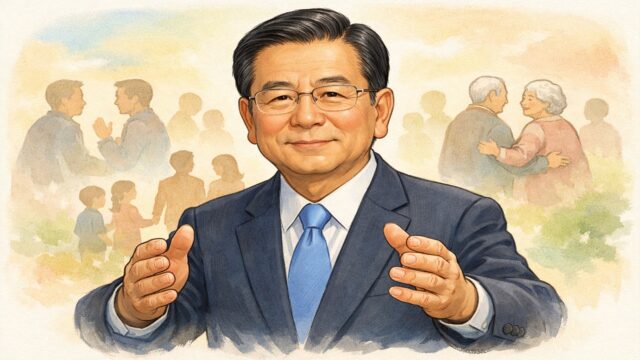
?Constitutional Democratic Party/Noda’s Centrist — Pragmatism as a Political Method
On the other hand, the “centrism” spoken by Noda Yoshihiko of the Constitutional Democratic Party is closer to a stance in political management than a philosophy. Not leaning to the right or left to extremes, it seeks practical solutions through deliberation. That is the sense of centrism.
What matters here is not ideological purity but the process of policy-making and how consensus is formed. How to realistically handle issues affecting citizens’ lives. That is the stance for which “centrism” is used.
In other words, Noda’s centrism is not a declaration of values but an explanation of political technique and posture.
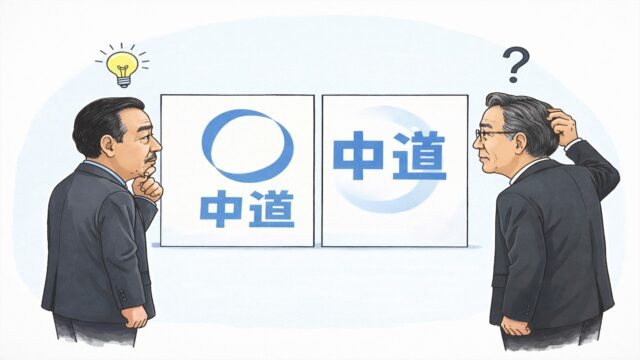
?Where do they overlap?
What they share is a high level of abstraction: “human-centered,” “dialogue-focused,” and “citizen-oriented.” These are concepts that are easy for voters to accept and convenient as a banner for cooperation.However, this alignment is more about direction and atmosphere than deep shared values.
In areas where judgments diverge—such as foreign policy, security, and energy—each centrist view surfaces directly. There are common points, but that does not mean they share the ideological foundation.

?Gaps in Ideology Covered by the Same Word
Komeito’s centrism stands on the axis of humanism rooted in Ikeda’s thought. Meanwhile, the centrist of the Constitutional Democratic Party and Noda is centered on a stance of political management that emphasizes deliberation and practical responses. They are described by the same word “centrist,” but their inner substance is clearly different.
If one were to position themselves as the only true centrist and tilt toward rhetoric that excludes opponents, it would clash with the inclusivity and spirit of dialogue that true centrism embodies.
The impression that this coalition is hurried likely comes from not having fully organized and shared these ideological differences before campaign responses. Whether this gap can be overcome or remains a temporary collaboration remains to be seen. Going forward, the content itself will be questioned.
Practice and verify freely with a completely risk-free trade simulator!
Details page for One-Click FX Training MAX