

LDP's big victory in sight, with unexpected stock rise and yen depreciation as well. Traders should watch out for intervention!
As the possibility of a dissolution election becomes realistic, the market mood has already started to move. Political topics typically seem distant from stocks and foreign exchange, but this time the situation is a little different.
With high support for the Takai administration, expansive economic policies, and the opposition parties' discord, these factors have overlapped to make“Liberal Democratic landslide → rising stocks and weak yen”a plausible scenario.What lies ahead beyond that?

?Stability of the Takai administration and election prospects
Currently, the Takai administration enjoys a high cabinet approval rating and a strong presence on the diplomatic front.Gasoline tax cuts, utility subsidies, revisions to the so-called 1.03 million yen income ceiling, free school meals, and year-end subsidies, among other household support measures, leave little to push down the approval rating.
On the other hand, the opposition side is discusses new structures like the Center-Right Reform Coalition, but overall lacks unity, making election strategy unclear.
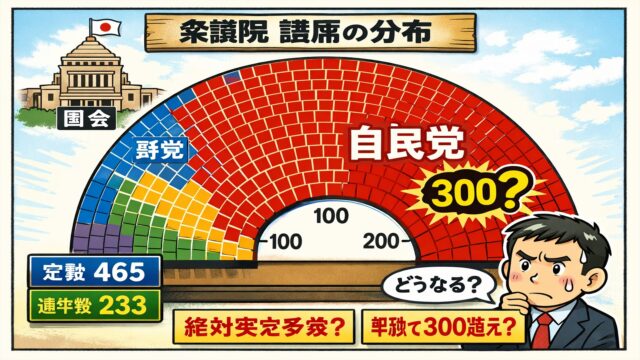
?“300 seats” a dream or reality?
The prospect of the Liberal Democratic Party winning 300 seats sounds bold. However, this number does not mean it will be achieved unconditionally; it symbolizes an atmosphere in which it is not fantastical to consider that possibility.
Realistically, a range of about 260–280 seats is often cited, but if the opposition remains fragmented and the ruling side can adjust districts effectively, a landslide scenario could become visible.
?Takai trade and market reaction
Against this political backdrop, the so-called “Takai trade” is being considered. With expectations for expansionary fiscal policy, the stock market remains firm, and sectors such as export-related, defense, and semiconductors tend to be favored.
At the same time, the FX market is experiencing a weakening yen, with dollar/yen approaching the 160 level.The election and policy expectations are jointly supporting near-term stock gains and yen weakness.
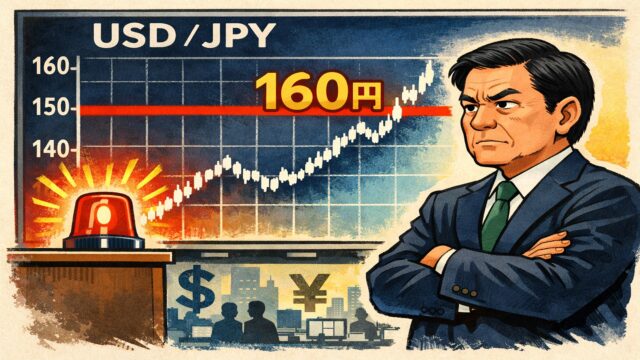
? About to hit 160 yen, will intervention occur?
However, a weakening yen is not welcomed unconditionally. The market’s greatest concern is currency intervention.The government and financial authorities care less about the level itself and more about “sudden and one-sided moves,” but the psychologically and policy-wise important threshold around 160 yen is strongly watched.If the yen continues to weaken sharply in a short period, the likelihood of actual intervention rises dramatically.
? Realistic perspective for traders
If intervention occurs, a short-term sizeable rally in the yen (yen appreciation) can be expected. However, unless fundamental factors like interest rate differentials and fiscal expectations change, the overall trend may not reverse.
In other words, while being mindful of rising stock prices and yen weakness, the FX market remains in a state that always carries an “intervention as an abrupt event.”介入という不連続なイベント

?Summary: Finance Minister also continues supply-side rhetoric
As dissolution election approaches, the view that the Liberal Democratic Party will win big is by no means a minority view. While that expectation begins to show in the market as stock gains and yen weakness, the risk of intervention quietly rises as the 160 yen threshold approaches.
Finance Minister Katayama has repeatedly warned about forex movements, and the market has already entered a phase of verbal intervention.In a period where politics and markets are closely linked, it becomes increasingly important to remain calm and assess not only the trend but also the underlying risks behind it.
The more momentum there is,the more likely intervention can occur after a lull, leading to large losses.That is something to always keep in mind.
Practice and verify freely with a completely no-risk trading simulator!
Details page for One-Click FX Training MAX