

Cryptocurrency Market Analysis [December 30]
Time flies, and this year’s article is also the last one.
In 2024, when President Trump was born, the cryptocurrency market attracted a large inflow of funds, and prices rose significantly, becoming lively. In 2025, regulations and bills regarding cryptocurrencies progressed, and the infrastructure steadily became more complete.
Currently, precious metals and stock prices are rising, but despite the overall rise in financial assets, the cryptocurrency market remains stagnant since the big drop in November (although some privacy-focused currencies have surged). In terms of competing for the share with existing fiat currencies (existing finance), precious metals and stock prices may have been prioritized.stagnant since the big drop in November (although some privacy-focused currencies have surged). In terms of competing for the share with existing fiat currencies (existing finance), precious metals and stock prices may have been prioritized.
Nevertheless, the role that the cryptocurrency market plays in society—thanks to the reliability of blockchain so far and the development of infrastructure—seems to be bigger than ever. The United States is trying to regain the dominance of the dollar by utilizing stablecoins, and in the sense of riding the flow of the U.S. economy, the cryptocurrency market may be positioned as mainstream.
Even after the market slowed in the latter half of the year, some subscribers have continued, and since Japan’s cryptocurrency taxation moved to separated taxation, some people became interested in cryptocurrencies and subscribed anew, making me feel more than ever the significance of this article.
In the coming year, while praying that it will be a good year for the cryptocurrency market, I would like to consider this article as a final greeting for this year.
1.Year-end market overview and movements of major cryptocurrencies
The rise seen briefly before Christmas has settled, and the market as a whole is moving mildly in the quiet trading environment typical of the holiday season.
Looking at the movements of major assets, Bitcoin (BTC) fell below the psychological threshold of 8000, and Ethereum (ETH) also dropped to just under the 3000 level. This week’s gains and losses show many large-cap stocks down 1% to 3%; Dogecoin (DOGE) and Cardano (ADA) declined even more, both down about 8%.
In the ETF (exchange-traded fund) landscape reflecting investors’ behavior, on December 24 BTC and ETH ETFs saw net outflows. In the cryptocurrency market overall, total outflows reached $4.46 billion, with the breakdown as follows:
- Bitcoin (BTC): about $444 million outflow
- Ethereum (ETH): about $59 million outflow
- Ripple (XRP): about $70 million inflow
- Solana (SOL): about $7.5 million inflow
While XRP and SOL have seen some buying, Bitcoin’s large outflow is weighing on the entire market.
2.Macro economic environment and a contrast with the commodities market
The U.S. third-quarter real GDP released on the 23rd exceeded market expectations, reinforcing the impression of the U.S. economy’s resilience. This strong economic indicator should have been positive for risk assets, but this time it only served as a tailwind for U.S. equities and the commodities market.
In particular, the precious metals market has been incredibly strong, with gold rising for two consecutive business days and silver reaching new all-time highs for three consecutive days. However, such macro favorable factors have not fully spilled over into the crypto market. Bitcoin price continues to fall, and ongoing outflows from physical ETFs have become a direct selling pressure.
Looking at the long-term cycle, next year corresponds to the period after Bitcoin’s halving cycle, historically believed to be the weakest year, the year after next. This anomaly being in mind may also contribute to cautious buying.
3.Technical analysis: the current state of BTC and ETH
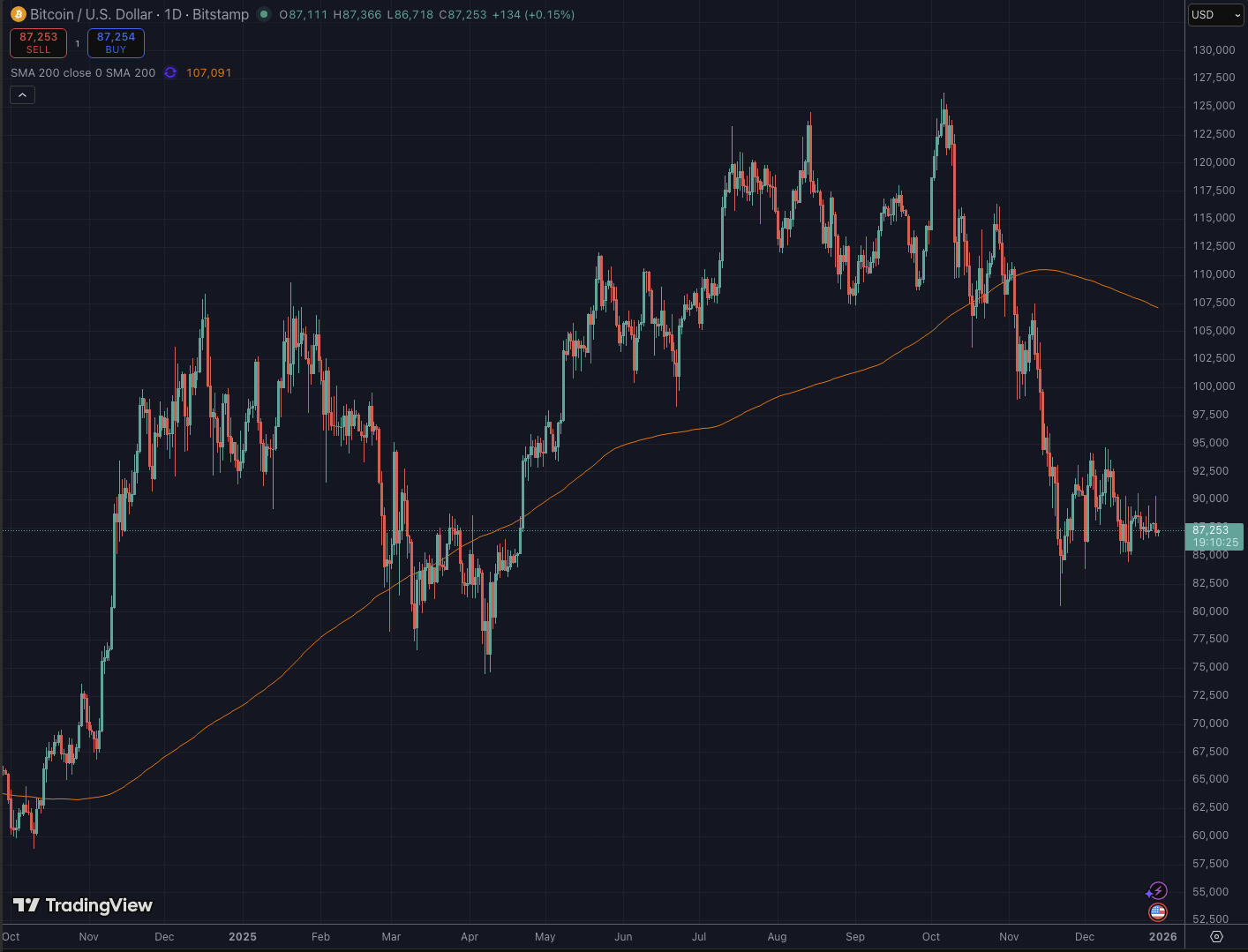
A detailed analysis of Bitcoin’s chart shows that after the fall from late November and a rebound, it is currently in a consolidation around the 87,000-dollar price range. Notably, it remains well below the long-term trend indicated by the 200-day moving average (orange), indicating a continued technically bearish dominance.
For Ethereum, like Bitcoin, price action is converging around the important level of 3,000 dollars. The market tends to have extremely low liquidity from Christmas to New Year’s, and volatility is suppressed. However, low liquidity means that large orders could push prices unexpectedly in one direction when they do occur, so caution is warranted.
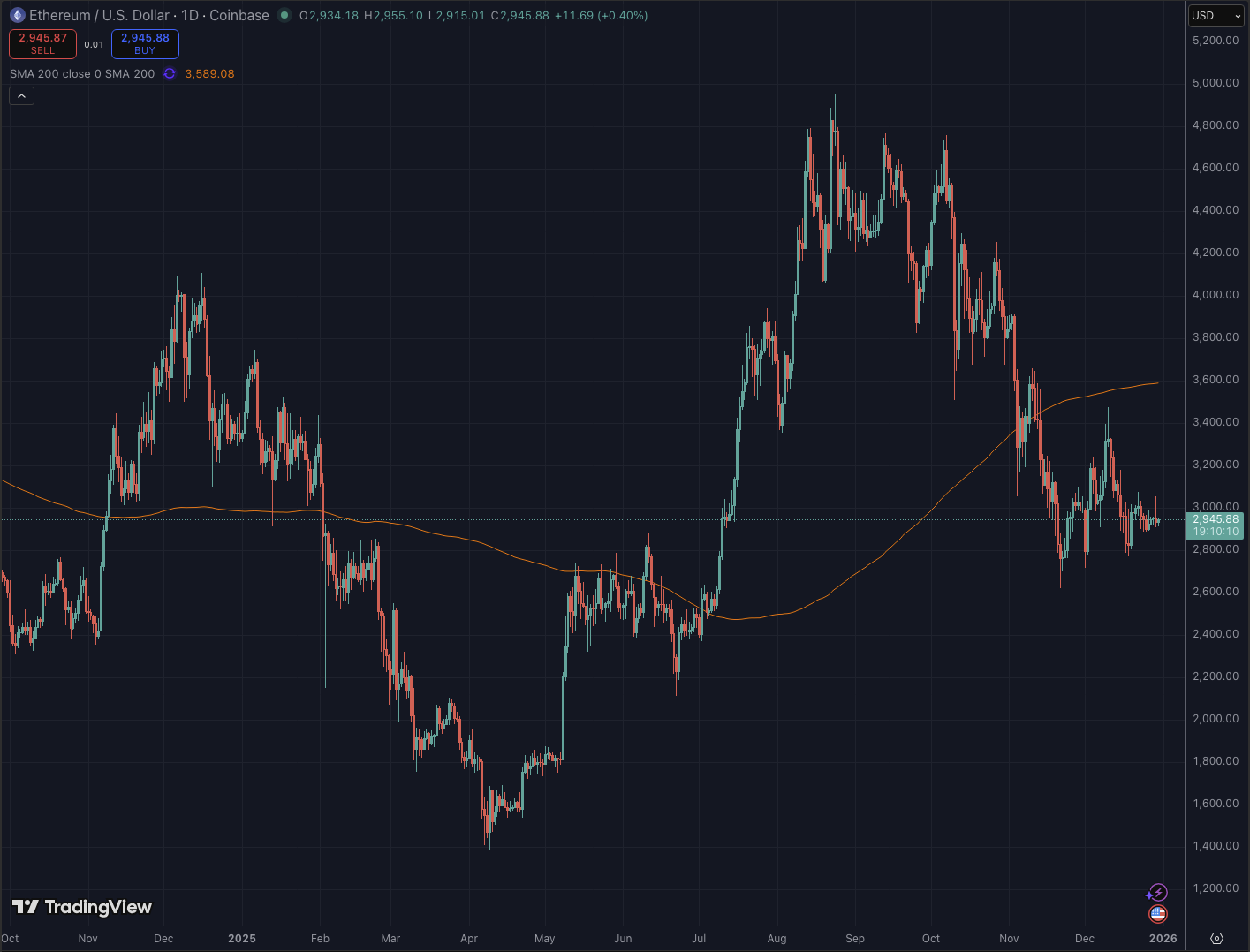
Also, Ethereum’s 200-day moving average is closer to the current price than Bitcoin’s, suggesting somewhat stronger potential for a rebound for Ethereum.
4.Volatility in the precious metals market and the rise of silver
On the other hand, the precious metals market saw sharp profit-taking selling and briefly turned broadly lower. The intraday lows show the following moves:
- Gold: -3%
- Silver: -7%
- Platinum: -12%
- Palladium: -15%
Such sharp fluctuations reflect the enormous buying orders that gathered in a short period. Going forward, larger price moves are expected, but silver’s price trend appears relatively steadier.
5.Market sentiment and outlook for 2026
Bitcoin’s Fear & Greed Index is currently very low. The market has been in “Extreme Fear” for two consecutive weeks, with today’s index recorded at 23. The majority of December has hovered in this bottom range, and investor sentiment is clearly cooled.
Against this backdrop, opinions on Bitcoin’s outlook for 2026 are sharply divided among experts.
- Bullish view: PlanC argues that historically there has been no two-year down cycle in a row, and next year will surely rebound. Also, Matt Hogan, CIO of Bitwise, remains bullish.
- Bearish view: Veteran trader Peter Brandt and Fidelity Global Macro Chief Julian Timmer insist next year will be a “stagnant year,” pointing out the possibility of a drop from $60,000 to around $65,000.
In other words, it is very difficult to predict whether it will be a low year following the four-year cycle or whether liquidity will be added by the FED’s rate cuts, overwriting the cycle and inviting inflows.
(Since its launch in 2016, this report has consistently delivered at the forefront of the market)