

Translate the following HTML to English, keeping the HTML format, no Markdown, and do not insert line breaks. Decode standard entities before translating. Original: ?植田日銀総裁「利上げしたのに円安?」年末相場の違和感と為替介入の現実味 Translated: Ueda, Bank of Japan Governor: "Interes
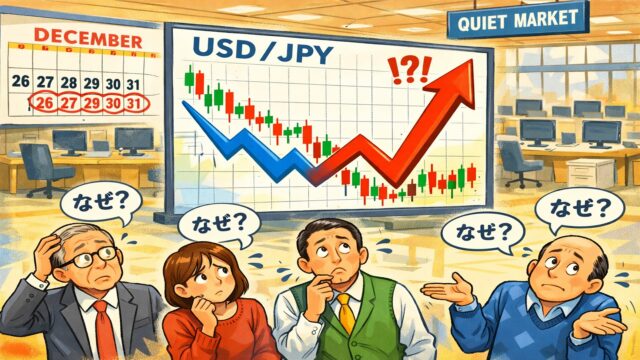
The year-end FX market tends to be less logical than usual, but this December has moved in a way that resembles a symbol of such behavior. If the Bank of Japan were to raise rates by 0.25%, one would normally expect a “yen appreciation.”However, in reality the USD/JPY has swung strongly in the opposite direction, and looking only at the chart, it seems as if policy judgments have been completely ignored.
This gap is precisely the difficulty of the current market, and at the same time its fascination.End-of-year thin trading, speculative momentum, intervention expectations, and the distances between policy authorities—all of these complicate the market, leading it to behave one step outside textbook expectations.Is the current yen weakness a transient distortion, or a waypoint to a new level? As the new week approaches, it would be helpful to整理 this sense of unease.
Completely risk-free trading simulator to practice and verify freely!
? Even after rate hikes, yen weakness—this sense of incongruity
The Bank of Japan delivered the 0.25% rate hike as scheduled. Purely logically, one might expect the yen to strengthen, but actual FX moved sharply in the opposite direction, ending December 19 (Friday) with USD/JPY at 157.75.
Even with a textbook-like rate hike, the result was the exact opposite. Many market participants must have felt a strong sense of incongruity.

? End-of-year thin trading and the setup of speculators
This movement is less about fundamentals and more about the market's low liquidity typical of year-end,where speculators tilt positions in one direction.In a low-participant environment, the ease of maneuvering a stance moves the market more than the quality of the news. In that sense, “speculators’ playcan aptly describe the situation.

? Is 160 yen possible? A fork in the road for Monday morning
If the market opens the week with the current dynamics, liquidity is expected to return and more measured pricing may resume. However, if speculators continue to build yen-selling momentum in this flow, a temporary move above 160 may not be completely denied.
If that level is reached, expectations of FX intervention will quickly come into focus.On the other hand, it is unclear whether Governor Ueda will immediately issue a strong message, and a cautious stance that does not excessively provoke the market may be taken.
? The cautious voices on rate hikes and the practical meaning of yen weakness
Takahashi Yoichi has long argued that “now is not the time to raise rates,” and Prime Minister Takaichi initially made similar statements. As a result, the yen’s depreciation has become a significant profit opportunity for exporting companies.
Move away from easy price-cutting competition based on currency swings, and fight in foreign markets with bold pricing, returning those profits to the domestic market.If such a trend spreads, this yen depreciation may not be a bad thing after all.
? How should traders respond
At minimum, it is clear that year-end markets have become harder to read. In such a situation, experienced traders tend to refrain from forcing participation and instead observe, while those who base trades on price movements may view it as a highly speculative market.
However, even in that case, risk management capable of withstanding a sudden 5-yen move and rigorous mechanical stop-loss discipline are prerequisites.Year-end markets are opportunities but also moments where one can be taken away in an instant if not careful.
As a yearly wrap-up, aiming for a dramatic reversal might be part of the year-end market charm, but moderation could be preferable.
Completely risk-free trading simulator to practice and verify freely!
Details page for One-Click FX Training MAX