

?China Collapse Scenario and the Shocking Answer Led by AI! A Desperate Future for China and What Japanese People Can Do to Survive
Is China headed for collapse now, or will it endure a century in cold silence――? If you ask AI about the fate of this country, what future picture do you think would be drawn?If you hear the AI's answer, your spine would surely feel a little colder.
There is no “freedom” or “revolution” there; only a forecast of a looming shadow quietly sweeping toward Japan. It’s not like the Soviet Union breaking apart bringing peace, nor does Xi Jinping's downfall lead to democratization.
What AI derives is a far more realistic and despairing answer, and it is...
? Diagnosis: Almost zero chance of a Soviet-style “split”
The first question was,“Will China be split like the Soviet Union?”to which AI fairly clearly concludes that “Soviet-style split scenarios are not realistic.” The Soviet Union was a federation of 15 republics, each with its own constitution, official language, and party organization, and legally possessed “grounds for independence.”
On the other hand, China is largely designed as a single nation with the Han ethnicity making up about 92% of the population, and regions like Xinjiang, Tibet, and Hong Kong, while boasting slogans like “one country, two systems” and autonomy, are effectively governed centrally from Beijing.
Most importantly,the People’s Liberation Army is not “regional forces,” but “the party’s army under centralized party management.”Because there is no structure where local forces declare independence as in the Soviet collapse, AI estimates the probability of China splitting into multiple states as “less than 0.01%” based on a very low likelihood. How do you feel about this assessment?
? Risks of “freezing” and “rigidity” rather than “independence”
Then what about “partial regional independence” rather than full “split”? AI evaluates the future of regions like Taiwan, Xinjiang, Tibet, and Hong Kong quite calmly. Taiwan is already effectively independent in administration, military, police, and economy, so the likelihood of “independence realization” is said to be 99%, but that is a projection along the current trajectory.
Meanwhile Xinjiang, Tibet, and Hong Kong rely on Beijing for administration and military and police, and the moment they declare independence, risks of tax collection and pension payments stopping are high.AI also presents figures such as “probability of Xinjiang independence succeeding is less than 0.1%, Tibet less than 0.01%,” and notes that except for Taiwan, independence tends to take a form closer to “collapse” rather than true independence.
As a result, the most likely future for China as a whole is not “collapse,” but “rigidification → stagnation,” i.e., the economy and society freezing and prolonging over the long term. Haven’t you ever felt that perhaps it would be more peaceful if they simply split apart?
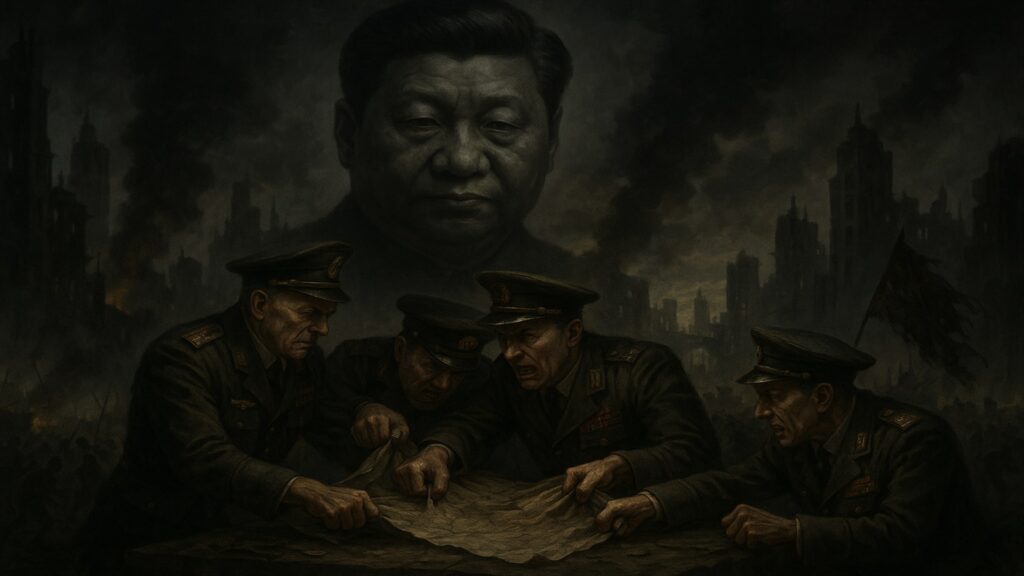
? Xi Jinping downfall scenario and the danger of “warlordism”
In response to the question, “Even if Xi Jinping were to fall, would something change?” AI highlights another risk. For example, a complex scenario where Xi dies suddenly or is assassinated after a failed Taiwan invasion.
If the Central Military Commission chair position becomes vacant, factions within the party—Xi Jinping faction, Jiang Zemin faction, and Communist Youth League faction—could vie for military control, and coups around martial law or Beijing containment could be imagined.However, AI sees the future not as a “military dictatorship,” but rather as a pattern where war zones act independently in different regions—a fragmentation of the military districts
The Northern Theater Command would control the capital and the northeast, the Southern Theater Command would control Guangdong and Hainan, and the Western Theater Command would control Xinjiang and Tibet, all under the pretext of “protection,” increasing the risk of a warlord-style civil war close to the 1930s.
? Why are “independence” dreams in Xinjiang, Tibet, and Hong Kong considered illusory
What stood out in the discussion was the calm evaluation of the difficulty of independence for Xinjiang, Tibet, and Hong Kong across five axes: administration, military, police, economy, and international recognition. Xinjiang has energy resources, but its finances depend on transfers from Beijing, and if subsidies from the central government stop, salaries for civil servants the following month and pension payments may become difficult.
Tibet already has a small population and weak economic base; it does not have its own military or police force. Hong Kong, while a financial hub, relies on the mainland for defense and security.Furthermore, the international community remains cautious about departing too far from the “One China” principle, making full independence unlikely to receive broad recognition.
Past incidents like Lhasa riots or the Urumqi events have been contained through internet blackouts and the deployment of security forces, underscoring the reality that citizens’ hopes alone cannot sustain national governance. How much of a gap between hope and reality can we face head-on?
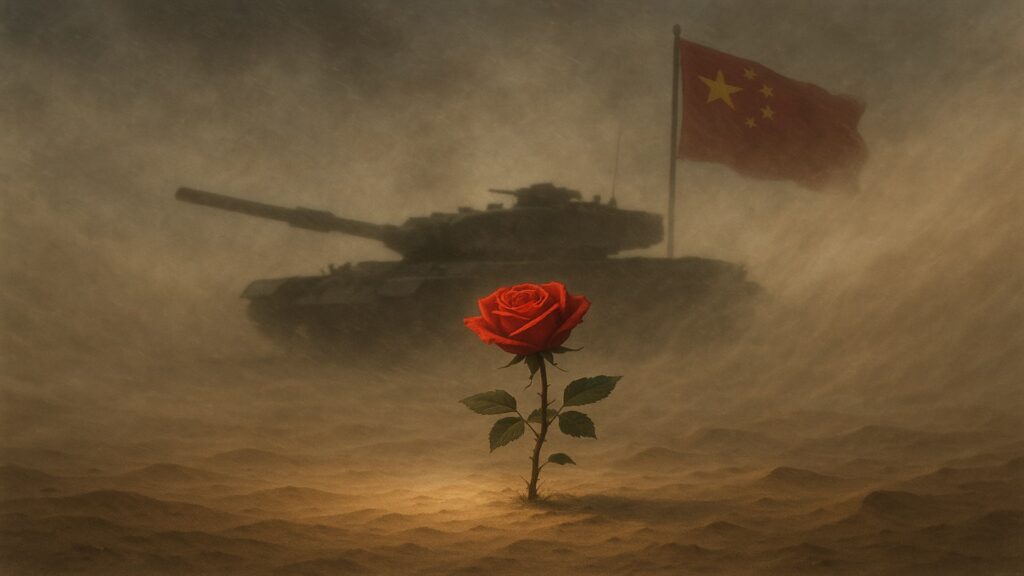
? Why is democratization seen as a “rose in a desert”
Then,what about the widely hoped-for path of “Xi Jinping falls → democratization”?Here too AI assesses quite harshly from the perspectives of history, institutions, and talent. After the 1911 Xinhai Revolution, civil war among warlords led to the Nationalist dictatorship; after the 1989 Tiananmen Square incident, democratic movements were crushed by tanks, resulting in a return to “reform and opening up + single-party rule.”
The Jasmine Revolution wave around 2011 was also blocked by internet shutdowns. Systemically, the PLA is positioned not as the state’s army but as the party’s army in the constitution, with a pledge of loyalty to the party at enlistment.
Moreover, the party's Organization Department holds the power to appoint officials nationwide, and AI notes a structure where even elections yield only Communist Party members as candidates. Considering the history of reformists and democrats like Hu Yaobang, Zhao Ziyang, Liu Xiaobo who were sidelined, jailed, or exiled, AI concludes that the chance of a Gorbachev-like reformer arising is extremely small.
The overall probability of democratization is as small as “one in five hundred thousand” and is described as a miracle of roses blooming in a desert.Whether to lean toward optimism or confront the data frankly is up to the reader.
? The waves that flood Japan and the quiet wall idea
In the latter part of the discussion, the topic shifts to how China’s internal dynamics could affect Japan. With slowed growth and a real estate bubble bust, the middle class’ assets erode and youth unemployment remains high, leading to increased interest in emigration, especially to neighboring countries like Japan.
There are already around 800,000 Chinese residents in Japan, with more students and visa applications. Of course, circumstances vary by individual, but AI suggests calmly that Japan should assess how much a large influx would burden society.Specifically, issues include de facto economic immigration via tourist visas, unified front operations and spy risks in strategic industries, and expanding influence through investments in real estate and infrastructure.
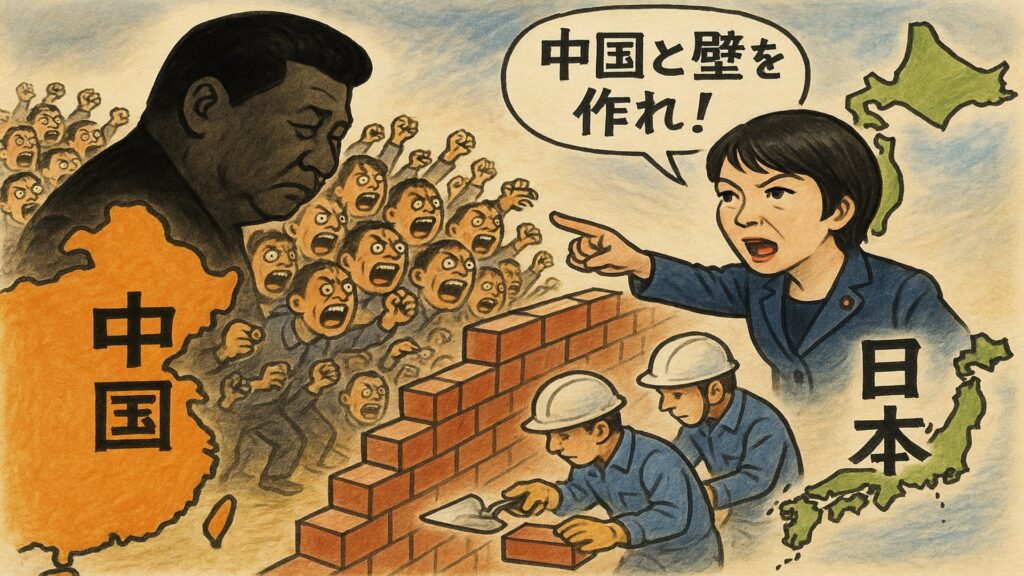
? Summary: what does AI advise the “wall” to mean?
Looking back on the discussions, AI’s vision for China’s future is not “collapse” or “revolution,” but a heavy, slowly rotting giant prison state. While shifts like Xi Jinping’s downfall or failed Taiwan invasion are possible,AI asserts that they are extremely unlikely to lead to freedom or democratization.
Rather, the chain of warlordization, refugee flows, and economic collapse could threaten Japan as well. At such times, should Japan stand as a neighbor sharing values or distance itself as a security risk, or find a middle ground?
AI’s conclusion was brutal and clear: “China freezes as a prison state, Japan risks becoming a dumping ground for escapees. Build the wall now.”That may not be an overstatement; it could be a pragmatic recommendation to safeguard Japan and its people. Rather than merely debating how China will change, what lines should Japan draw?
How do you, the reader, respond to the conclusion this AI presents?
A completely risk-free trade simulator to freely practice and verify!
Details page for One-Click FX Training MAX