

Trump Visit Fever in Japan! The Era of Prime Minister Takai (Takai?) and the Birth of the Japan-US Golden Line
From October 27 to 29, a 3-day, 2-night visit by U.S. President Donald Trump to Japan included a summit with Prime Minister Sanae Takahashi (Takaichi Saya? likely 高市早苗), a signing ceremony, and a shipboard speech in Yokosuka, making for an intense schedule.
In the economic realm, there were successive announcements and reports that, within the overall “80 trillion yen (about 550 billion dollars) in U.S. investment,” roughly 60 trillion yen worth of projects centered on Japanese companies had a clear path forward, highlighting speed.
During this visit, where diplomacy, security, and economics intertwined, what was agreed or confirmed, what progressed, and what challenges remained? Let’s calmly organize it step by step.
?Summit and signing ceremony: “The US-Japan Golden Era”
At the October 28 summit, signing ceremony, and working lunch,
(1) Strengthening the Japan-U.S. alliance (defense capabilities, enhanced deterrence and response),
(2) Economics and trade (transparency in progress of U.S. investment, adherence confirmations of tariff agreements),
(3) Advanced technologies (6G, AI infrastructure, use of power and nuclear energy),
(4) Supply chain cooperation for critical minerals and rare earths,
(5) Collaborative consideration in the shipbuilding sector,
were confirmed. Notably, by adopting the term “US-Japan Golden Era” and outlining practical steps through individual memoranda and fact sheets, it represented a major advance.
?Among the 80 trillion yen of U.S. investment, 60 trillion yen
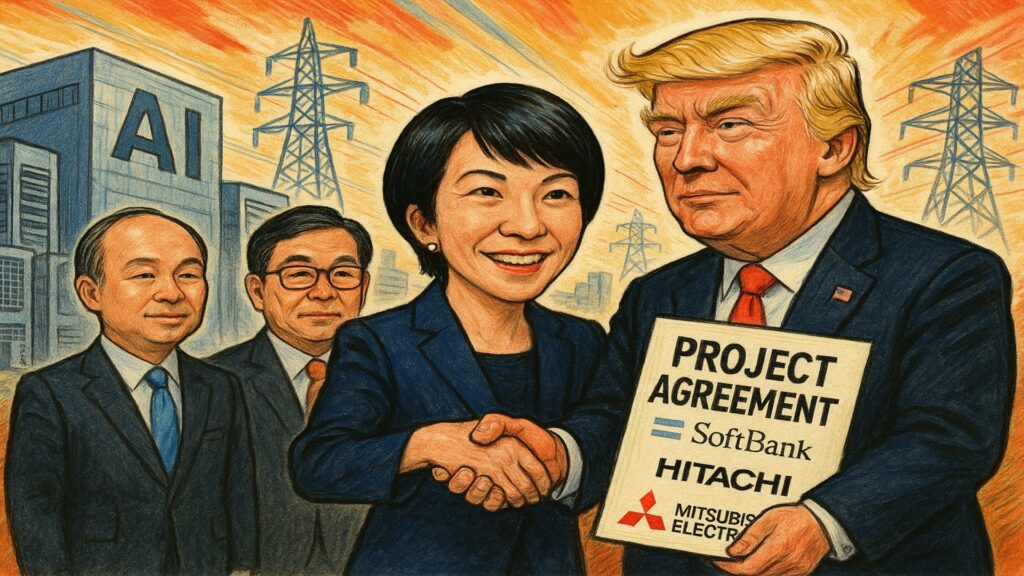
In the economic arena, regarding the previously announced investment package to the United States (total roughly 80 trillion yen), the plan to concretize around 60 trillion yen was clarified.The sectors span: power supply and transmission networks for AI data centers, AI infrastructure itself, reevaluation of nuclear power and related supply chains, energy such as LNG, important minerals like rare earths and nickel, and upgrading manufacturing bases, with prominent involvement by Japanese companies (SoftBank Group, Hitachi, Mitsubishi Electric, Toshiba, etc.).
Of course, there remain “execution barriers” such as final investment decisions (FID) for individual projects, permissions and approvals, and securing sites and power supply, but it is factual that momentum has built up at this speed. Among this investment, which sector do you expect to have the broadest ripple effects?
?Rare earths, critical minerals, and shipbuilding cooperation
Rare earths and critical minerals are foundational resources affecting AI, electronics, and defense equipment. This time, Japan and the United States have advanced toward formalizing an agreement to strengthen the supply chain from mining to refining and recycling.
Additionally, in shipbuilding, the establishment of a “U.S.-Japan Working Group” was announced, with plans to consider roles in building and maintenance capacities that could counter China’s overwhelming shipbuilding ability.
Viewed together with resources, shipping, and shipbuilding, this outlines a framework to reconstruct the backbone of supply chain security in the U.S.-Japan alliance. The challenge will be balancing cost and speed.
?Accelerating the defense spending 2% target
Japan committed to fundamentally strengthening its defense capabilities, including speeding up the achievement of the 2% of GDP defense expenditure target. There is a need for simultaneous expansion of quantity and quality in areas such as ammunition, missile defense, maritime and air capabilities, and cross-domain operations (space, cyber, electromagnetic).
On the other hand, sustainability challenges are evident, such as personnel and equipment maintenance costs, continuity of domestic production lines, and the review of the reserve self-defense force system. The visible deterrence in Yokosuka is symbolic, but steady, practical joint training, joint maintenance, and interoperability are where the core work lies.How to align Japan’s industrial policy with defense equipment transfer (three principles)――This is where private sector participation has room to grow.
?Reconciling with “America First”
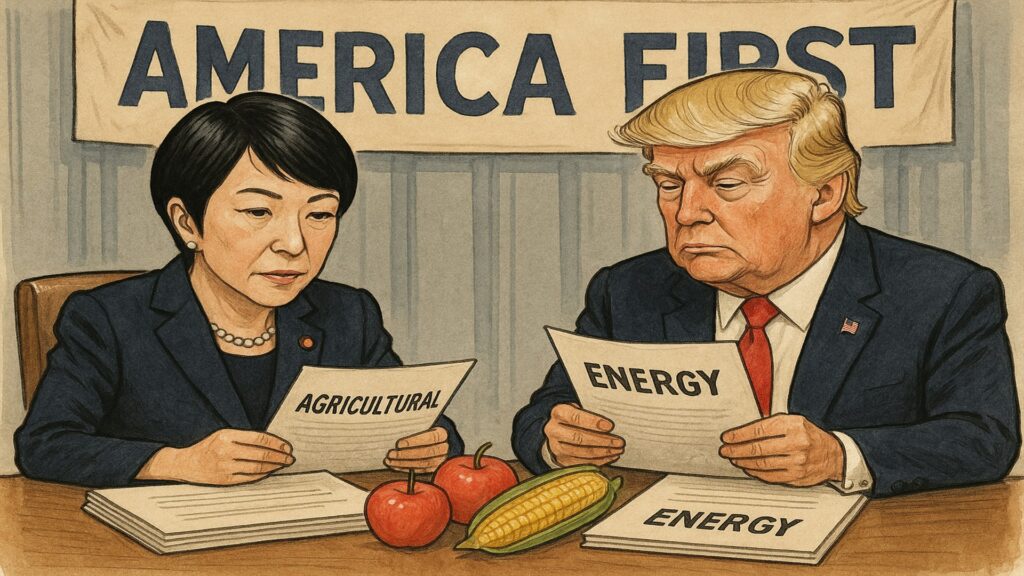
The Trump administration’s trade stance is succinctly “America First.” In exchange for confirming the implementation of tariff agreements, Japan reaffirmed its stance to increase U.S. investment and procurement of U.S. products (soybeans, rice, LNG, etc.).In the short term, this will contribute to greater stability in relations, but in the medium to long term, close attention is needed to currency exchange, prices, and domestic agriculture impacts.
Furthermore, standardization of 6G and AI international standards will hinge on coherence within the alliance as well as cooperation with Europe, India, and ASEAN. Can Japanese companies leverage their strengths in parts, materials, and equipment while taking a leading role in rulemaking? This agreement could serve as a stepping stone for that.
?The meaning of boarding Marine One
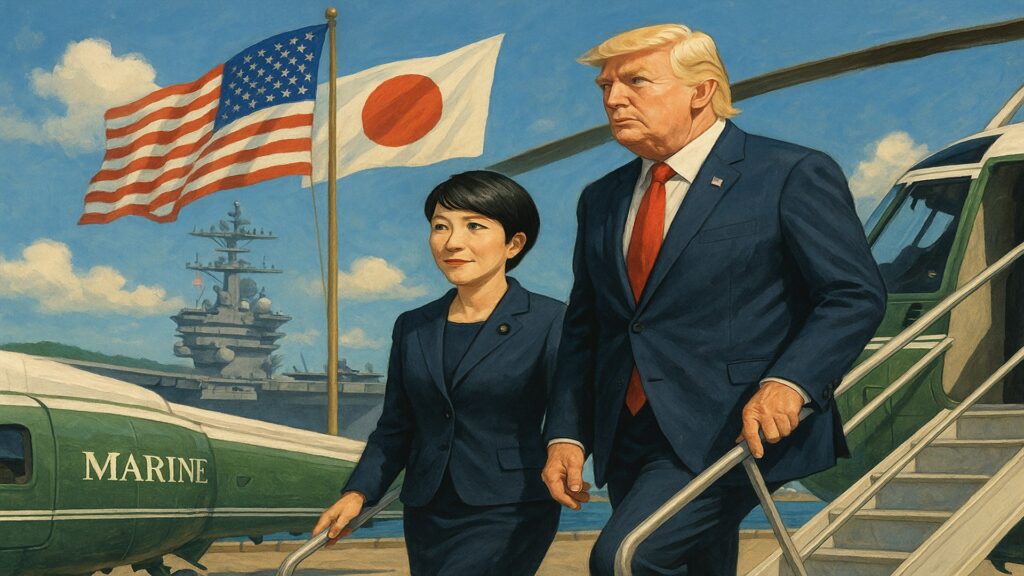
The most emblematic moment of this visit was when President Trump and Prime Minister Takahashi boarded Marine One for the trip to the Yokosuka base.Having foreign leaders aboard the president’s helicopter is extremely unusual, and it can be said to have sent a message of “the same helicopter = complete trust” to the world.
Along with the on-board speech, this visual presentation reinforced the strength of the U.S.-Japan alliance and concretely demonstrated the personal trust between the two leaders. It can be said that this reenacted the “US-J Japan Golden Era” as a continuation of the legacy of former Prime Minister Abe.
?Summary: Three days that demonstrated strength to the world
This trip of Trump to Japan combined deft staging with practical groundwork over three days. In economics, roughly 60 trillion yen of the 80 trillion yen investment plan was clarified, and the bolster of the supply chain including rare earths and shipbuilding contributed to reducing dependence on China. In defense, the accelerated target of 2% was highlighted, bringing the operational reality of the alliance into focus.
Moreover, with accompanying economic and security teams (e.g., Mr. Bessent and others) and parallel discussions among relevant ministers, it is believed that negotiations continued beyond what appeared publicly. The Marine One aboard and the Yokosuka speech visually demonstrated the unity of the US-Japan alliance and strongly reinforced the leaders’ mutual trust.
At the upcoming APEC, negotiations with Chairman Xi Jinping of China appear to be in progress. The Nikkei stock average surpassed 51,000 yen. The yen has also been weakening, solet’s keep monitoring developments.
Practice and verify freely with a completely risk-free trade simulator!
Details page for One-Click FX Training MAX