

? High City Premier’s true intention behind the “stop of rice production increase”! What is happening behind the scenes as rice prices double?
In autumn 2025, Prime Minister Sanae Takaichi stated that “the production of rice will be stopped from increasing,” a remark that surprised many citizens. In a time of ongoing price rises, the decision not to increase rice production as a staple food is, at first glance, difficult to understand.
However, even when considering factors like a weaker yen, inflation, and rising inbound demand, it is unnatural for prices to nearly double in just one year.Beyond temporary factors such as weather anomalies and distribution delays, there is a background presence of the “Dojima Commodities Exchange” that the media does not often report on.。
With rice being traded as a financial instrument, actual demand and speculative activity began to interweave in complex ways. Prime Minister Takaichi’s “stop increase” remark might have been a realistic assessment that takes that market structure into account. Now, let us take a closer look.
? Why did the price go up
Since summer 2024, rice prices surged. The price, which was around 10,000 yen per 60 kg, rose to over 20,000 yen within a few months. Several factors contributed, including a weaker yen, rising fertilizer costs, and reduced harvests due to extreme heat, but that alone cannot explain it. One cited factor isthe resumption of the Dojima Rice Futures Market at the Dojima Exchange in Osaka in August 2024.
Immediately after trading began, prices in the spot market rose by about 2,000 yen, and the high-leverage mechanism that allows trading with small funds attracted investment money. This “speculative sentiment” spread to the spot price, causing wholesalers to hold back on selling and farmers to receive direct buy orders, accelerating price increases. The government’s slow response allowed the price surge to become established.
? Dojima Rice Index — a market moved by the financial market
The Dojima Rice Index influences the overall market price even with small trading volumes. In reality, expectations in the futures market began to dominate price formation more than the actual rice distribution. With leverage as high as 50x, even small amounts of capital could execute large trades, triggering a flood of speculative funds. As a result, prices rose beyond actual demand.
At the time, Ishin’s Governor Hirofumi Yoshimura of Osaka proposed releasing stockpiled rice, but Minister of Agriculture, Forestry and Fisheries Sakamoto Tetsushi (then) postponed it.If such mouth-based interventions had been carried out, they might have had a dampening effect, but in the end the market established a “speculation-led price rally.” Looking at current rice prices, it is clear that the policy decisions were delayed at that time.
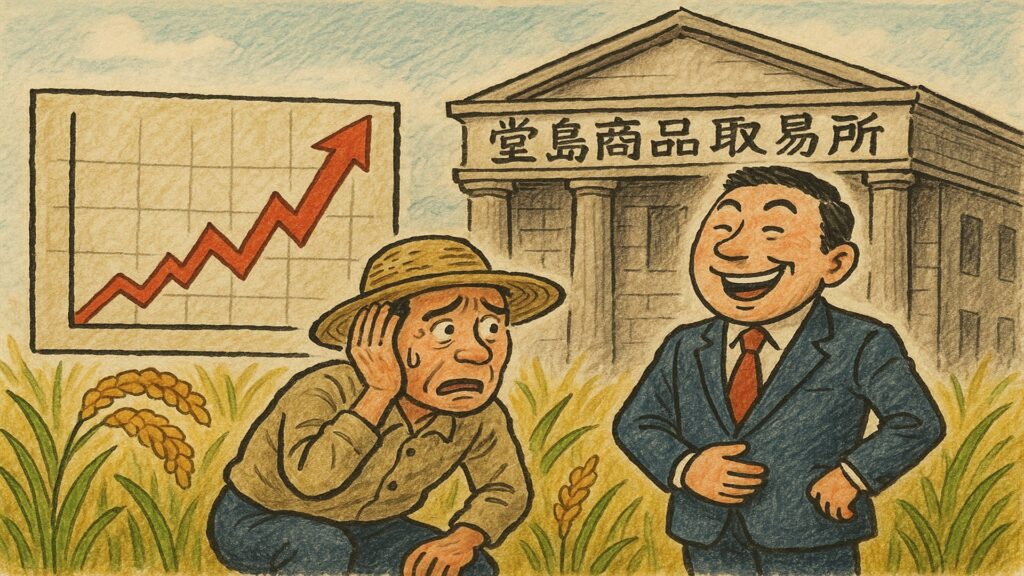
? Why Prime Minister Takaichi stopped production increases
In such a situation, Prime Minister Takaichi proposed reviewing production increases. Shifting away from the policy of expansion championed by the Ishiba administration,the plan was changed to reduce main staple rice production in the 2026 harvest year to about 670 million tons, down about 50,000 tons from the previous year. This is not just a simple reduction in production; it is also a brake on speculative markets.
If production were increased, inventories would surge, and speculators could sell off all at once, risking a sharp price drop and harming farmers. Through statements like “we don’t want a surplus that causes prices to fall,” Prime Minister Takaichi clearly aimed to prevent a collapse in prices.
? Speculation and Regulation — The Risk of 50x Leverage
The core issue lies in theextremely leveraged Dojima market with 50x leverage. With 100,000 yen in margin, you could trade up to 5 million yen, making this a true “financial game.”The Takaichi administration instructed the Financial Services Agency and the Ministry of Agriculture, Forestry and Fisheries to consider stronger regulation of speculation and market surveillance.
If leverage were reduced to around 10x, excessive trading by small investors would diminish, and price stability could be expected. In the past, similar measures in the crude oil market helped prices settle, and there is a movement to balance market freedom with stability.

? Media Silence with Ishin and SBI Involvement
The Osaka Ishin no Kai has supported corporatization of the Dojima Exchange as part of a plan to make Osaka an “international financial city,” and SBI Holdings became a major shareholder investing in the exchange. On August 13, 2024, the “Dojima Rice Average Index” began to be traded at the Dojima Commodities Exchange, introducing rice as a speculative asset with up to 50x leverage, which is cited as a factor in price surges.
Additionally, because SBI is a major shareholder of Fuji Media Holdings, some see a “structural silence” in which media outlets find it difficult to heavily criticize the two parties.Media outlets have hardly reported that the Dojima market is the starting point of the rice price surge and that SBI is involved behind the scenes.
? A Soft Landing for Rice Prices
Currently, a typical household 5 kg bag of rice costs around 4,000 yen.To bring this back to the 3,000 yen range, it is necessary to regulate leverage at the Dojima Exchange, revise margin requirements, release stockpiled rice, adjust import quotas, and revise production targets to match a consumption curve (a 1–2% annual decline).
Too rapid an increase in production would trigger a collapse, while too steep a decrease would keep prices high, so the Takaichi administration’s stance can be seen as a pragmatic middle-ground policy. To cool speculative fever and restore price levels aligned with real demand, a carefully phased, gradual adjustment is essential.A gradual adjustment over timeis indispensable.

? Summary — From Agricultural Policy to a Financial Policy Perspective
This time, the “stop increasing rice production” is not just an agricultural policy but a response mindful offinancial market stabilization. The Dojima market’s expansion of speculation affects both farmers and consumers, so the Takaichi administration took a cautious stance that connects “agriculture policy” with “finance policy.”
On the other hand, given that SBI Holdings is a major shareholder of Fuji Media Holdings, there is a structural tendency for the media to hesitate to heavily criticize SBI. A reporting stance that does not deeply explore the effects of speculation and the reality of price formation makes market distortions harder to see.Mr. Yoshitaka Nao of SBI criticized the existing media in the past over the Fuji-Nakiai issue, but in this case the media appears to be protecting SBI instead.
For price stability, reducing speculation and gradual adjustment are essential, and a “soft landing” that supports households with rice vouchers while gently cooling the market is a realistic solution.
Practice and verify freely with a completely risk-free trading simulator!
Details page for the One-Click FX Training MAX