

Prime Minister Takashi? Parliament roars with a stunning policy address, while the opposition self-destructs with vulgar chants
In October 2025, Prime Minister Sanae Takashi gave her first policy address since taking office. The content covered a wide range, including economic revitalization, anti-inflation measures, and strengthened defense,with many policies that would be realized within six months in particular.Her stance emphasizes building practical policies and foregrounding stability and implementation.
This article organizes, among those, the policies that will move in the next six months, and also touches on the disappointing aspects observed in Parliament. Politics is built on trust. Will Japan’s politics be able to regain trust?
? Inflation countermeasures and responsive supplementary budget
First priority is to address inflation. Prime Minister Takashi stated that a supplementary budget to protect citizens’ livelihoods would be promptly submitted to the Diet.
Abolish provisional tax rates on gasoline tax and tonnage tax at this session, continue price-controlling subsidies, and further provide winter electricity and gas price support, aiming to reduce living burdens directly.
All of these are expected to be implemented from this year through winter. The emphasis on speed was prominent in this urgent situation.
? Support for small and medium-sized enterprises and development of a wage-increase environment
It takes time to sustain real wage growth—acknowledging this reality, Takashi’s cabinet positioned the government as responsible for “creating an environment where wage increases can be sustained.” It will expand targeted subsidies to SMEs, revise contract unit prices, and advance subsidies ahead of revisions to medical and nursing care fees to support business operations.
These moves are expected to roll out sequentially from the end of 2025 toward the fiscal year-end.As the Prime Minister said, stability in politics leads to economic stability, so support for businesses and households will progress.
? Expansion of education and living support
A pillar of household support is the **universalization of high school tuition and school meals**. Scheduled to start from April 2026, with progress in system design and funding secured. Also, the tax reform to raise the “103 million yen wall” to 1.6 million yen will be reflected in this year's year-end tax adjustments.
In addition, work has begun on designing a tax credit system with benefits, broadening reduced burdens based on income.Progress in these multi-layered reforms in such a short period is rare in recent years.The approach to align education and living infrastructure will likely be a beacon of hope for many families.
? Defense, disaster prevention, and rebuilding the national framework
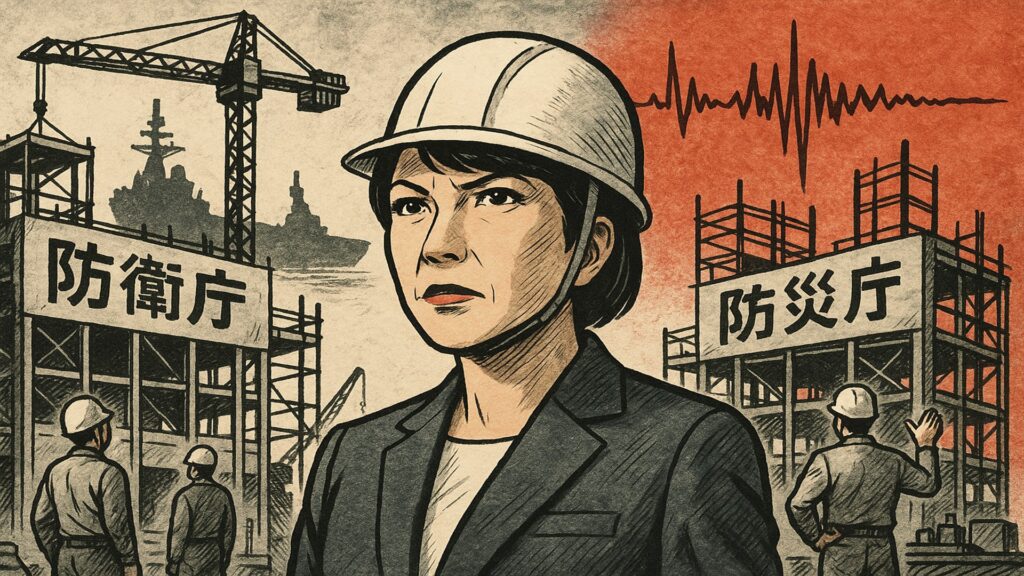
On defense, the policy to achieve defense spending at 2% of GDP within the year was announced.This decision reflects the changing security environment, and together with the establishment of a Disaster Prevention Agency next year, aims to fundamentally strengthen crisis management.
Additionally, in a disaster-prone country like Japan, disaster response and disaster infrastructure redevelopment are important tasks. Decentralization of capital functions, preservation of aging infrastructure, and the introduction of digital disaster prevention are expected to progress. The creation of the Disaster Prevention Agency will be a major step in underpinning national safety policy.
? Launch of a growth strategy and turning Japan into an AI-powered nation
Prime Minister Takashi announced the establishment of the “Japan Growth Strategy Council” to implement growth strategies. With bold national investments in AI, semiconductors, biotech, space, and cybersecurity,aiming to become “the easiest country in the world to use AI.”
By linking R&D with startup support, the aim is to raise the competitiveness of domestic industries. This six-month period is expected to see rapid laying of the groundwork. Industrial transformation has already begun quietly.
? Suspicious low-level heckling remains a concern
Now, more memorable than the speech’s content wasthe crude heckling by some lawmakersThe Diet is the nation's highest deliberative body, and lawmakers represent public opinion. Yet the repeated, incoherent remarks were beyond surprising and verged on exasperating.
If you are a politician, you should argue policies directly through legislative measures and questions, and resorting to heckling to show presence is a lack of dignity.
The names of the speakers are already published online. If you’re curious, look them up. Can the future of Japan be entrusted to politicians who cannot listen to others?
? Summary: sincerely engaging with all parties
Policies realized in this six months include the supplementary budget, tax reforms, defense strengthening, universal education, and establishment of the Disaster Prevention Agency—things directly tied to daily life and safety. On the other hand, on the parliamentary floor, there are more scenes of raising voices than policy debate, calling into question the quality of politics.
As Prime Minister Takashi urged—“Speak together, Decide together,” and “engage sincerely with all parties for the nation and the people”—a dignified discourse from both ruling and opposition is required.Prime Minister Takashi’s term lasts two years. How much will Japan change in this short period?
Since the leadership election, Nagatacho has been moving at an unprecedented pace. In the world of investment, missing changes can entail significant losses.Even within this speech, elements that move the market are included.Can you keep up with this speed of change?
A completely risk-free trade simulator to practice and verify freely!
Details page for One-Click FX Training MAX