

Will the LDP abandon Osaka and team up with Ishin? The 국민 left out in the cold. A scenario of “appointing the prime minister → supplementary budget → dissolution” with Osaka risk in sight
The Komeito party withdrew, and the Liberal Democratic Party lost its single-party majority in the House of Representatives. Then emerged the idea of a new coalition with Ishin and the Democratic Party for the People—a rescue hand, or a new burden?Centered on Osaka, the Ishin influence strengthens, relations with Komeito sour, and the Kansai region is becoming a political “epicenter.”
How will Saana Takaichi, the new party president, ride out these rough seas? The focus is on whether it will be a coalition or a dissolution. As the prime minister designation on October 21 approaches, behind-the-scenes bargaining has begun in quiet. Will the Takaichi administration be a “lifespan extension” or a “rebirth”? The next move will determine everything.
? A snapshot of the current situation in numbers (Arithmetics of House seats)
The total seats in the House of Representatives are 465, with a majority of 233. After the Komeito withdrawal, the LDP has about 191, Nippon Ishin no Kai 41, and the Democratic Party for the People about 7. The combination of LDP + Ishin stands at 232, theoretically requiring just “one more vote.”The House of Councillors has a total of 248 seats, a majority of 125; with LDP 108 + Ishin 23 = 131, so a majority is likely achievable there.
First, securing the majority in the House of Representatives is the biggest hurdle, and the weight of a single vote for the prime minister designation stands out. Therefore, it is realistic to design to clear the “first hurdle” with minimal consensus. Which would you prioritize: arithmetic of a majority or political cost?
? Osaka/Kansai’s “minefield” — district adjustments as the toughest part
Pushing to a hasty new coalition will bring district adjustments centered on Osaka to the surface all at once. In Osaka, the Ishin presence is extremely strong among the 19 single-member districts, and the LDP has continued to perform poorly. Additionally, Komeito has a solid base in Kansai and is opposed to Ishin’s “countercapital concept.”
If a solid coalition is formed here, a three-way contest among LDP, Ishin, and Komeito could spread conservative votes and provoke regional sentiment backlash.This is not just Osaka’s problem; it’s a broader “front” issue that could ripple to Hyogo, Kyoto, and Nara. The local situation of Saana Takaichi’s district (Nara 2) isn’t irrelevant. Is there really a rationality to hurry to a conclusion now?
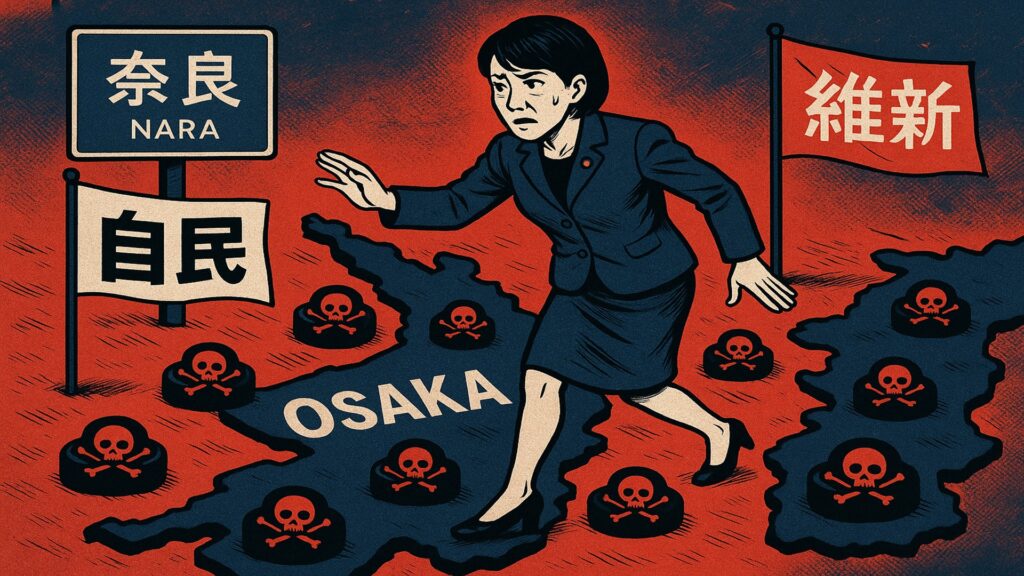
? First, pass the prime minister designation — meaning of minimal consensus
The prime minister designation in the extraordinary Diet on October 21 is an “early stability test” for the administration. The consensus to get through here does not necessarily require a comprehensive coalition.Ishin and the Democratic Party for the People should agree on “cooperation limited to the prime minister designation,” and leave policy concretization to the supplementary budget.
To cover the risk of not reaching an outright majority in the House, use separate cooperation and cross-faction agreements to ensure the government’s legitimacy at the outset. The idea is to maximize speed and flexibility by minimizing the scope of the agreement, while avoiding backlash and defections from a hastily formed comprehensive coalition.
? Build “成果” in the supplementary budget — a design of payback to Ishin and the DPFP
After the prime minister, the next step is “deliverables” in the supplementary budget. Ishin would begin designing the system for the countercapital concept and related special zones, while the DPFP would tackle issues like the “income threshold” and measures related to gasoline tax (temporary tax rate), within the bounds of fiscal discipline. The key is to formalize this as a three-part package: roadmap + initial actions + deadlines.
Define what can be done now, what cannot be done immediately, and what will be reconsidered at the start of next fiscal year in a formal agreement.By accommodating the finance ministry and ruling party disciplinarians, establish a “minimum成果” that cooperating parties can explain to their supporters. This practical settlement directly ties to short-term stability. Which items would you prioritize?
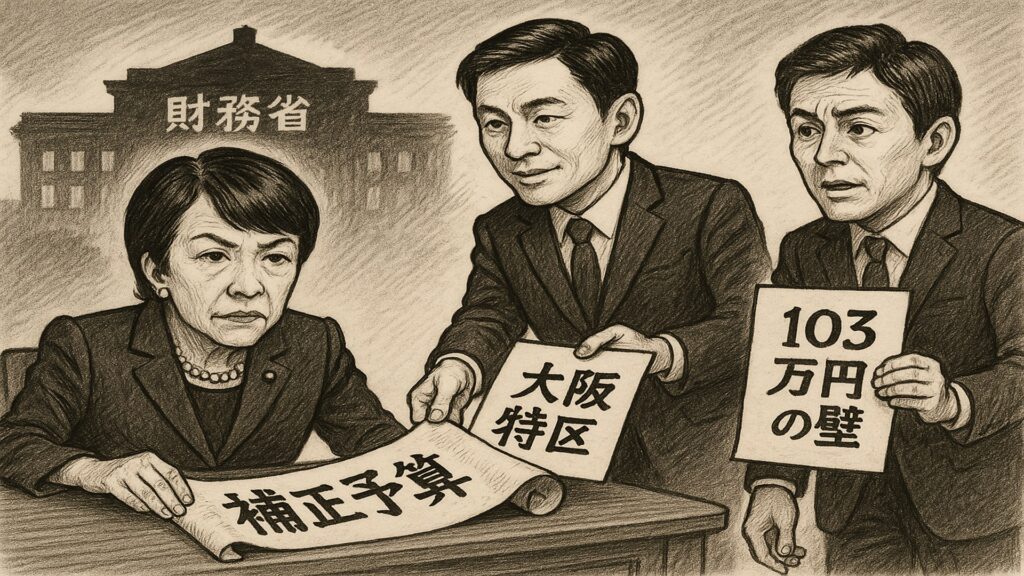
? Pass the supplementary budget → dissolve quickly — advantages of “redesign by public opinion”
After the supplementary budget is enacted, dissolve the Diet and go to general elections promptly. Visualize the latest public opinion through the election, and based on the seat distribution, redesign the permanent framework (coalition/extramural cooperation) anew. There are two advantages to this order. First, it avoids criticism of “backroom deals before the election.”
Second, it allows negotiating the Osaka/Kansai district issues with the backing of public opinion.Depending on the results, the LDP might recover with a single-party majority, or Ishin and the DPFP might gain strength and increase their leverage in negotiations.In any case, after the election, clarifying allocations and roles will help stabilize parliamentary operations in the long term.
? Timeline of governing — reading a realistic schedule
Looking ahead at the political timetable, the scenario is as follows. An extraordinary Diet opens on October 21, and the designation vote is held the same day. If President Takaichi is designated as prime minister, the cabinet will be formed promptly and a policy address delivered, followed by full-scale drafting of the supplementary budget.
By late October the Diet will submit the bill, and by early November it will pass, allowing dissolution and a year-end general election. This is the ideal schedule. By delivering policy成果 in a short period, not only the LDP but also Ishin and the DPFP can showcase成果 in the campaign.The visit of President Trump to Japan also coincides with this time, giving a rare wind in the campaign.
If you miss this schedule, political vacancy will linger, and the impression of an untrusted prime minister will strengthen, with continued bashing from the party and media. Speed is the key to stability. How do you evaluate this tempo?
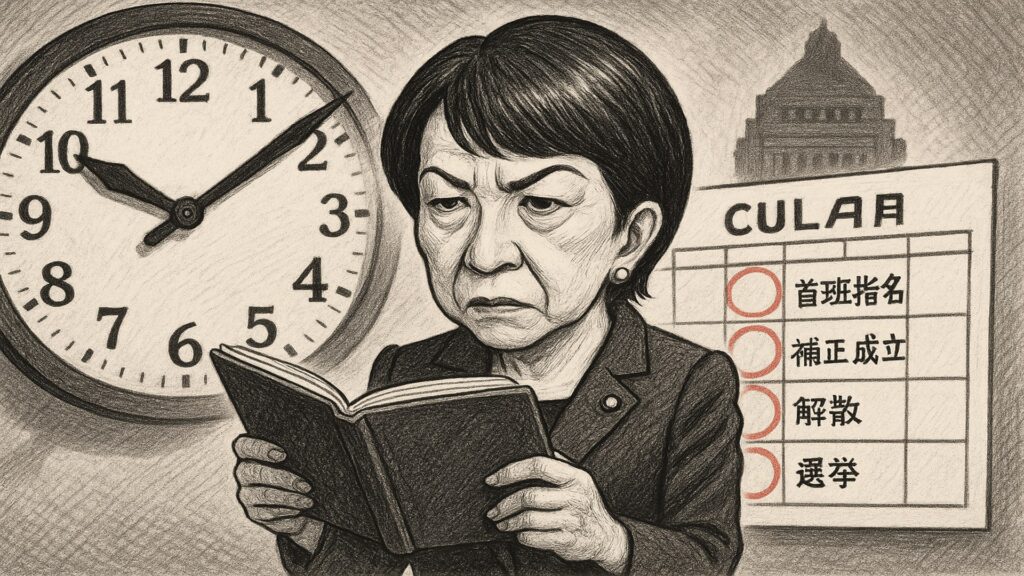
? Summary: a phased approach that balances “stability” and “legitimacy”
In conclusion, now is better to pursue a phased approach rather than a solid coalition, namelyLimited cooperation for the prime minister designation → partial成果 via the supplementary budget → dissolution to confirm public opinion → after the election, redesign the permanent frameworkThis phased approach is the most realistic. The Osaka/Kansai’s complex landscape, the Komeito relationship, and fiscal discipline are three intertwined issues that are almost impossible to resolve all at once. Therefore, cross the first hurdle with minimal consensus, demonstrate concrete gains via the supplementary budget, and leave the final decision to the election results and public opinion to balance stability and legitimacy.
Until last year’s election, the LDP held 247 seats, and under a transition from the Ishiba administration to the Takaichi administration, support from conservative factions and local organizations might recover.First, seek the public’s judgment through the election, and draft the coalition concept afterwards. This is healthier and a quicker route to parliamentary governance backed by public opinion. Which order would you choose, where would you concede, and what would you defend?
Practice and verify freely with a completely risk-free trade simulator!
Details page for One-Click FX Training MAX