

The oil war that begins with Trump's "Dig, dig, dig!" Is Russia drying up? Impact on Japan
When energy prices wobble, the market often reflects the shadows of politics and geopolitics.Currently, WTI crude is around $58 and Brent crude around $62, significantly down from the start of the year, and this level is exerting strong influence on the world economy and foreign exchange markets.
Oil is under downward pressure due to oversupply expectations and rising inventories, while Russia’s refineries have been intermittently harmed by Ukrainian drone attacks.Into this, the Trump administration signals a push for increased domestic production—“dig, dig, dig more.”How will this affect prices, and to what extent will it pressure Russia?
What ripple effects will this have on Japanese households, businesses, and exchange rates and stocks? Readers, where will you focus? Let’s calmly organize the facts step by step.
? Current status of oil prices: inventories and sentiment pushing downward
The most recent oil market shows simultaneous supply-demand slack and weak sentiment. As of October 10, 2025, WTI crude futures are about $58.24 per barrel (down 5.32% from the previous day), Brent crude futures around $62.17 per barrel (down 4.68% from the previous day). From the year's peak (over $80) they have fallen by 16–20% and have roughly returned to near the April low (around $55).
U.S. crude inventories rose to 420.3 million barrels (up 3.7 million from the previous week), while OPEC+ production increases (up to 0.5 million barrels per day through November) and production expansions in non-OPEC countries (notably the U.S., averaging 13.5 million barrels per day) are supporting an oversupply.
Which do you think is the main drag on prices and which is the upside factor? While considering potential rebounds from geopolitical shocks, the key factor to watch now is whether inventories will build up.
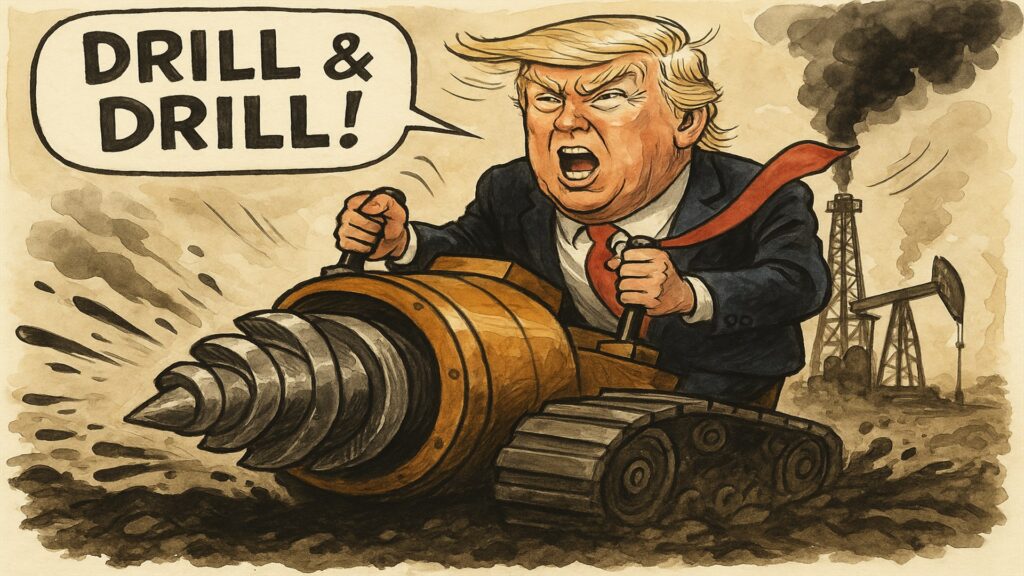
? Did the U.S. Trigger It? The Meaning of “Dig, dig, dig, dig”
The signal of increased production affects prices through market expectations. Under the Trump administration, there has repeatedly been talk of regulatory relaxations and infrastructure development that would boost drilling and production domestically, particularly in shale regions. Even without direct price manipulation, the more investors believe a policy environment will tolerate and encourage higher output, the more the futures market tends to ease in its supply outlook. Unlike “one-off policies” like SPR (Strategic Petroleum Reserve) sales, policies that operate on the broader level—such as drilling permits, pipelines, and tax incentives—are often interpreted as shifting the future supply curve to the right.
The United States is one of the world’s largest oil producers. Even if oil stabilizes around $60, continued advances in drilling technology and cost improvements make U.S. production likely to persist.Do you view these policy accumulations as an intentional oil-price low strategy, or as a byproduct of market forces?
? The situation in Russia and Ukraine: What is targeted is not the crude oil but the refining capacity
Since the beginning of this year, Ukraine has continued drone attacks on Russia’s deep-refinery infrastructure and related facilities.What stands out is that the targets are not crude oil itself but the refining capacity that produces gasoline and diesel.Oil can be extracted, but if refining bottlenecks occur, domestic fuel supply can stall, affecting transport, agriculture, and military needs, and reverberating through the entire economy.Repair is hindered by sanctions as well, making operations less likely to resume quickly.
As a result, fuel supply instability and price spikes periodically occur within Russia, while unrefined crude oil is left with fewer outlets, creating a glut. This reduces export revenue and pressures wartime finances. How do you view such a “refining-targeting” strategy?
? The United States supporting Ukraine: Intelligence, Finance, and Equipment—Three-in-One
The United States has continued military and financial support to Ukraine while showing strong involvement on the intelligence front. Public information points to sharing satellite and signals intelligence, considering providing air-defense and long-range weapons, and aiding energy and infrastructure protection. These efforts enhance Ukraine’s ability to disrupt Russia’s rear-area functions from a distance and intermittently undermine its supply, refining and power generation capabilities.
Even if the frontline stalls in winter, support for the rear via drones and missiles is expected to continue and grow.While U.S. policy can adjust with changes of administration, at least in the context of deterrence and endurance, support combining intelligence with financing and equipment is likely to continue. Readers, where do you see the critical threshold of support?
?? How Oil Prices Falling Affects the World: Benefits and Side Effects
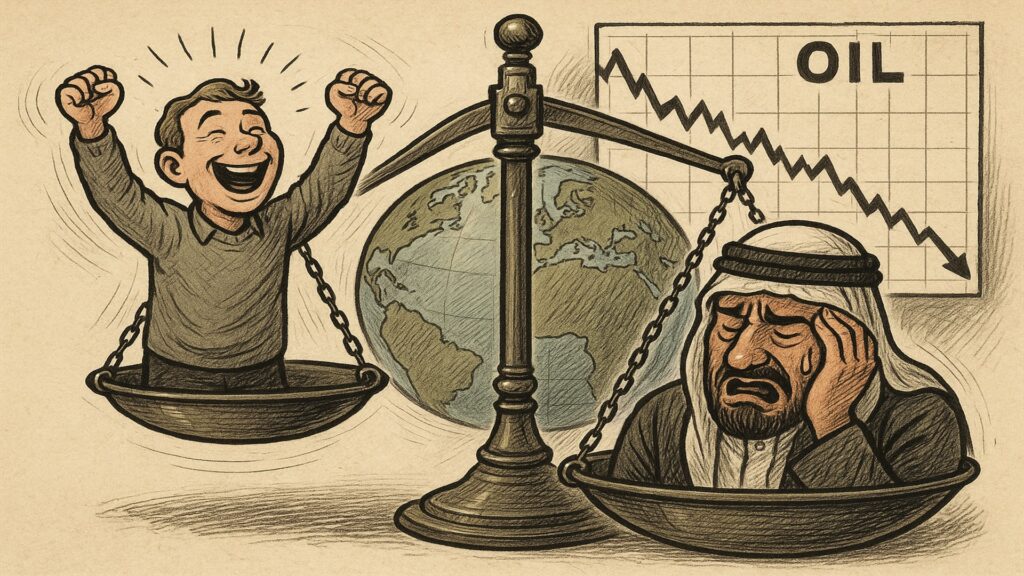
A decline in crude prices is commonly described as a tax cut that raises real disposable incomes worldwide.Lower fuel and logistics costs ease inflationary pressures in developed countries, and reduce the tightening pressure on monetary policy.On the other hand, oil-producing countries may face tighter budgets, and reduced capital expenditure by energy companies can raise future supply risks.
Moreover, in cases like Russia where “oil is abundant but refining is bottlenecked,” even as crude prices stay down, regional gasoline and diesel prices can swing sharply, distorting prices and logistics in the region.Geopolitically, anticipation of retaliation cycles and potential supply disruption remains, with upside price risks arising from sudden factors. How do you weigh short-term gains against medium-term investment risks?
? Japan’s Impact: How households, businesses, and markets (stocks and FX) are affected
Currently the yen is trending weaker and the Nikkei stock average remains near high levels (around 40,000). These currency and stock movements are important context for assessing benefits or impacts of cheaper oil.Japan is a net energy importer, so cheap crude tends to improve terms of trade.If the costs for gasoline, electricity, and gas ease, household burdens lessen relatively, and firms’ fuel and logistics costs decrease. This is especially favorable for cost-sensitive sectors like chemicals, paper, air transport, and land transport.
However, if the yen continues to weaken, the benefits of cheaper oil are partially offset.FX markets are highly volatile in the short term due to the U.S.-Japan interest rate differential and intervention expectations, and 155 yen tends to be a watchful range. The stock market may see energy-related stocks weigh more, while domestically oriented defensive stocks, logistics, and globally exposed sectors with pricing power are likely to perform better. Where will you seek benefits for households’ utility bills, corporate fuel surcharges, and your investment portfolio?
? Summary: Oil is cheap but unstable, Russia is parched, Japan calmly reaps benefits
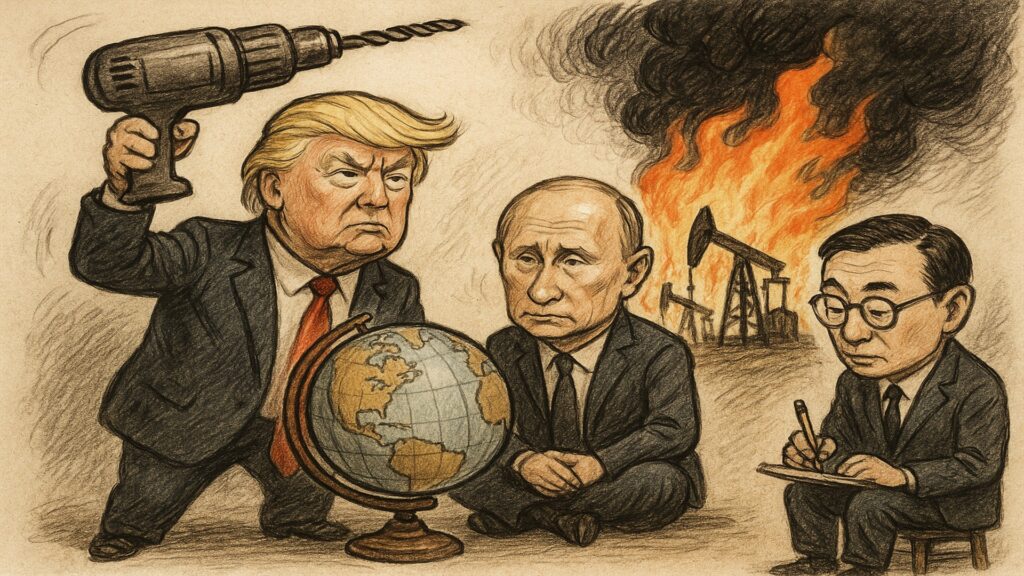
Overall, oil remains in a difficult phase of “cheap due to inventories and production expectations, but unstable due to geopolitics.” Russia faces a double bind of refinery damage and compressed export revenue, while U.S. intelligence, funding, and equipment support to Ukraine is likely to sustain pressure over the medium to long term. Japan, meanwhile, stands to benefit from lower import costs, but is unlikely to reap full gains due to a weak yen, tariffs, and soft global demand.
For short-term trading, it is realistic to consider multiple scenarios simultaneously: oil around $60 ± $5, a sharp spike due to geopolitical shocks, and a drop below $55 due to a rapid inventory buildup. Oil and FX correlations change by the minute, so avoid fixed assumptions and keep monitoring information.
A single remark from President Trump can move the currency significantly, and Russia’s stance can cause oil prices to swing dramatically.In an era where it is unclear where these will spill over, it is more important to read the news and prepare scenario forecasts than to rely on charts alone.
Which scenario do you think will derive from this oil shock?
Practice and verify freely with a completely risk-free trade simulator!
Details page for One-Click FX Training MAX