

Prime Minister Ishiba’s UN Speech! The oration of a mere talker and its futility. No impact on stock prices or exchange rates, just a final attempt to create memories
Hello everyone. That former Prime Minister Ishiba struck the desk on the United Nations podium and delivered a powerful, energetic speech. His general debate speech at the 80th United Nations General Assembly was indeed impressive.However, if you listen carefully, voices saying “it’s already too late” echo both domestically and internationally.
Why didn’t this enthusiasm surface earlier? If he had shown it right after taking office, wouldn’t the fate of the administration have been different? Such questions cross my mind. Today, using that speech as material, let’s look back at the trajectory of the Ishiba administration.
? Strong words on UN Security Council reform
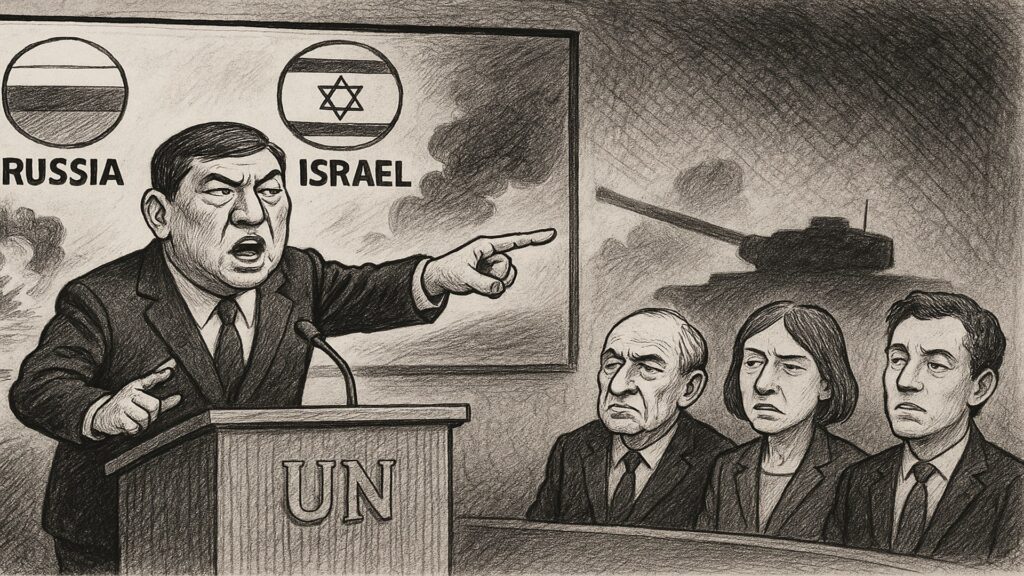
At the outset of his speech, Prime Minister Ishiba slammed the dysfunction of the Security Council while pounding the desk. He voiced strong words about how the international community cannot move due to the abuse of veto powers.
He proposed expanding permanent and non-permanent members and freezing the veto power for a certain period for the new permanent members. This was a more assertive stance than traditional Japanese diplomacy. Do you think this proposal could really be realized?
? Harsh condemnation of Russia and Israel
What especially stood out were the strong words against Russia. He labeled the invasion of Ukraine as “an act that shakes the very foundations of international order” and harshly criticized actions backed by nuclear weapons as a nuclear-armed power.For a Japanese diplomacy that had been cautious until now, this was a bold step.
He also called for an immediate halt to the humanitarian crisis in Gaza and to the ground operations by the Israeli military. Furthermore, he stated outright that “the recognition of a Palestinian state is a matter of when,” emphasizing the necessity of a two-state solution. This is commendable, but would such fervent rhetoric from a Prime Minister nearing resignation resonate much in the international community? What do you think?
? Nuclear disarmament and realism
While advocating for a world without nuclear weapons, he also acknowledged the realities of nuclear deterrence. He did not step into the Treaty on the Prohibition of Nuclear Weapons, but showed a pragmatic stance centered on the NPT.
Repeated references to the devastation of Hiroshima and Nagasaki and a call not to forget it conveyed a proud stance as a victim state. However, as mentioned again,the speech loses persuasive power when delivered just as resignation is looming.
? Inheriting Abe’s statement
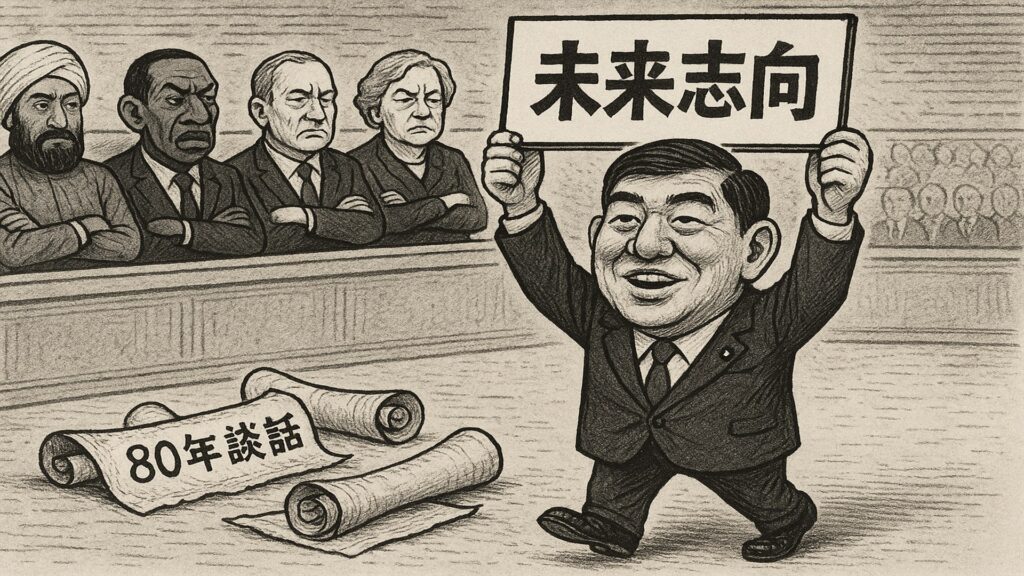
Ishiba’s speech diverged from the “80-year-old statement” often seen as apologetic diplomacy and inherited Abe’s “forward-looking” stance. It is commendable that he emphasized “what Japan will do” without falling into repetitive apologies or self-denial.
Nevertheless, because it was a message from a near-resignation, what he aimed to achieve and how to implement it remained vague. Media coverage tended to list facts rather than reproduce the intensity, and overseas reactions were also limited. As a result, the strength of the message appeared detached from the policy’s practicality, highlighting a gap between content and outcomes. How did you perceive this gap?
? The image of a talking-head
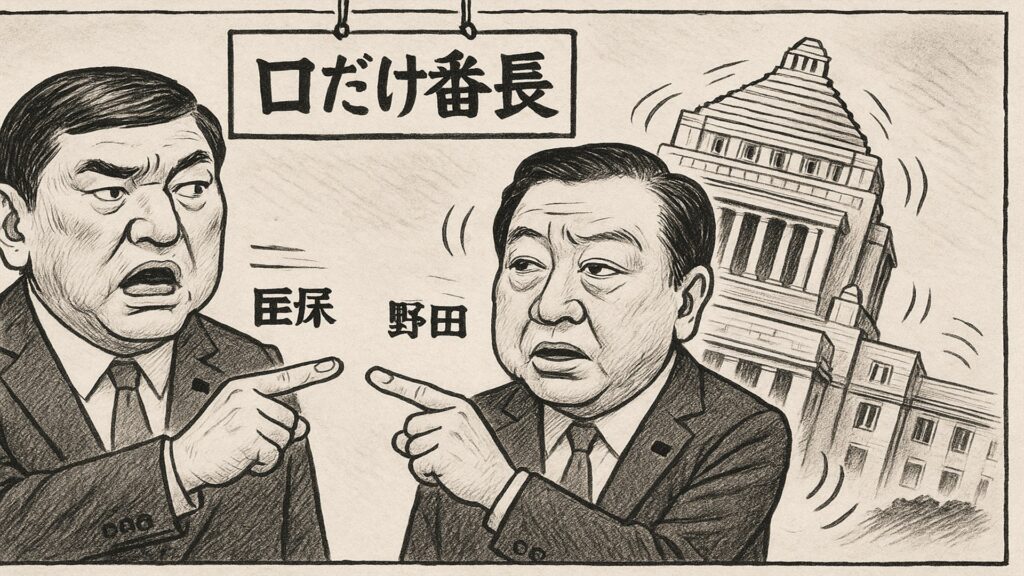
Listening to this speech, many people felt again that “Shigeru Ishiba was just a mouthpiece.” There are people like this in every company: they criticize and complain, but once they have to take responsibility, they lack execution power. Ishiba repeatedly criticized within the party, but when he became prime minister, he echoed the criticisms he had made. His speech was admirable in content, but it looked like he spoke only because he had no responsibility. It is unclear whether he led sanctions against Russia or took actions to stop the conflict — the answer is that he did nothing. By comparison, it seems even more tangible that Akie Abe personally met Putin to try to persuade him.
? Another mouthpiece: Yukio Edano
Speaking of mouthpieces, former Prime Minister Noda also fits this description. He said he would raise taxes with his political life on the line, yet he dumped the actual consumption tax increase onto former Prime Minister Abe. Moreover, even when there was an opportunity to topple the administration, he did not submit a no-confidence motion, while repeatedly saying things like “I want to see Noda named as the premier,” which were impractical. What they share is that both emerged as prime ministers out of a desire to avoid the worst opponents. Ishiba formed a bloc against the Takashi faction, and Noda became prime minister as someone who disliked the Ozawa faction. In the end, a “mouthpiece” became prime minister. Ultimately, a prime minister born out of a coalition opposing, only led to tragedy.
? Summary: why now?
For many people, it would have been unexpected that Ishiba’s prime ministership would end so harshly. Even the party members and lawmakers who voted might not have imagined such a miserable exit. Losing three elections, being pressured to resign from within the party, and finally resigning on his own—this sequence was not something to be proud of. As a result, his career as a politician was tarnished, and it revealed as a “mouthpiece” with many calling that perhaps it would have been better if he had never become prime minister. The final speech also seemed like an attempt to create a memory of “speaking passionately on the international stage” in a largely empty hall. Now, how would you evaluate Ishiba’s administration over the past year?
Completely risk-free trade simulator to practice and verify freely!
Details page for One-Click FX Training MAX