

"ATS-25" Lecture Series Part 3: "Manual (All) Settlement and the Three Automatic Settlements"

Thank you for always using our service.
This time we will explain the “AllClose” and the “Three automatic settlements” equipped in 『ATS-25』. Manual acquisition, automatic settlement, this is what we call a semi-discretionary EA.
It's very convenient that you can settle all positions automatically even though it is discretionary and you have full settlement buttons.
First, we will explain the “AllClose” button that can settle all positions at once for all positions.
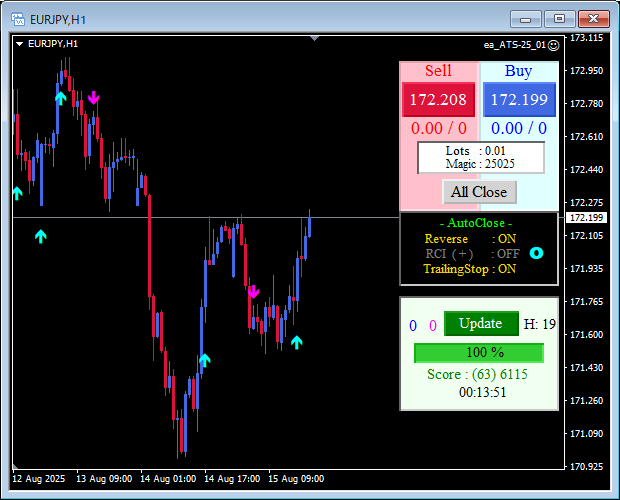
■ Manual All-Settlement (AllClose) ■
If you are trading on multiple charts and want to settle only the positions acquired on a specific chart, you can settle them with a single AllClose button.
You won’t mistakenly settle other positions, and above all it is convenient and fast.
■ 3 Automatic Settlements ■
Next, we will explain the three automatic settlements. These are the three that are equipped.
----- ----- ----- ----- -----
・Reverse
・RCI(+)
・TrailingStop
----- ----- ----- ----- -----
When the gauge reaches 100% and the optimal values are set, information is automatically passed to the EA. Based on that information, the settlement points are calculated.
From the three settlements provided, you can choose which to apply.
If all three are set to “False (OFF)”, automatic settlement will not occur.
Also, when all three are “true (ON)”, automatic settlement will occur as soon as any one settlement condition is met.
For currently open trades, all are set to “true (ON)” or only “Reverse” and “TrailingStop” to “true (ON)”. The intention is that since many people will view this, settlements are made early to avoid large losses. Large gains may be smaller, but large losses are avoided, aiming for stable trading.
Knowing the characteristics of each allows you to find a settlement method that suits you.
Now, let’s look at each one in a little more detail.
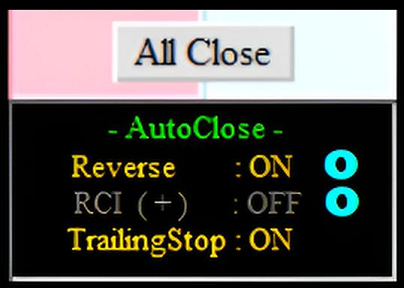
【Reverse】
If you turn “Reverse” ON, trades will be settled when the signal opposite to the entry signal appears, regardless of profit or loss.
This assumes that the price will move in the opposite direction from the signal that appeared at entry, leading to settlement accordingly.
It settles before moving strongly in the opposite direction, avoiding large losses.
Because of this, win rate decreases.
You won’t incur large losses, but there tends to be small, incremental negative settlements.
If after acquisition the price continues to move in the positive direction, the opposite signal will not appear, so you can also gain a large positive.
【RCI(+)】
Recently, RCI has attracted much attention, and this is the settlement that uses it.
“RCI(+)” sets conditions with the parameters “Close_RCI_Deviation” and “Close_RCI_Line”. By default, Close_RCI_Deviation = 14 and Close_RCI_Line = 80.
In this case, for Buy positions settlement occurs when RCI (14 lines) reaches 80 or more, and for Sell positions when RCI (14 lines) reaches -80 or less.
There is another important absolute condition: the position must be in positive profit to settle.
In a negative situation, even if the RCI condition is met, it will not settle.
With this settlement, you will always end with a profit, so in terms of “RCI(+)” alone, the win rate is 100%.
Next, we will explain the advantages and disadvantages of its effect.
The rule says “settle when RCI(14) is 80 or higher,” but this means the current bar has reached that condition.
The feature is that if you acquired a position and it moves strongly in the plus direction, it will settle immediately after acquisition, which can reduce profit margin. Conversely, if after settlement the price reverses further into the minus direction, it has already completed, so you end up with a positive result.
This settlement is a positive-condition method, so it is very strong for a conservative strategy.
【TrailingStop】
“TrailingStop” has parameters: standard value Close_TS_Point = 8.0, and Close_TS_Per = 0.5.
In the case of USDJPY, for example, if you acquire Buy at 147.00, the trailing stop activates when rate (Bid) reaches 147.08. The take profit line starts from the plus range of 0.5 (= 50%) at 147.04.
Since this is a trailing stop, this settlement also has a 100% win rate when viewed alone.
It is also a method that can aim for a large plus.
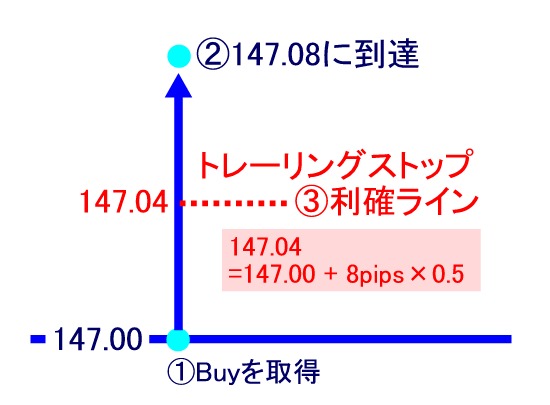
The parameters related to trailing stop are as follows.
・“TrailingStop” = “true (ON)” (default)
・“Close_TS_Point” = “8.0” (default) … meaning “8 pips.”
・“Close_TS_Per” = “0.5” (default) … meaning “50%.”
This time we explained the “AllClose” and the “Three Automatic Settlements” equipped in 『ATS-25』.
Next, we will teach you about thinking for FX that is beneficial to know.
× ![]()