

ICT Theory × Institutional Investors / Smart Money Series | Part 6: Identifying Overvaluation and Undervaluation in the Market with PDA (Premium / Discount Array)
1. Review up to last time
In previous articles, we introduced the fundamental ideas that form the basis of ICT theory. This time, we will discuss PDA (Premium / Discount Array), which can be considered a foundation.2. What is PDA?
PDA stands for Premium / Discount Array, a framework for determining whether the market is "overpriced" or "undervalued."The usage is as follows:
① Take the most recent high (Swing High) and low (Swing Low)
② Draw Fibonacci between them
③ Use the 50% line as a boundary,
Upper half → Premium (shorting candidate)
Lower half → Discount (buying candidate)
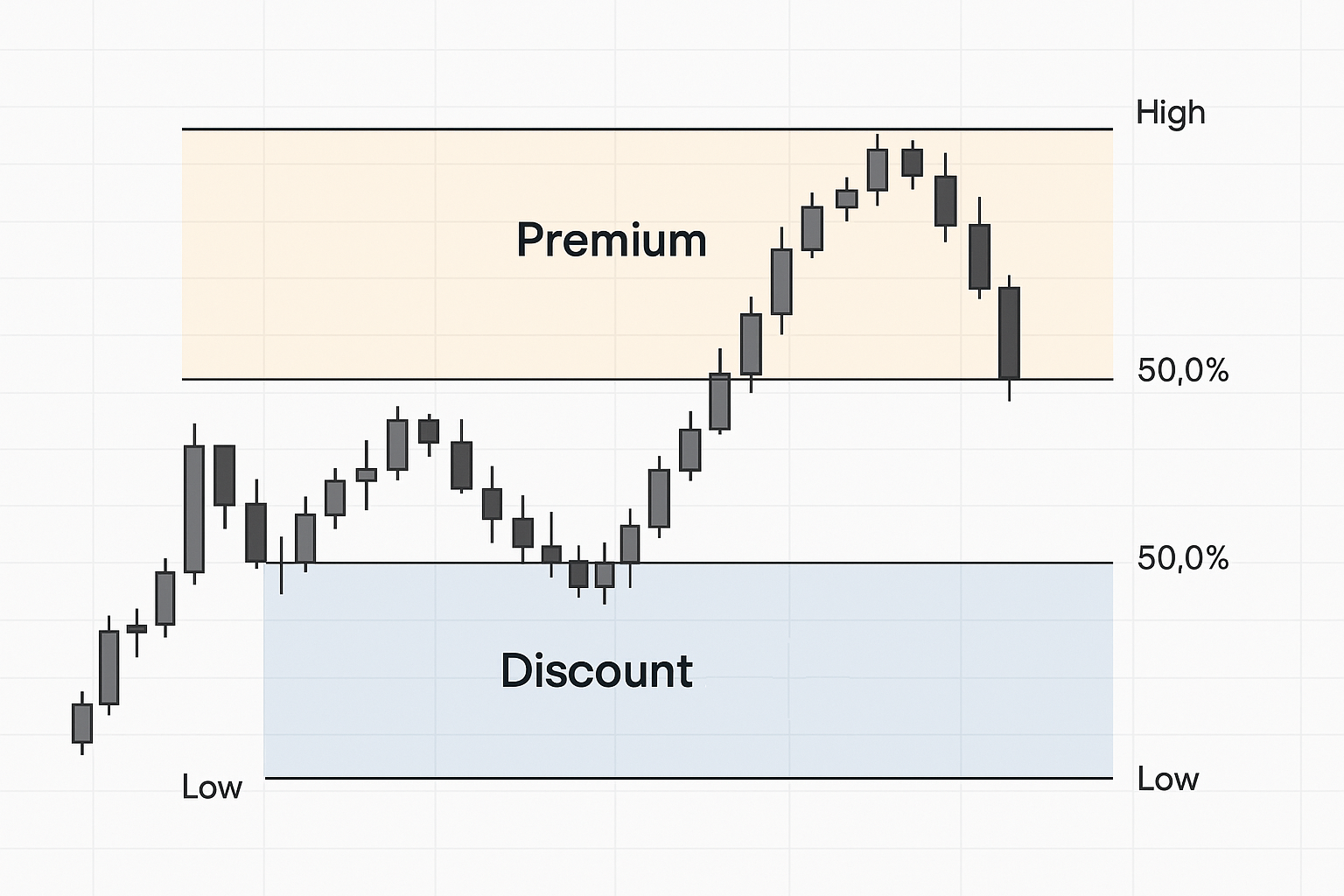
3. How to think about Premium and Discount
Premium (Premium Zone / Overpriced area)A zone where the market is perceived as "overpriced."
→ Easier to target selling.
Discount (Discount Zone / Undervalued area)
A zone where the market is perceived as "undervalued."
→ Easier to target buying.
Using PDA makes it simple to determine “where to enter buy or sell.”
4. Practical application examples
PDA is useful on its own, but combining it with other ICT concepts increases accuracy.Order Block (OB) × PDA
When in the Premium zone, search for a “bearish OB” → aim for a short
When in the Discount zone, search for a “bullish OB” → aim for a long
FVG × PDA
Premium-side FVG → short from the fill
Discount-side FVG → long from the fill
Liquidity × PDA
If a liquidity pool is on the Premium side → reverse to short after the hunt
If a liquidity pool is on the Discount side → reverse to long after the hunt
5. Multitimeframe and HTF PDA
The key to leveraging PDA is to base it on HTF (Higher Time Frame) and look for entries on LTF (Lower Time Frame).Example timeframe setups (recommended pairs)
Monthly PDA → Weekly / Daily
? Grasp long-term trend, target swings
Weekly PDA → Daily / 4-hour
? Confirm mid-term directional bias
Daily PDA → 4-hour / 1-hour
? Foundation for swing to intraday trading
4-hour PDA → 15-minute / 5-minute
? Classic intraday pattern
1-hour PDA → 5-minute / 1-minute
? Suitable for short-term trading and scalping
HTF PDA provides “environment recognition,” while LTF provides “timing entry.”
5. Multitimeframe and HTF PDA
What becomes important here is the concept of HTF (Higher Time Frame) = upper time frame. PDA can be drawn on any time frame, but the most effective combination is to recognize the market environment on a higher timeframe PDA and seek entry timing on a lower timeframe.Concrete example
Based on the daily PDA → look for targets on 4-hour or 1-hour
Based on the 4-hour (HTF PDA) → gauge entries on 15-minute or 5-minute
? HTF PDA is like a map
The higher-timeframe PDA determines the overall direction,
and the lower-timeframe movement indicates the entry points within that direction.
6. Summary
PDA (Premium / Discount Array) is a reference point for overvaluation and undervaluation in ICT theory. By using this:You can avoid unnecessary buying at highs or selling at lows
Combining with OB and FVG allows for more accurate entries
Using HTF PDA as a baseline provides consistency for entries on lower timeframes
? PDA is a bridge between “environment recognition” and “entry precision.” It is the strongest tool to implement ICT in practice.
× ![]()