

ICT Theory × Institutional Investors & Smart Money | Part ② 'FVG (Fair Value Gap)攻略法'
What is FVG (Fair Value Gap)?
FVG refers to the “price gap” deliberately created by institutional investors through large orders.
? How FVG Forms
Institutions place large buy orders
Prices jump suddenly (a gap occurs)
A price range where no trades occur
Later, prices return to fill that gap
Key point:Since the market seeks “fair value,” it inherently tends to fill gaps.
Bullish FVG
An up-gap occurring during a sharp rally is called a bullish FVG. It is typically confirmed with the following three candles.
Bearish candle or small bullish candle
Huge bullish candle (rapid rally)
Bearish candle or small bullish candle
Here,a price-absent zone between the high of the first candle and the low of the third candlethat forms is the bullish FVG.
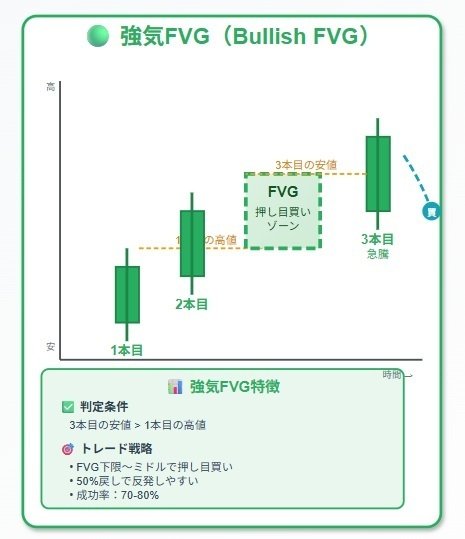
Characteristics of Bullish FVG
If it appears during a bullish trendit can be a strong point to buy on dips
Prices tend to retrace to themiddle or lower bound of the FVGthen resume rising
Interpretation: “the place where institutions’ buy orders remain”and are left standing
Institutional Traders’ Expectations at Bullish FVG Formation
Building a large long position
If bought aggressively at once, price may surge too much
Prefer to add to positions gradually
Using retail traders’ “selling at highs”
Targeting profits being taken by retail after the rally
FVG pullback to shake out retail again
Efficient position building
Place additional buys at a lower price
Improve the average entry price
In short,bullish FVG can be interpreted as “a place where institutions absorb retail selling to buy more”.
Trading Strategy
Buy on pullbacks
In many cases, the price rebounds and rises before the gap is fully filled.
Bearish FVG
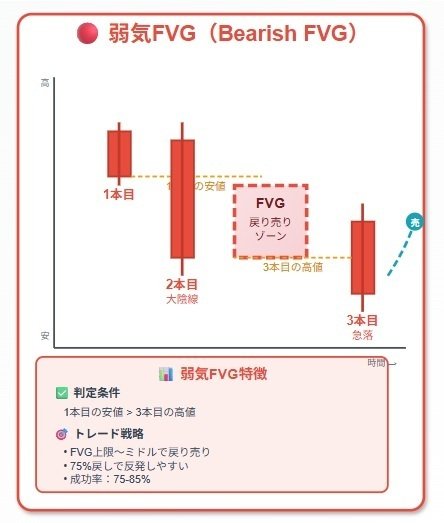
A downward gap occurring during a sharp decline is called a bearish FVG. It is typically confirmed with the following three candles.
Bullish candle or small bearish candle
Huge bearish candle (rapid drop)
Bullish candle or small bearish candle
Here, if a price-absent zone forms between the low of the first candle and the high of the third candle, that is the bearish FVG.
Characteristics of Bearish FVG
If it appears during a bearish trendit is a strong point for selling on rallies
Prices tend to retrace to themiddle or upper bound of the FVGthen resume falling
Interpretation: “the place where institutions’ sell orders remain”and are left standing
Institutional Traders’ Expectations at Bearish FVG Formation
Building large short positions
If sold all at once, price may fall too much
Prefer to add to short positions gradually
Using retail traders’ “buying at lows”
Targeting retail buying after the drop
FVG pullback to shake out retail again
Efficient profit-taking
Place additional sells at a higher price
Improve the average selling price
In short,bearish FVG is“a place where institutions absorb retail buying to build large selling positions”.
Trading Strategy
Aim for pullback selling
In many cases, the gap is filled and price falls beforethe gap is fully filled
Combining FVG with Order Block Strategies
The strongest entry point is where OB and FVG areas overlap. Price ranges where both overlap have a much higher probability of reversal because institutional orders are concentrated there.
How to Use FVG by Timeframe
Daily FVG
Use: Major trend reversal points
Holding period: days to weeks
Reliability: ★★★★★
4-H FVG
Use: Entry for swing trades
Holding period: hours to days
Reliability: ★★★★☆
1-H FVG
Use: Entry for day trading
Holding period: within hours
Reliability: ★★★☆☆
⚠️ Important Note
FVG on 15 minutes or smaller timeframes can be misleading, so beware!
Could be retail noise rather than institutional moves
Treat short-timeframe FVG as参考 only
Practical FVG Usage Rules
✅ Conditions for a good FVG
Occurs on daily or 4H chart
Appears within a clear trend
Gap width is moderate (about 1-3% of price)
Overlaps with important support/resistance
❌ FVGs to avoid
Occurred in ranging markets
Gap is too small (noise)
Gap is too large (e.g., around major economic announcements)
FVG already widely anticipated (have been consumed)
cautions in FVG trading
Common failure patterns
If the gap does not fill
Trend is too strong
Market moves sharply on major news
False FVGs
Unexpected gaps at economic data releases
Gaps in low-liquidity periods
Timeframe confusion
Overreliance on 15m FVG
Ignoring higher timeframe trend direction
? Countermeasures
Weigh multiple confirmations (OB + FVG + trendlines, etc.)
Check economic calendar
Target high-liquidity times
? Key takeaways
FVG represents intentional setups by institutional investors
Institutions aim to entice retail to jump in, then absorb it
Patience to wait for FVG pullbacks is the key to success