

[Amida-style: Master the Market with the Volume Profile] Lesson 24: Volume Setup #4 (Volume Gap Setup) Volume Gap Setup – The Power of Synergy with the "Gap in Volume"
“When the market leaves a gap, it invites prices to return. And when that invitation is rejected, it is time to act.”
1. Linking Knowledge: From the Control Area to Market Gaps
Until now, we have built a powerful set of tools to “read” the market through volume profiles.
Lesson 21: Volume Concentration Setup– How to enter smartly from volume accumulation areas in a ranging market.
Lesson 22: Trend Setup– How to widen trading opportunities by finding Volume Concentration Areas (AOC) within an ongoing trend.
Lesson 23: Rejection Setup– How to capture market “rejection” signals accompanied by strong price action and spikes in volume.
However, there are aspects of volume profiles that have not been deeply explored. That is the “volume gaps” in zones where trading volume is extremely low or nonexistent. These areas often act as magnets that pull prices, and when combined with other strong signals, can demonstrate remarkable power.
So, how do we recognize these “volume gaps” and use them in trading? And what does it mean to bring them together with a “strong rejection signal” to give trading remarkable power?
2. Volume Gap Setup – What are “Volume Gaps”?
The “Volume Gap Setup” is a trading strategy focused on the following points.
Identify “volume gaps” (Volume Gap) on the volume profile. These are clear valleys where volume bars suddenly become extremely low, sparse, or nearly absent.
When price breaks through this volume gap, execute the trade immediately.

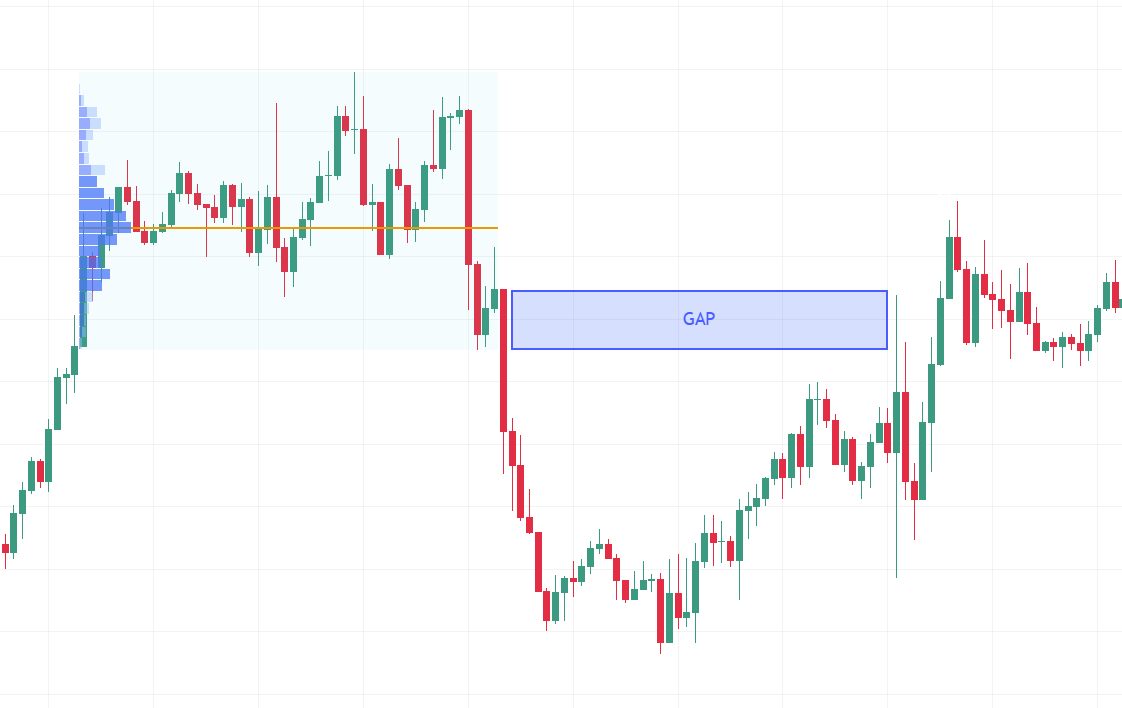
Central idea of this strategy:
The market hates gaps. When price quickly moves through a volume gap, it often returns later to “fill in” or “retest” the area. This is precisely where we target trading opportunities.
3. How to Use Volume Gaps to Increase Trade Win Rate
Treat volume gaps not as a standalone strategy, but as a confirmation step within the strategies learned so far.
Step 1: Use one of the learned strategies to identify a potential entry point
First, look for strong signals from the main strategies we studied.
In a ranging market:
Identify a clear range and use the volume profile to identifyAOC/POC.
After a breakout, the price retesting this AOC/POCpoints to a potential entry.
In a trending market:
Identify the main trend.
Use the volume profile to measure AOC/POC formed by pullbacks or retracements within the trend.
The point where price returns to thisAOC/POC becomes a potential entry point.
In a rejection setup:
Look for strong rejection candles (pin bars, engulfing patterns, etc.) at key support/resistance.
Use the volume profile to measure theAOC/POC within that candle. The point where price retests this AOC/POC becomes a potential entry point.
Step 2: Find volume gaps and verify signals
Before placing orders, check the volume profile near the potential entry point.
What to look for:
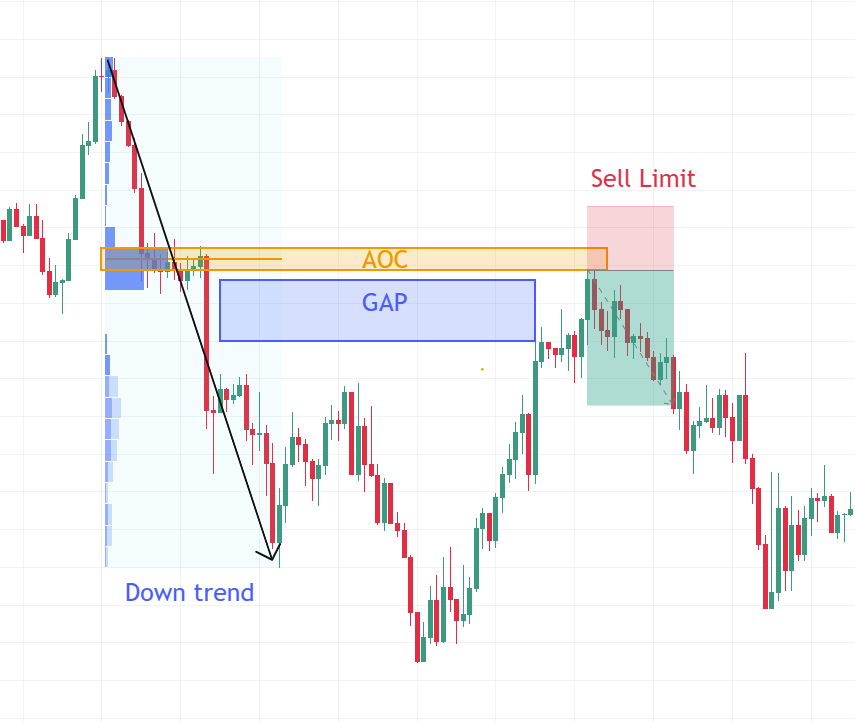
Whether there is a volume gap just below (in uptrends) or just above (in downtrends) the entry point.
An ideal volume gap appears as a deep, wide valley indicating that price could pass through easily.
The power of volume gaps:
In range-bound markets: A volume gap formed immediately after a breakout indicates decisive advantage by the buyers or sellers. When price tests AOC/POC and the gap remains, it confirms little resistance to the breakout direction.
In trending markets: When price returns to AOC/POC and there is a volume gap, it shows there is little resistance to the subsequent move in the trend direction. Price will likely pass through this gap easily after resuming the trend from the AOC/POC.
Rejection signals: This is the strongest combination. A rejection signal with volume (e.g., a high-volume pin bar) appears at the POC/AOC, and a volume gap just below indicates smart money has stepped in and that there is little resistance to follow-on price movement, a very powerful signal.
Step 3: Place orders and manage risk
Once a volume gap confirmation is obtained, confidently place orders according to the original strategy rules.
Entry point:Place a limit order (Buy/Sell Limit) in the identifiedAOC/POC area.
Stop loss:
General rule:Place the stop outside the most recent low-volume node (LVN) or outside the volume gap area.
In a trending market:Place the stop outside the nearby swing low/high of the pullback/retracement.
In a rejection setup:Place the stop just outside the rejection candle’s wick.
Take profit:
General rule:Use the next major POC/AOC as a profit target or follow your preset risk-reward ratio (RR).
Recommendation:Start with RR 1:1.5, and as you gain experience, consider raising to 1:2 or more depending on market conditions.


✅
Volume gaps are not a standalone strategy, but a powerful confirmation tool that can dramatically improve trading win rates. When combined with other strategies learned, you can not only identify entry points but also spot trades where price is likely to move rapidly and decisively. This allows you to optimize profits and manage risk more effectively.
?
See you in the next summary lesson as well!