
[Amidashiki: Using Volume Profile to Dominate the Market] Lesson 21: Volume Setup #1 Entry from Volume Accumulation Area – Chasing Big Footprints with the "Volume Concentration Setup"
“Don’t rush to breakouts; patiently wait for the footprints of the big players to become clear.”
1. Connect the knowledge so far
To understand this strategy, you need to firmly grasp the following key concepts.
POC (Point of Control): The price level where the most trading occurred. This indicates where the “smart money” (large capital) was most active.
AOC (Area of Control): The price control zone surrounding the POC. If the POC is a single “fingerprint,” the AOC is the entire “activity site” where that fingerprint was found. This is a very important clue for finding entry points.
Range (Sideways/Range): The period when price moves within a defined range. This can be viewed as a “quiet battlefield” where big investors quietly accumulate (accumulation) or distribute (distribution) in preparation for the next big move.
Understanding these concepts is the first step to elevate information from volume profile into concrete trading strategies.
2. What is the “Volume Concentration Setup”?
The Volume Accumulation Setup is a strategy to capture the accumulation activity of smart money and to avoid missing the subsequent market move. Its essence is as follows.
During the sideways (range) period, precisely identify the “Accumulation Zone.”
After price clearlybreaks out from this range, place trades in the direction of the breakout.
Core idea of this strategy:
We do not blindly enter while the price is inside the range, nor chase the price the moment it breaks out. Instead, we aim to join the market in conjunction with the flow created by large capital after confirming a clear breakout from the range.
3. Four steps to find the “Volume Concentration Setup”
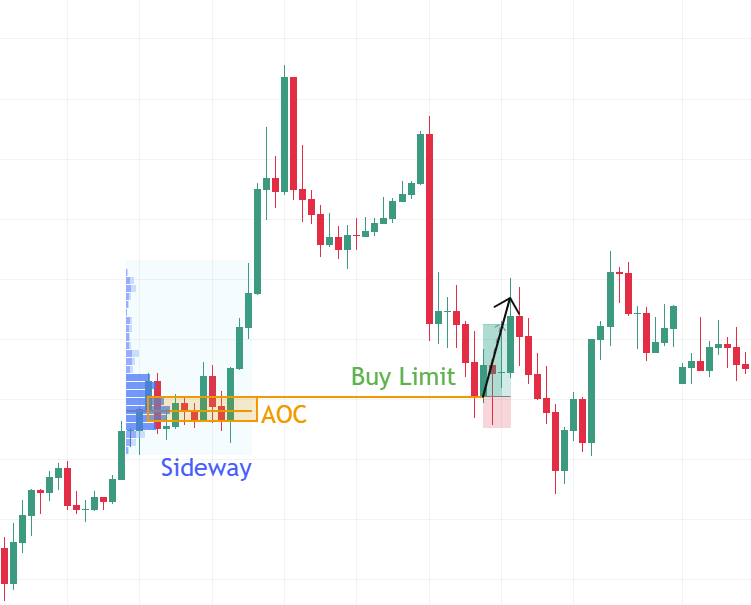
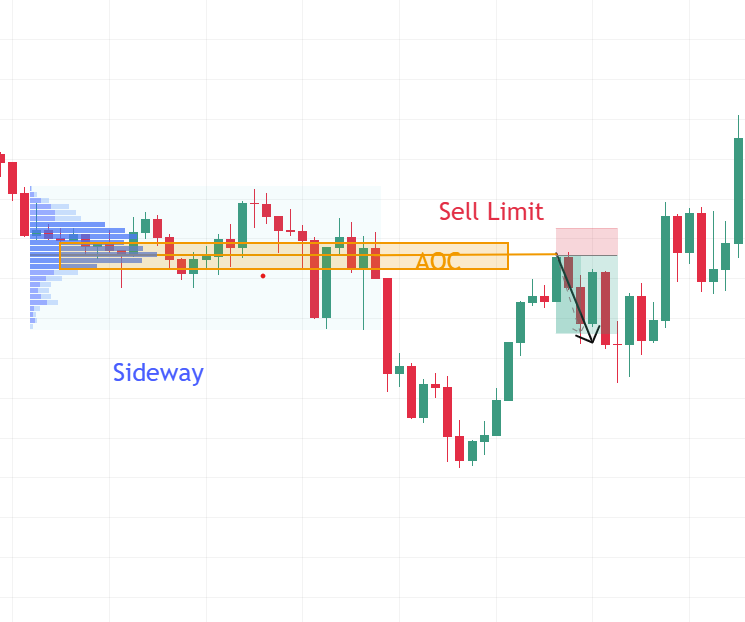
Find a range market (Sideway) First, look for periods where price moves in a narrow range with highs and lows almost aligned in a straight line. This indicates the market is in balance.
Wait for the breakout Next, wait for a clear breakout from this range. Real breakouts are usually accompanied by sharp increases in volume, indicating big-money participation.
Look for entry points in the volume profile After the breakout, use the volume profile tool to measure the entire range. This identifies the exact Volume Concentration Area (AOC) and the Control Point (POC).
Place limit orders Wait for price to retest the previously identified AOC or POC, then take action at that point.
For rising breakout: Place Buy Limit orders in the AOC/POC area.
For falling breakout: Place Sell Limit orders in the AOC/POC area.
Trading strategy in the “Volume Concentration Setup”
Entry point: Enter on the first retracement (retest) after the breakout. This confirms the breakout is real and allows a more favorable entry price.
For rising breakout: Place Buy Limit orders at the POC or the most recent high-volume node (HVN) of the broken range.
For falling breakout: Place Sell Limit orders at the POC or the most recent high-volume node (HVN) of the broken range.
Stop Loss: Set below/above the most recent low/high within the range or below/above the most recent low-volume node (LVN).
Take Profit: Set risk-reward ratio (RR) from 1:1.5 to 1:2.
4. Why prioritize AOC over POC?
This point is a crucial hint for success.
POC can be a “trap”: Since POC is where volume concentrates, it is attractive, but institutions may deliberately create “apparent liquidity” to trap retail traders at that spot.
AOC is the “area of activity”: In contrast, AOC represents the broader “control region” that includes the POC. This affords a wider entry range and helps avoid early stops due to small market noise.
Practical reaction: In real markets, price often reacts to the whole AOC rather than touching a specific POC and reversing.
5. Deep dive into the role of “Volume” in this setup
Volume is not merely a supplementary indicator. It is the market’s true sentiment and a key to success in this setup. Volume tells us the following:
When big players complete their orders: Concentrated volume within the range indicates institutions have built enough positions in preparation for the next move.
When a real breakout occurs: A surge in volume at breakout is not just a fake move; it confirms that large capital has begun moving the price.
By interpreting these signals, you can trade in tandem with the flow of smart money – rather than blindly opposing it.
✅Conclusion
The Volume Concentration Setup helps you avoid impulsive chasing of price and instead enter calmly where smart money has left a clear footprint.
Mastering volume reading will give you a significant edge before a new strong trend begins, compared with other traders.
?In the next session (Lesson 22), we will continue focusing on volume analysis within the trend and explore the “Trend Setup – Area Control within the Trend.” This is a strategy to safely enter during an ongoing trend without waiting for sideways movement.
If there is anything you’d like adjusted, please let me know.