

【FX Environment Awareness Explanation!】A simple way to grasp the market that you can start using right away
This article is for people like this
- “Can environmental recognition actually be used for trading?”
- “How exactly should you use environmental recognition?”
- “First of all, can environmental recognition be applied to trading?”
There are countless sites and YouTube videos explaining environmental recognition.
However, in reality, concrete discussions such as “how exactly should I apply it?” and “how should I use it as entry material?” seem to be avoided.
【So can environmental recognition be useful?】
By clarifying what you want to know from environmental recognition, your approach to it changes, and you can apply it to trading.
This article focuses on “a simple overview of environmental recognition,” “methods of environmental recognition,” and “concrete ways to apply it to trading.”
■ What is environmental recognition
FX environmental recognition is the process of grasping the current state of the foreign exchange market (FX) and, based on that, formulating the optimal trading strategy. By doing this, you can make calm decisions without being swayed by reckless trades or unstable market conditions.
Some people perform environmental recognition based on Dow Theory, while others use Elliott Waves or Fundamentals.
From here onward, the content is my personal method of environmental recognition, so this article does not encompass all of environmental recognition.
In short, it is a type of technical analysis used to determine where the current chart stands.
In short, the conclusion is that “environmental recognition = trend determination.”
■ The theories used for environmental recognition
I base my environmental recognition on“Dow Theory” and “Elliott Wave”.
Dow Theory consists mainly of six principles:
- The averages Discount All Facts
- There are three types of trends
- Major trends consist of three phases
- Averages must confirm with each other
- Trends must be confirmed by volume
- Trends continue until a clear reversal signal occurs
This is how it is.
In FX, item 5, “Trends must be confirmed by volume,” is not as advantageous, so you don’t need to pay much attention to it.
As for Elliott Waves, explaining it in depth is too much here, so I’ll keep it simple.
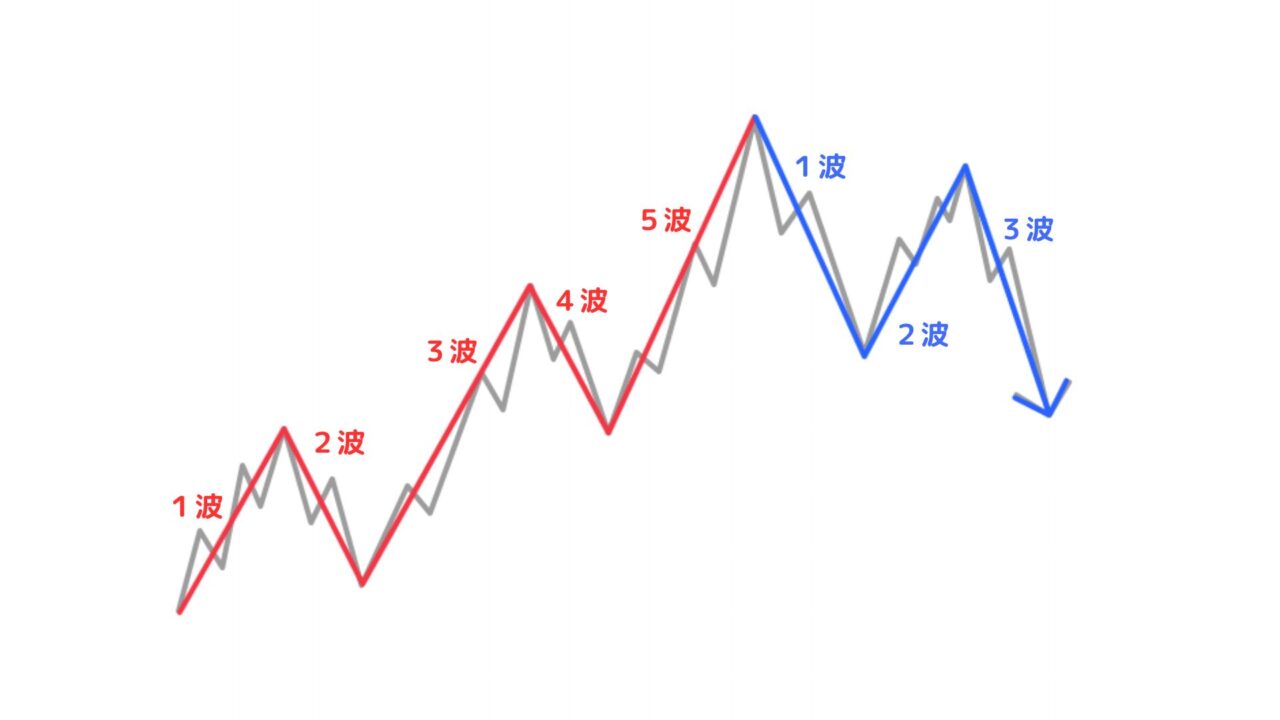
Elliott Wave Theory is based on the idea that market price movements in stocks, currencies, and other markets follow certain patterns.
It mainly consists of five upward waves (impulse waves) and three downward waves (corrective waves), and is used to analyze market cycles and trends.
- Impulse waves(Upward phase): 5 waves (1, 2, 3, 4, 5) indicating an uptrend.
- Corrective waves(Downward phase): 3 waves (A, B, C) indicating a downtrend. (In the image it is written as 1, 2, 3 waves, but the proper labeling is A, B, C.)
I do not claim to understand all aspects of correction waves or wave counts, and it would be extremely long to cover here, so I will skip those details.
Because counting is not the goal...
■How to apply environmental recognition
Now, let’s look at how to practically perform environmental recognition.
Dow Theory involves looking at where you cut the chart, which changes your perspective, so it can be a bit tricky. Don’t worry, I will explain with diagrams.
How to identify trends
Most traders in the world are aware of “6.Trends continue until a clear reversal signal occurs” when analyzing charts (scalpers may not look at it as much though...).
As mentioned in my past articles, the basic form in Dow Theory is“Higher highs and higher lows continue” indicates an uptrend.A downtrend is the opposite.
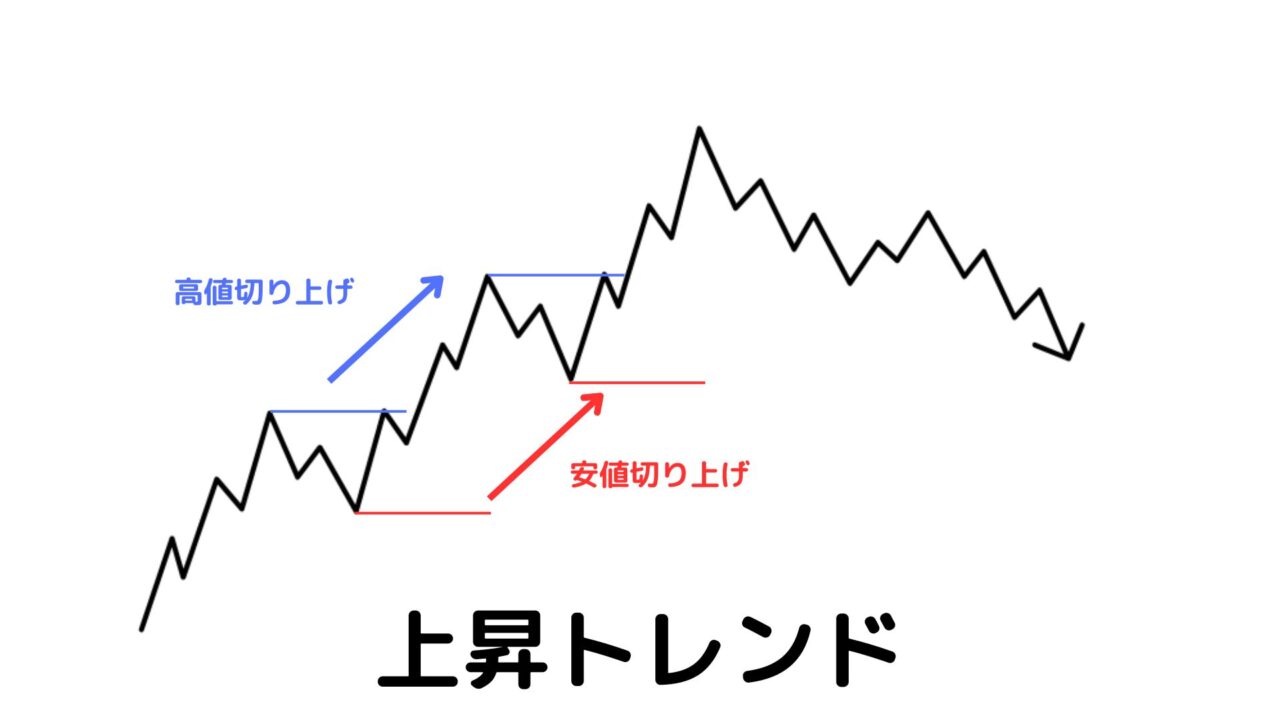
Thissignal collapses when there is a trend reversal.