
What are dot charts and neutral rates!?
Today, on December 20, 2018, at 4:00, the FOMC policy rate and statement will be announced. A press conference by Fed Chair Powell is scheduled for 4:30. The market is pricing in a rate hike at this FOMC. With that in mind, there are two points to watch, as I see them.
1)Dot Chart
2)Neutral rate
I’ve summarized each below.
1) Dot Chart
A dot chart is explained as follows.
“The target federal funds rate path is shown as a scatter plot, with each dot representing a member’s view of the appropriate level of the federal funds rate (FF rate) for the policy rate.”“This is the policy rate outlook published by the Federal Reserve Board (FRB) members, four times a year in March, June, September, and December.” reference: Nomura Securities.
First, FOMC members consist of the chair, vice chair, and governors of the Federal Reserve Board, plus the presidents of the 12 Federal Reserve Banks. In the FOMC, they discuss monetary policy and express their views on future interest rate forecasts over the next three years as dots. The chart representation of those points is called the “dot chart.”
Because each member forecasts rates, there can be dispersion or skew. The median of the dots becomes the forecast for the FF rate, i.e., the U.S. policy rate.
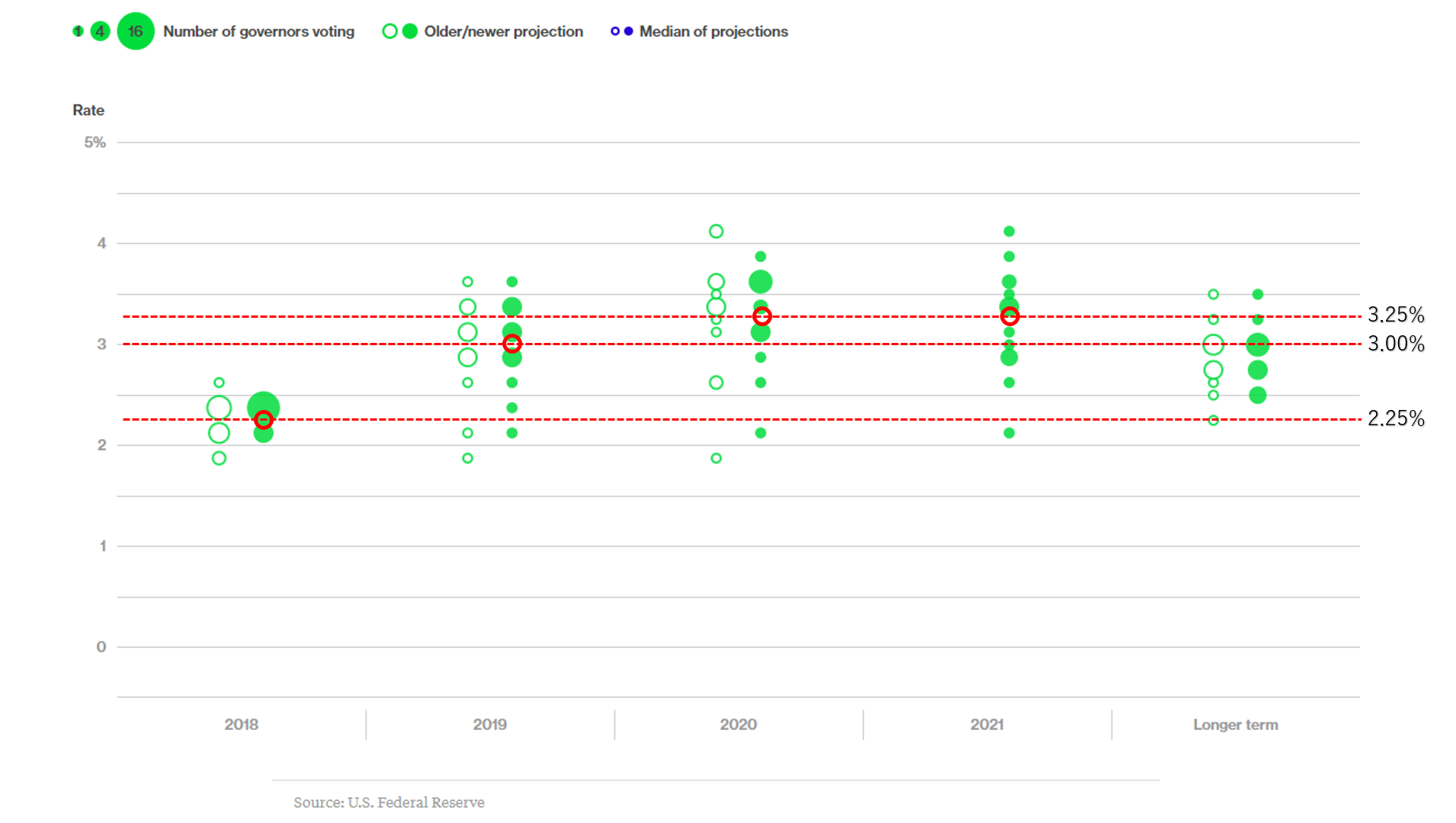
The above is the dot chart published at the September 2018 FOMC. I’ve roughly highlighted the median in red. The policy rate in September was 2.25%. In the chart, the 2018 dots cluster around 2.25% to 2.50%. This implies that by the end of 2018, the policy rate is expected to be around 2.25%–2.50%. By the end of 2019, it is expected to be around 3.0%–3.25%.
With the end of September at 2.25%, a December rate hike would bring it to 2.50%. If there are 2–3 hikes in 2019, it would reach 3.0%–3.25%.
In this way,looking at the dot chart reveals the projected number of rate hikes. They are published at the FOMC meetings in March, June, September, and December.
The 12 regional Federal Reserve Banks are the 12 banks under the FRB (the Federal Reserve System).
Note that both are part of the “FRB.” However, the common names differ, so be careful not to confuse them.
Federal Reserve Board / Federal Reserve System →FRB→Common name: FRB
Federal Reserve Banks →FRB→Common name: the regional banks
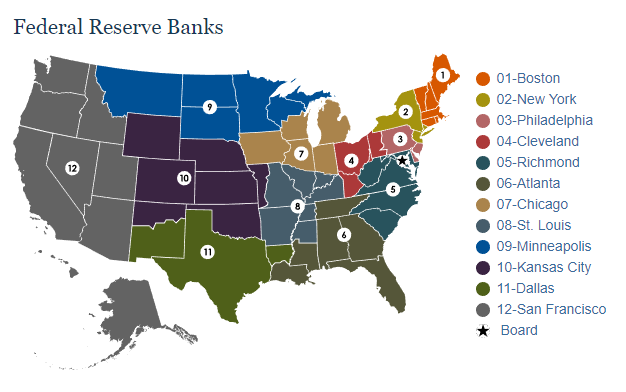
See the FRB website for reference
2) About the Neutral Rate
In the recent remarks by Fed Chair Jerome Powell, attention has focused on the “neutral rate.”What is the neutral rate?It is the level of the interest rate that neither stimulates nor restrains economic activity.
Chair Powell had said in October that the neutral rate was still far, but by late November his remarks shifted to “slightly below neutral.” In October he said the economy still needed rate hikes to reach a good level, but by late November he indicated that the rate hikes might soon be finished, approaching the neutral rate.
With this statement, concerns about the end of rate hikes surged.This time, the focus is on what the neutral rate actually is.
At this press conference, attention is on what the neutral rate is. For example, if the neutral rate is around 3%, then with a December hike to 2.5%, another 0.5% of hikes would bring us to the neutral rate. Two more hikes of 0.25% each would reach neutral. Therefore, if two hikes occur in 2019, that would imply the end of rate hikes. The prospect of rate hikes ending would also imply the end of dollar buying. I’d like to watch this together with the dot chart.