
This time, not billions but trillions of people! Warren Buffett’s record of all trades during the crash – average holding period is only 3 years

Hello everyone, I’m master_k.
In this series, I will introduce the techniques of investing used by friends who have become billionaires and by billionaires around the world, as I aim for assets over one hundred million!
By the way, do you know the shortest way to improve your investment results? It is to analyze how people who are making money do it and imitate them.
So, this time it’s not about billions but trillions—an overview of Warren Buffett’s IT bubble and Lehman Brothers era trades. He massively increased his assets during crashes!
Table of contents
2. IT bubble burst and Lehman shock: what Buffett did
2-1. The stock market crash and Buffett’s buying timing
2-2. The financial stocks Buffett bought and sold
3. Reasons for buying financial stocks
4. Supplement: Buffett’s trading cycle is about 3 years!
5. Supplement: raw data of Buffett’s holdings
1. Introduction
As of 2018, given the business cycle and various indicators, there are voices that stocks may crash soon.
I feel the same.
Like earthquakes, stock market crashes are unpredictable. However,it is possible to profit by acting wisely after a crash.
Therefore, shifting from prediction to countermeasures, to achieve large profits in the stock market, I have summarized Buffett’s actions after stock market crashes.
2. IT bubble burst and Lehman shock: what Buffett did
Next, let us look at Buffett’s buying timing and stocks after crashes.
2-1. The U.S. stock market crash and Buffett’s buying timing
Now, let’s look at the trend of the U.S. stock market (SP500) and Berkshire Hathaway (Buffett’s investment company) cash ratio from late 1997 to August 2018.
Note: The cash ratio is based on Berkshire Hathaway’s annual report balance sheet, aggregated as Cash and U.S. Treasuries (short-term government securities). The cash ratio is calculated by dividing the value of Buffett’s holdings by Berkshire’s total holdings value.
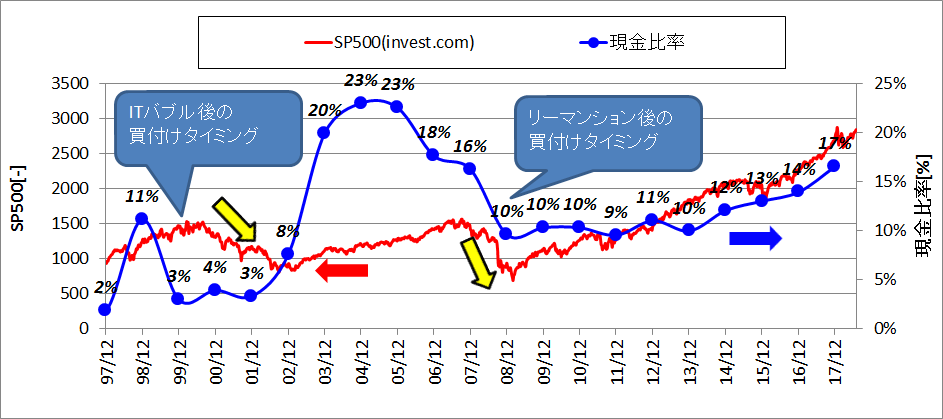
Now, from this figure, the following can be observed.
• The IT bubble burst occurred in 2000. Just before that, cash reserves declined (11% to 3%), indicating heavy buying (slightly mis-timed?).
• 2002–2007 saw a lot of cash on hand; cash reserves were clearly high.
• Lehman shock was in 2008. There was substantial buying in 2008.
In short, Buffett increases cash during good times and buys stocks aggressively when prices crash.
Next, let’s look at Buffett’s asset management performance.
The blue plot represents the value of Berkshire Hathaway’s stock holdings.
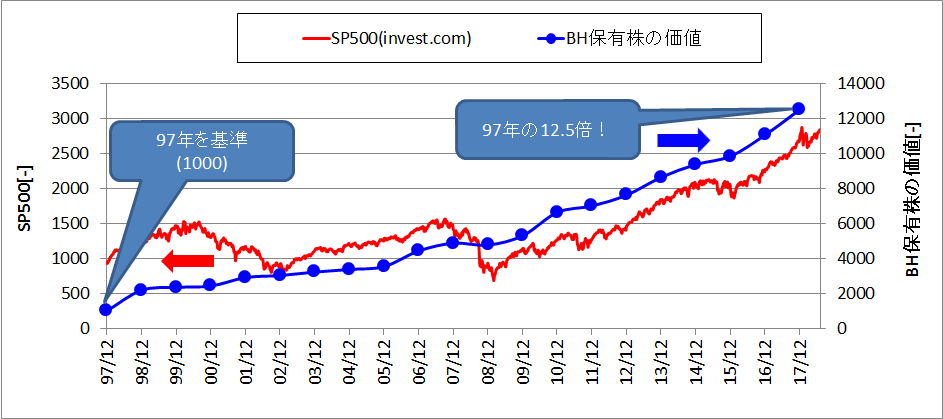
From the end of 1997 to the end of 2017, performance was extraordinarily high, with the value of holdings increasing by 12.5 times! (about 13.5% annualized).
In comparison, it clearly outperformed the SP500 (which only tripled at most).
2-2. Stocks Buffett bought and sold
Now, let’s look at the stocks Buffett traded. From the end of 1999 to the end of 2017, there were 136 companies that he held at least temporarily. To avoid argument, we will focus onstocks bought and sold after crashes with a market value over 50 billion yen.
Note that data is calculated from the number of shares held at each year-end, so stocks bought/sold within a year are not fully captured, please understand.
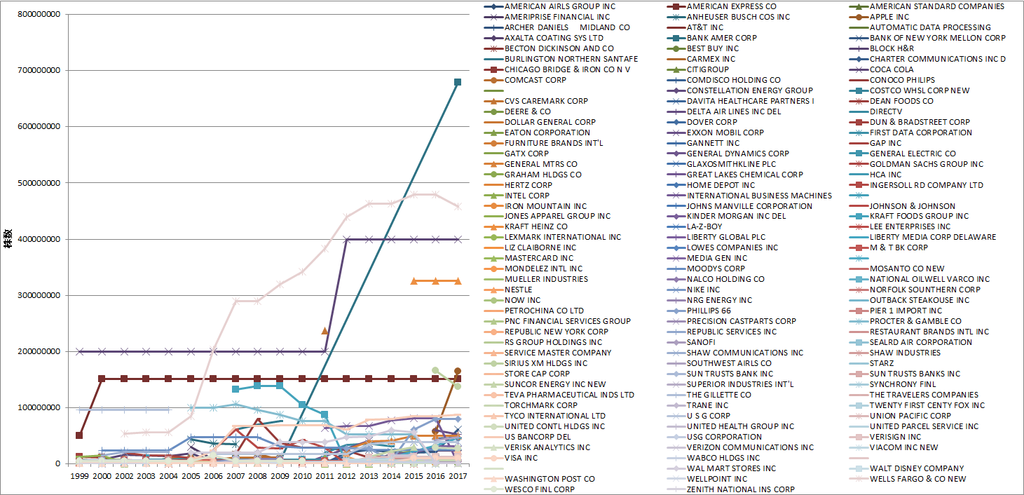
Right before to right after the IT bubble
1999… no data from 1998, so cannot identify the bought stocks.
2000… purchased American Express (AmEx) for 555 billion yen. No sales above 50 billion.
| Buy | AmEx | 5552 billion yen |
| Sell | None | - |
Right after Lehman shock
2008
・ConocoPhillips (oil company) bought for 3230 billion yen.
・Goldman Sachs (investment bank) preferred shares (10% dividend) bought for 5000 billion yen.
・Anheuser-Busch (beer), Johnson & Johnson, P&G, etc.—Buffett holdings were heavily sold (total 4440 billion yen)
・Burlington Northern Santa Fe Railway bought for 770 billion yen
(Berkshire acquired in 2009; this was for that purpose)
| Buy | Burlington Northern Santa Fe Railway | 771 billion yen |
| ConocoPhillips | 3232 billion yen | |
| Goldman Sachs (preferred shares) | 5000 billion yen | |
| Sell | Anheuser-Busch | 1871 billion yen |
| Johnson & Johnson | 1983 billion yen | |
| P&G | 589 billion yen |
2009
・Walmart purchased for 1020 billion yen. Wells Fargo (bank) purchased for 810 billion yen.
・大量に売却したConocoPhillips (bought last year) (2150 billion yen). Buffett later said that buying ConocoPhillips was a mistake. See the link below for details.
Buffett recorded over 1000 billion yen in losses on ConocoPhillips trades! Also, the world’s top 3 investment failures and lessons.
● Top 3 investment failures in the world and lessons learned
Following last year, sold P&G again (530 billion yen).
• Burlington Northern Santa Fe Railway bought for 660 billion yen
(Berkshire acquired in 2009; this was for that purpose)
| Buy | Burlington Northern Santa Fe Railway | 659 billion yen |
| Walmart | 1021 billion yen | |
| Wells Fargo | 805 billion yen | |
| Sell | ConocoPhillips | 3154 billion yen |
| P&G | 534 billion yen |
How about that? The common thread in Buffett’s post-crash buying is simple: he buys a lot of financial stocks.
• After the IT bubble, he bought financial stocks.
• After Lehman, Buffett sold Buffett stocks to buy Goldman Sachs (financial) and ConocoPhillips (oil stock).
• When ConocoPhillips’ purchase proved a mistake, in 2009 he sold it and bought Wells Fargo (bank).
3. Why buy financial stocks
Next, why does he buy financial stocks? Let’s consider.
The answer becomes clear when you look at stock price movements.
The figure below shows the price trends of Buffett’s post-IT bubble and post-Lehman buys.
Note 1: ConocoPhillips trades are acknowledged as a mistake, so omitted.
Note 2: Only data after 2008 for Anheuser-Busch are available, so use as reference.
Note 3: 1997 year-end stock price is set as 1.0.
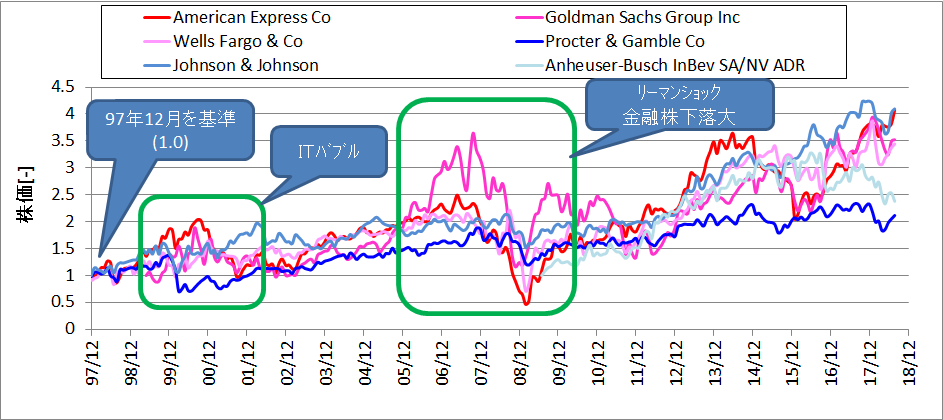
Now, if you look at financial stocks (red) versus non-financial stocks (blue), it becomes intuitive that after Lehman, financial stocks fell sharply, but then recovered strongly.
If you extract the numbers from the table, it becomes even clearer. Financial stocks fell 63–81% during Lehman, and then rose 240–781% afterwards.
| Financial stocks | Consumer goods | |
| IT bubble decline | 29–54% | 33–49% |
| Post-IT bubble rise | 91–276% | 86–166% |
| Lehman decline | 63–81% | 29–36% |
| Lehman rise afterward | 240–781% | 96–178% |
On the other hand, non-financial stocks fell only 29–36% during Lehman and rose 96–178% afterward.
During the IT bubble, the signal existed but the gap between financial and non-financial stocks was smaller (likely because the stock price fell not due to financial products).
More detailed data are also provided in the table below.
| AmEx | GS | WellsFargo | P&G | J&J | |
| IT bubble decline | 54% | 49% | 29% | 49% | 33% |
| Post-IT rise | 169% | 276% | 91% | 166% | 86% |
| Lehman decline | 81% | 68% | 63% | 36% | 29% |
| Lehman rise | 781% | 240% | 444% | 96% | 178% |
Now... have you understood?
Buffett, knowing that after crashes financial stocks fall sharply and recover sharply, and that non-financial stocks fall less and recover less,
1) increases cash before a market crash,
2) buys financial stocks after a crash,
3) buys more financial stocks by selling non-financial ones when cash runs short,
and profits greatly when the market recovers afterward.
Indeed, a rational approach.
So, regardless of whether this will hold in the future, buying U.S. financial stocks during a U.S. stock crash can be considered a prudent investment method.
Finally, I checked whether this method would apply in Japan as well.
I selected three large-cap banks, but unlike the U.S., their stock prices did not rise to Lehman-era highs and have not recovered.
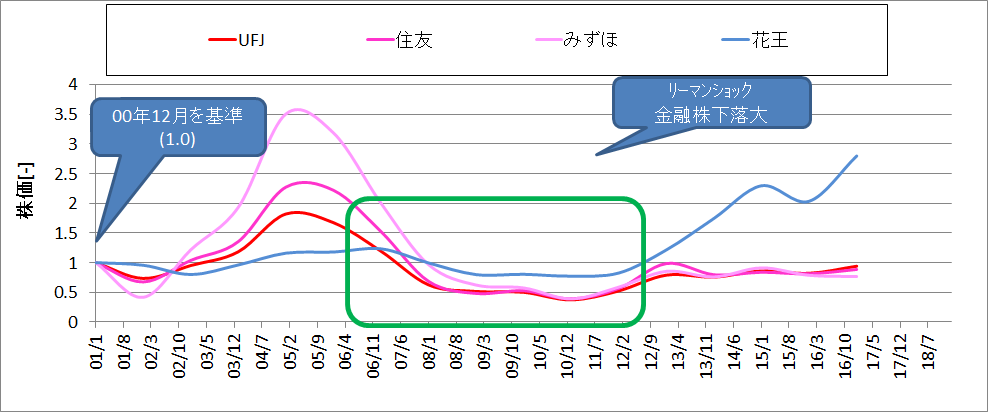
This is because Japanese banks’ earnings have not grown. Even the latest Mitsubishi UFJ Financial Group results show recurring profit declining.
| Year | Ordinary income | Ordinary profit | Profit margin |
| 2015 | 5兆6384億円 | 1兆1713億円 | 30.4% |
| 2016 | 5兆7144億円 | 1兆5395億円 | 26.9% |
| 2017 | 5兆9796億円 | 1兆3608億円 | 22.8% |
Therefore, in Japanese stocks, Buffett’s exact method does not work.
I have written another article about how to profit in Japan after stock market crashes, so if you’re interested please check it out.
After Lehman, Japanese financial stocks did not rise; what rose were machinery and automobiles. This is a different approach to profiting in Japan after a crash compared to the U.S.
● How to profit in the Japanese stock market after the Lehman shock, based on stock price trends
4. Supplement: Buffett’s trading cycle is about 3 years!
When people think of Buffett, the famous line is, “My favorite holding period is forever,” but in reality there are few truly evergreen, promising stocks.
From 1999 year-end to 2017 year-end, studying the 136 holdings, here are the findings.
Always-held for 18 years: 4 companies (AmEx, Coca-Cola, M&T Bank, Torchmark)
Bought after 1999 year-end and sold by 2017 year-end: 83 companies
Held from before 1999 year-end and still held at end of 2017, with holding period not determinable: 49 companies
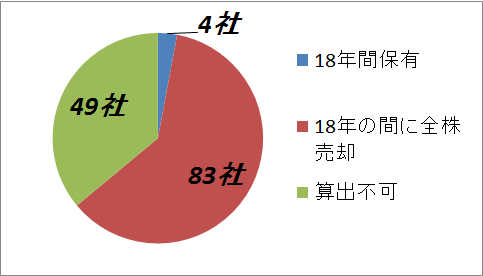
As a result, the stocks held throughout are only4 companies.
Also, among the 83 companies bought after 1999 year-end and sold by 2017 year-end, their holding periods are classified as follows.
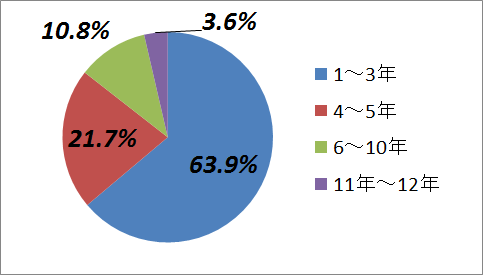
63.9% were fully sold within 1–3 years (53 companies).
Remarkably, only 3.6% were held for over 10 years. Does this imply there are very few stocks with long-term value?
Moreover, the average holding period for these 83 companies was a mere 3.2 years... quite short!
Thus, Buffett’s actual trading is, in practice, quite frequent, contrary to popular image.
Indeed, researching matters yourself is important. Ideally, hold forever, but sell sharply if you determine a stock is not profitable... This episode helps me understand why Buffett greatly outperformed the market.
5. Supplement: Buffett’s raw stock data
I’ve compiled Buffett’s holdings from 2000 to 2017 into an Excel file for download.
Click the links below to access.
Yahoo! Box — raw Buffett stock data used this time
The original data can be downloaded from the U.S. SEC, but compiling it is quite a task, so please feel free to use it.
Note: U.S. institutional investors are required to disclose quarterly holdings to the SEC. Form 13F is the report, and you can verify this report from the following link.
With that, this concludes.
In addition to thisI also publish useful investment information on my blog!Please give it a read!
My blog: shameless! — Aim for 100 million in pocket money! A blog that exposes all asset-accumulation results
Written by: master_k