

Can you become a hundred-millionaire with this? A summary of how a famous investment blogger operates and their assets

Hello everyone. This is master_k.
In this series, I will introduce the investment techniques of friends who have surpassed 100 million and other millionaires’ investment methods and performance!
By the way, do you know the fastest way to improve your investment results? It is to analyze how profitable people operate and imitate them.
With that in mind, this time we summarize the investment methods and performance of famous investment bloggers.
2. Introduction of famous investment bloggers
1. The Complete Edition! Summary of investment methods, principal, and risky assets of famous investment bloggers
Now, here is the summary.
The map below lists each blogger’s method, principal, and amount of risky assets.
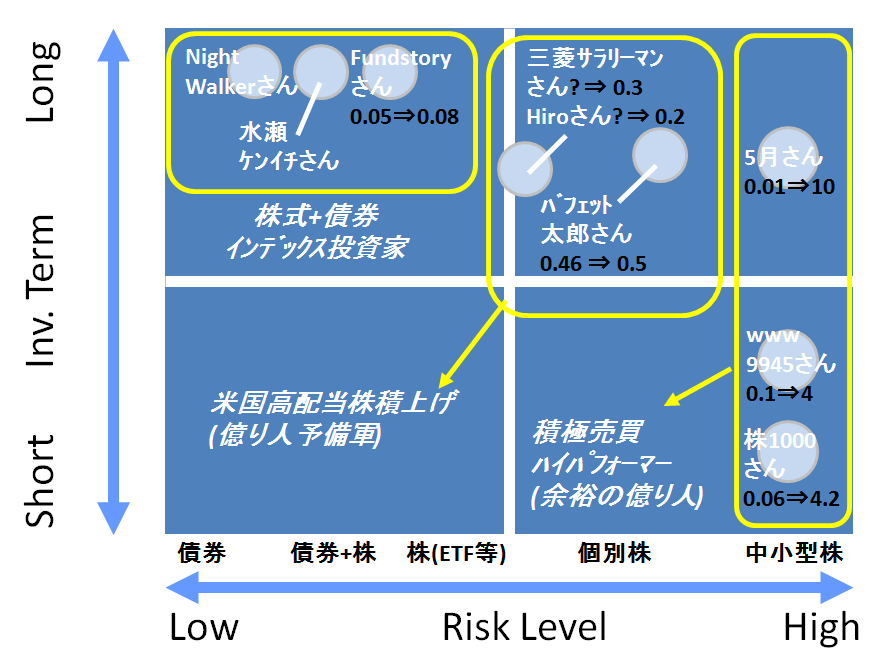
Note: The horizontal axis shows the assets being invested (from left to right: bonds ⇒ stocks (ETFs, mutual funds) ⇒ individual stocks ⇒ mid/small-cap individual stocks).
Note: If there is a gap between bonds and ETFs or mutual funds, it means both are being purchased, but some people buy both stocks and bonds, so this is only a rough guide.
Note: The black numbers to the right or below the blogger’s name indicate the investment amount and the latest (as of the blog) value. The unit is "hundreds of millions of yen."
Now, as a result, it seems we can divide into three patterns.
1) Proactive trading high-performance investors
2) US high-dividend stock stacking investors (Jeremy Siegel's Children)
3) Stock + bonds index investors (Lombard Street’s Random Walker)
Among these, those who publicly disclose their asset amount and have become billionaires all fall into pattern ①. Also, those in pattern ① have become billionaires even with relatively small seed capital.
In other words, people in pattern ① are analysts who conduct meticulous research or genius trader types.
If your seed capital is small, aim for this type!
People in pattern ②, the US high-dividend stock stacking investors, have not reached a billion yet, but have already reached 20-50 million yen, and are expected to surpass a hundred million in the not-too-distant future.
This is because, despite a short investment period, they have dramatically increased their assets. All three began this style since 2015, so they reached this amount in less than three years.
The dividends from high-dividend stocks are 4% or less, and the years of operation are three years or less, so it’s not reinvesting dividends butan earnest effort of allocating substantial investments from salarythat seems to be the case.
This investment method is in stocks, but it has aspects of a “high-interest savings” and, because it is stocks, an aspect of a “thing” that is resilient to inflation. If you have the purchasing poweryou’ll be invincible.
If your funding ability is high, this investment method is undoubtedly the right choice. It also greatly reduces risk.
Pattern ③ investors, who are already self-evident, are those who accumulate investments in index funds or ETFs and hold the buy-and-hold line, with a steel will not to sell after buying.
(Excluding selling profitable assets and buying assets with losses)
The valuation of risky assets is often not disclosed, but as an exception, fundstory publishes both the accumulated amount and the valuation completely, which was very educational.
Unfortunately, they stopped updating the blog in 2014. However, just reading this blog makes you feel like you’ve made money in investing, which is strange lol
A Poor Person’s Investment Trust Tale
Now, here is the summary.
- Famous investment bloggers (excluding ultra-short-term traders like day traders) can be broadly divided into three methods.
- Those who are good at analyzing individual securities or who can trade genius-level can build trillions of yen in assets with seed money in the hundreds of thousands of yen.
- If you work hard to invest as much income as possible, continuing to buy US high-dividend stocks can build assets in the tens of millions, and you can obtain a relatively stable dividend income.
2. Introduction of famous investment bloggers
Now, here is the introduction of famous investment bloggers shown in the map above.
1) Proactive trading high-performer investors
www9945
They are well known for publishing the book “How I Saved 100 Million Yen Why I, a Cleaner, Earned 100 Million Yen.” Currently, they are retired from corporate life and living off stocks.
kabu1000
Investment history of 25 years, only one negative year in the last 17 years, yielding an astonishing investment performance.
5g Kyo
They turned 650,000 yen into 1 billion yen. That return is 153,800%.
That is astonishing. Investment method is long-term investment in small-cap value stocks.
Because of their analytical power, they also served as an analyst at Leos Capital Works, which manages Hinomitsu Fund, making them arguably the pinnacle of individual long-term investors.
2) US high-dividend stock stacking investors
Mitsubishi Salaryman
They switched from FX to stock investing and increased to 30 million yen in just two years.
Income is 9 million yen, with 80% allocated to investments, so about 7 million yen per year.
Reading his blog, assets steadily grow, and just by reading you feel rich and get energized.
His investment method is thrilling to watch, even bordering on madness.
Hiro
He is an excellent person who passed the Certified Public Accountant exam on the first try.
Like Mitsubishi Salaryman, a stable high salary×aggressive buying of high-dividend stocks seems to pair perfectly.
Buffett Tarou
Buffett Taro’s Secret Portfolio (US stock dividend reinvestment strategy)
A famous blogger who published the book “Even a fool can earn money with US stocks: High-dividend investing.”
Already built assets of over 50 million yen.
Unlike the other two, he focuses on high-dividend stocks in a single category and narrows to 10 holdings.
People who set such investment rules are strong.
3) Stock + bonds index investors
fundstory
A Poor Person’s Investment Trust Tale
I studied investments for a huge amount of time through books and the Internet, but
nothing educated me as much as fundstory’s pages.
At that time, I mainly invested in index funds, but
there were few index investors who disclosed their investment amounts and valuations.
This person disclosed actual investment amounts, so
during the tough times of the Lehman Shock, I looked at fundstory’s asset progression and thought, I also have significant losses, but so does this person...
Reading their calm, resigned writings and steadily adding to investments, I thought, this crash must be temporary and now is the time to buy, which has led to today’s profits.
I myself see fundstory as a mentor and comrade (my own view lol).
Four years since the blog stopped, I look forward to their return someday.
Kenichi Minase
A representative index investor in Japan, as you know.
I’ve been reading for seven years, and it is truly informative.
NightWalker
This person is also a representative index investor in Japan.
I’ve been reading for seven years as well.
Now, have the investment methods of these famous bloggers been useful to your investments?
Then that’s all for now.
In addition to this We also publish investment information useful for blogs!Please give it a read!