
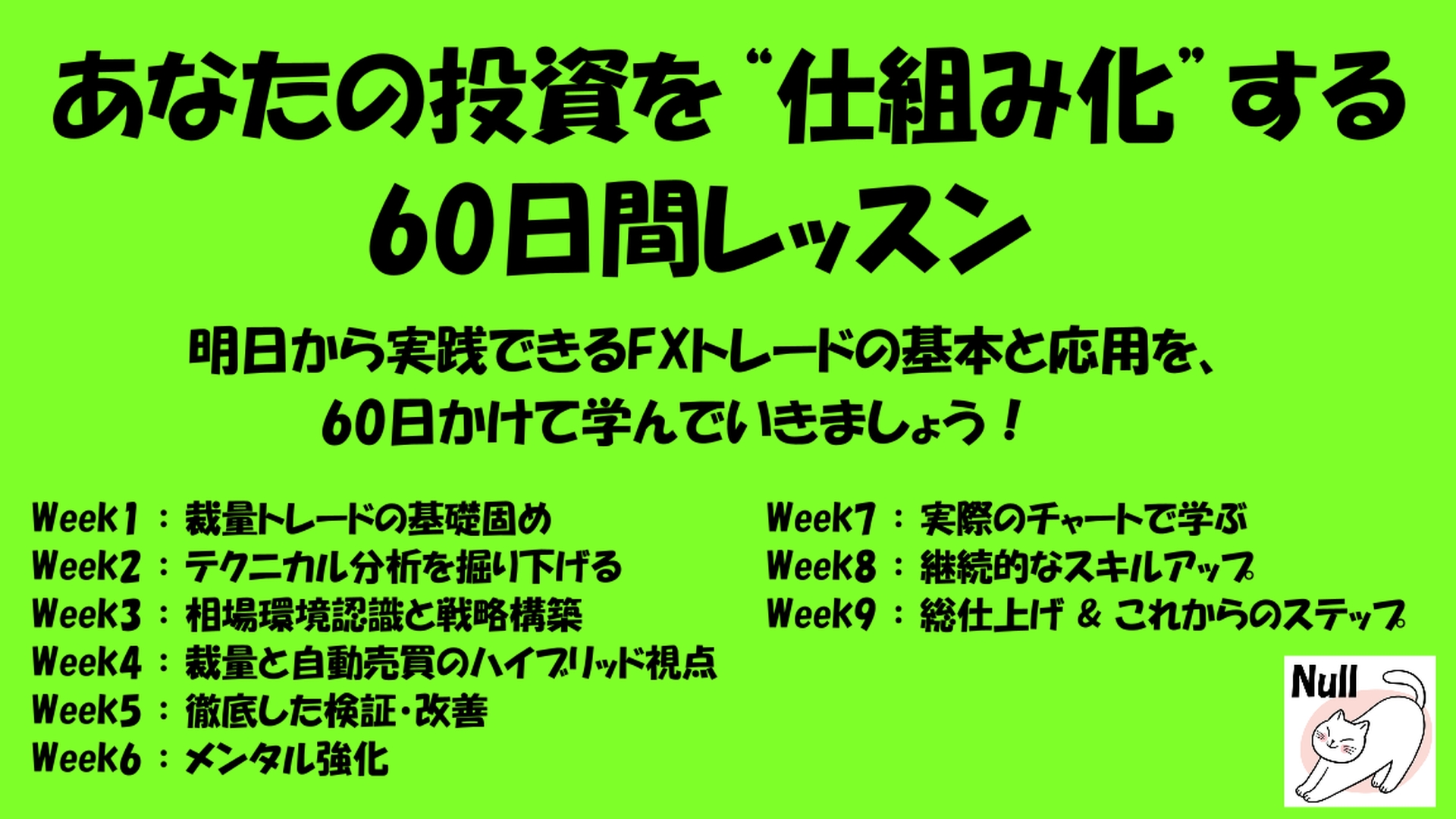
Final Episode: Course Summary – Towards Your Trading Career Ahead
So far, over a long period in this course, learners have studied all the elements traders need, such as “verification, mental resilience, adaptation to market environment, risk management, and annual planning.” etc.,
Here, as the final sessionwe will provide a comprehensive recap of the entire course and organize how to apply it to future trading life. Please use this as a reference for the final polish.
1. Reflecting on the entire course: key points
(1) Verification (backtesting & forward testing)
- Purpose:Confirm, using past markets and demo/small lots, whether one's method yields a positive expectancy.
- Caution:To avoid over-optimization (the optimization trap), the rule is to run a PDCA cycle of small adjustments → re-testing → forward testing.
- Outcomes:If verification becomes a habit, you can set rules such as stop-loss width and take-profit width based on data, making them easier to follow.
(2) Mental strengthening
- Issues:Human psychology factors such as fear of taking profits early, rejection of stop losses, anxiety after a losing streak, and overconfidence after a winning streak can distort trading.
- Measures:
- Distinguish “correct mistakes vs. incorrect mistakes,” and treat mandated stop losses as “necessary expenses.”
- Habits outside trading such as exercise, sleep, and meditationto support the mental foundation.
- Set clear lot adjustments after losing/winning streaks and a rule to pause trading.
- Outcomes:With a stable mind, even during drawdowns or sudden market moves, you are less likely to crash and can calmly follow the rules.
(3) Responding to market environment (market condition recognition & strategy fine-tuning)
- Markets are always changing:From trends to ranges, from high to low volatility.
- Approach:
- Grasp “the current market” on both technical (moving averages, oscillators, Bollinger Bands) and fundamental (data releases, interest rate policies, political factors) sides.
- Flexibility is key: turn on/off adjustments such as stopping EA in difficult markets or reducing lot sizes, and actively trading in favorable markets.
(4) Risk management
- Elements:Position sizing (lot size, leverage), stop-loss & take-profit settings, correlation risk across multiple positions, ON/OFF by market conditions.
- Total risk awareness:When running multiple logics simultaneously, avoid having too many positions in the same direction.
- Drawdown countermeasures:If drawdown exceeds expectations, pause operation or reduce lot sizes.
- Goal:Create a system that does not blow up the account in any market.
(5) Annual planning & continuous learning
- Long-term perspective:Clarify not just short-term results but targets such as “what percent over a year” and how to review monthly/quarterly.
- PDCA cycle:Review performance weekly, monthly, and quarterly, and make small adjustments. Limit major changes to about once every three months to prioritize stability.
- Ongoing learning framework:Institutionalize verification & backtesting, trading journals, and information exchange in communities or social networks.
- Integration with daily life:Choose a sustainable style that fits work and family balance without forcing yourself, to maintain consistency and performance.
2. Final advice for continuing your trading life
-
A single finish is not the end
- Even a “finished system” needs gradual updates as market environments and personal life change.
- Even with big changes, applying PDCA to adapt increases the likelihood of long-term success.
-
Prioritize “rules you can actually defend”
- Even the theoretically strongest system is useless if you cannot follow it mentally or end up repeatedly violating stop losses.
- Start simple, with rules that are easy to implement, and gradually advance to higher complexity for stability.
-
Accept the right mistakes and trust the expectancy
- Stop losses are necessary costs, and losing streaks may reflect periods when the market doesn’t fit—staying statistically consistent prevents wobbling.
- If long-term win rate and profitability (PF) are positive, even during drawdowns you can plan and eventually regain profit with confidence.
-
Habits outside trading have a big impact
- Mental and health status depend on daily exercise, sleep, and refreshment.
- Secure trading hours and off days, balance hobbies and time with family, which stabilizes mental state and improves performance.
3. Path for further study and growth after graduation
-
Next steps: exploring applied techniques and specialized fields
- Examples: options trading, futures, cryptocurrencies, and other applications beyond FX.
- If interested, delve into advanced technicals (Elliott Wave, Gann theory, etc.) or AI applications.
-
Deepening fundamentals
- Studying each country’s interest rate policies and macroeconomics can make long-term trend forecasts for currency pairs more accurate.
- Also strengthens swing and long-term investing capabilities.
-
Community and information sharing
- Outputting what you’ve learned in blogs or social posts leads to further growth from feedback from others.
- Having study groups or trading peers provides motivation and stimulation, increasing persistence.
-
Reiterating: PDCA is everything
- There is no perfect method. Tailor to market conditions and your lifestyle, and keep making small adjustments and verifications.
- A long-term, steady accumulation yields substantial results.
4. Toward the next phase of your trading life
-
Main themes learned in this courseare:
- Verification(Backtesting & Forward testing)
- Mental(Handling losses, win/loss streaks, habits outside trading)
- Market environment adaptation(Whether the market is trending or ranged, around data releases, fundamental factors)
- Risk management(capital management, stop loss & take profit, correlations across multiple positions, ON/OFF switching)
- Annual planning & ongoing learning(Yearly goals, PDCA, designing a trading life)
-
Final message:
- Even if the chosen method or logic isn’t perfect, use the cycle of verification → practice → review, along with proper risk management and mental care, to stand a good chance of long-term success.
- Trading is an endless journey of knowing yourself, knowing the market, and continually controlling risk. Based on the knowledge and skills you have learned thus far, please establish a trading style that fits you.
This marks the end of the course! Thank you for your hard work
Thank you very much for watching this long course until the end.
Trading is a lifelong learning—an incredibly deep world. I hope this course helps your trading life and brings some success and joy.
- Please continue in the future:
- Review monthly and weekly, and gradually update rules to fit market conditions and you life style.
- Output what you’ve learned and share with peers to improve skills.
- If you encounter drawdowns or major market moves, cut losses, maintain risk management, and keep PDCA running.
Wishing abundant success in your future trading life.Thank you!
If you’re interested in automated trading, please check the link below as well.
https://www.gogojungle.co.jp/users/147322/products
If this was helpful, please click “Read more.”
Thank you.