
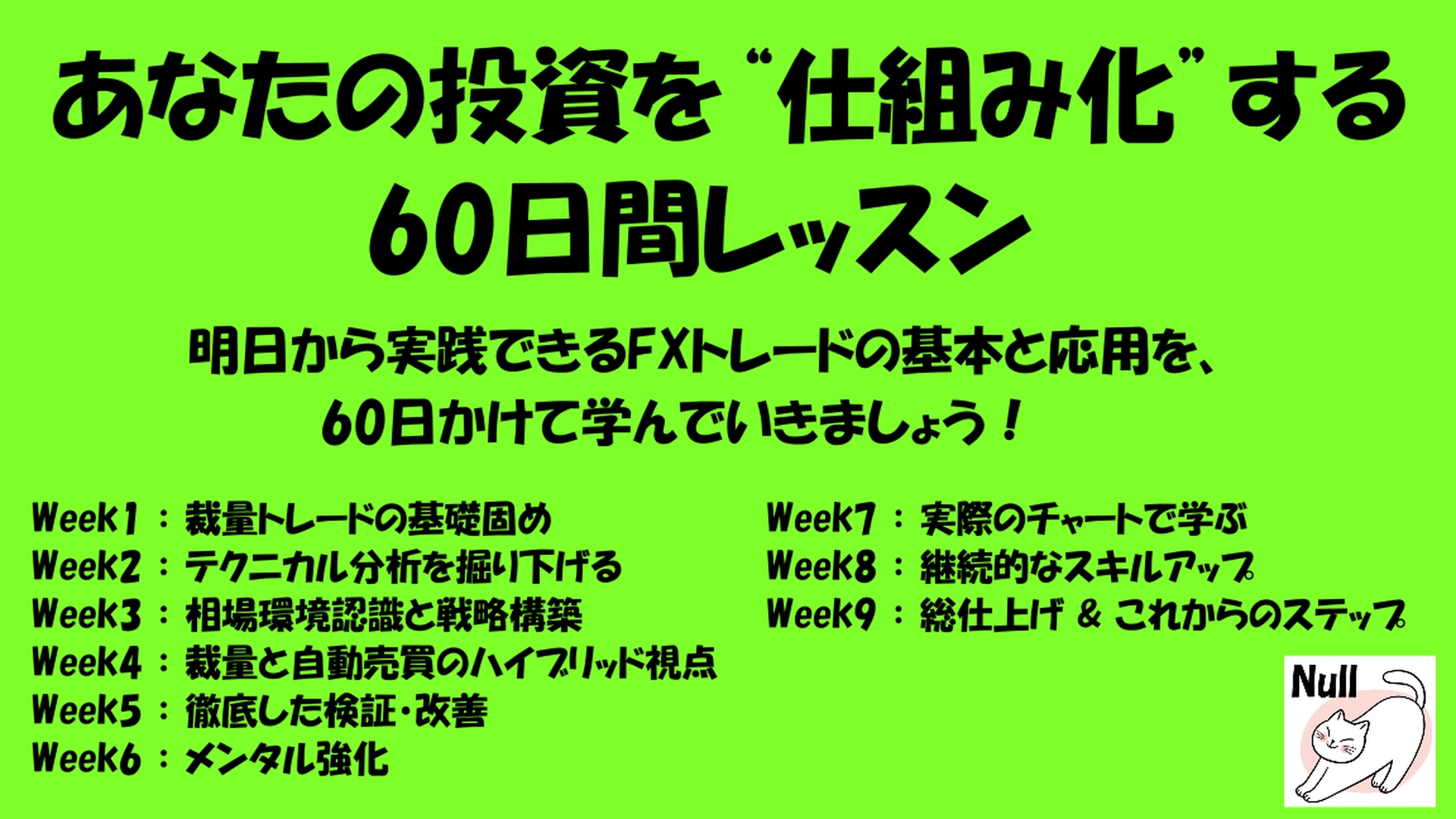
DAY 59: Integration of Annual Plan and System Operations – A framework for growth throughout the year
On DAY 58,Concrete examples of completing a trading systemwe introduced several, and looked at how to manage risk by combining multiple approaches.
TodayDAY 59as a theme, the **“fusion of annual planning and system operation”**,we will think more about how to operate and learn throughout the yearin detail.
As you have already learned, trading is not only about short-term wins and losses, but also about a long-term approach that builds expected value. Here we will explain how to operate and verify the system (EA, discretionary, etc.) on an annual basishow to operate and verify the system (EA, discretionary, etc.) on an annual basiswith concrete examples.
1. Why is an annual perspective important?
-
The market environment changes with seasons and fiscal years
- There are seasonal factors, such as yen moves at the end of the fiscal year (March, September) and thin trading with many ranges in summer (August).
- Looking at a one-year span makes it easier to grasp the “favorable periods” and “unfavorable periods.”
-
Stability of the mental state
- By aiming for “annual target achievement” rather than being swayed by monthly drawdowns, you can operate calmly.
- Even after a string of losses, you can have peace of mind thinking “you can recover by year-end.”
-
PDCA of verification and practical operation is easier
- Evaluate results every month, every quarter, and every six months, andmake small adjustmentscontinually.
- If you experience multiple market regimes over the year, you will clearly identify improvements for methods and mindsets.
2. Basic steps of annual planning × system operation
(1) Preparation: set goals and policies at the beginning of the year
- Goal setting
- Examples: “aim for annual return of +20%,” “increase capital from 1 million to 1.2 million,” etc.
- Also specify the expected maximum drawdown (e.g., keep within 20%).
- Systems used (EA, discretionary) and operating policy
- Determine the total upper limit of lots for trend-following EAs, range EAs, discretionary swing, etc.
- Reorganize pre-indicator pause rules and manuals.
(2) Monthly and quarterly reviews & adjustments
- End-of-month report
- Record key indicators such as “DD max 10%, PF 1.2, win rate 55%, +2%”.
- Compare market conditions (was there more trend? more range?) and performance by system.
- Quarterly overall review
- Major logic changes or stopping/adding EAs too often causes instability, so do itonce every three months.
(3) Year-end: final settlement & extracting tasks for next year
- Review annual performance
- Assess achievement rate, drawdown, monthly fluctuations, tendencies of favorable and unfavorable markets, and mental aspects.
- Decide which EAs or discretionary logics to discontinue or to continue reinforcing.
- Policy for the next year
- Decide on new areas to study (technical, fundamental, EA programming, etc.).
- Set directions such as “want to take more risk this year / want to reduce risk,” “reduce short-term trading and increase swings,” etc.
3. How to run operations and learning in parallel
- Split accounts operation: for live trading and learning experiments
- Live account
- Operate stably. Seek to achieve the goals while controlling risk according to the annual plan.
- Major rule changes are made about once per quarter.
- Learning account
- Test new EAs or new discretionary methods with small lots, demo or virtual is fine.
- Minimize impact on the live account whileverify new logic.
- Establish a short daily or weekly “learning time”
- Review trading notes
- Each day, briefly write the rationale for entries, mental state, and results, and read them over on the weekend.
- Backtesting and forward testing
- Improve logic or adjust parameters by dedicating about 30 minutes to 1 hour daily, progressing without overdoing it.
- Exchange information in S*S and communities
- Efficiently incorporate other traders’ perspectives and latest market analyses into daily learning.
- Regular review meetings (monthly or quarterly)
- At month-end summarize “this month’s results + learning outcomes”
- Review P/L, drawdown, patterns of success and failure, indicators learned and fundamental factors.
- Quarterly review
- If major changes exist, decide here whether to adopt them.
- Also check for over-optimization or mental health issues.
4. Case study: E’s annual operation scenario
-
Goals and assumed risks
- Account funds 500,000 yen → aim for +100,000 yen annually (20% annual return).
- Maximum drawdown limited to 15%. If DD exceeds 15%, halve the lot size to temporarily reduce risk.
-
Strategy composition
- EA1 (Trend-following / USD/JPY, EUR/USD / stop loss ATR×1.5)
- Discretionary scalping (GBP/JPY / only 2 hours in the evening / stop loss 10 pips, take profit 10 pips)
- Do not separate accounts; keep total risk on the same account limited to 3%.
-
Monthly operation flow
- DailyCheck market environment, set pre-indicator pause for EAs. In the evening adjust scalping lot sizes.
- WeekendSummarize trading notes, evaluate EA and discretionary P/L, PF, and drawdown. Adjust lot sizes if several consecutive losses occur.
- End of monthReview total net and drawdown, record achievement rate against target +○%/month.
- If experiencing large losses, reduce discretionary trading or turn off EAs for the next month.
-
Quarterly to year-end summary
- Update EA backtests every three months to ensure alignment with the latest market conditions.
- Year-endDetermine whether final profit is close to 20% annual return. If not, analyze reasons and feed insights into next year’s plan.
5. Summary & next episode
Summary
- By merging annual planning with system operation, you can avoid being swayed by short-term noise and pursue long-term expected value.
- Methods:
- Clearly define annual goals (e.g., annual return %) and a drawdown limit.
- Monitor performance monthly and quarterly, making small adjustments as needed (major changes should be quarterly).
- Carry out verification and learning in parallel, and track progress via daily trading notes and regular reviews.
If you’re interested in automated trading, please also check the link below.
https://www.gogojungle.co.jp/users/147322/products
If this was helpful, I’d be grateful if you click “Read more.”
Thank you.