
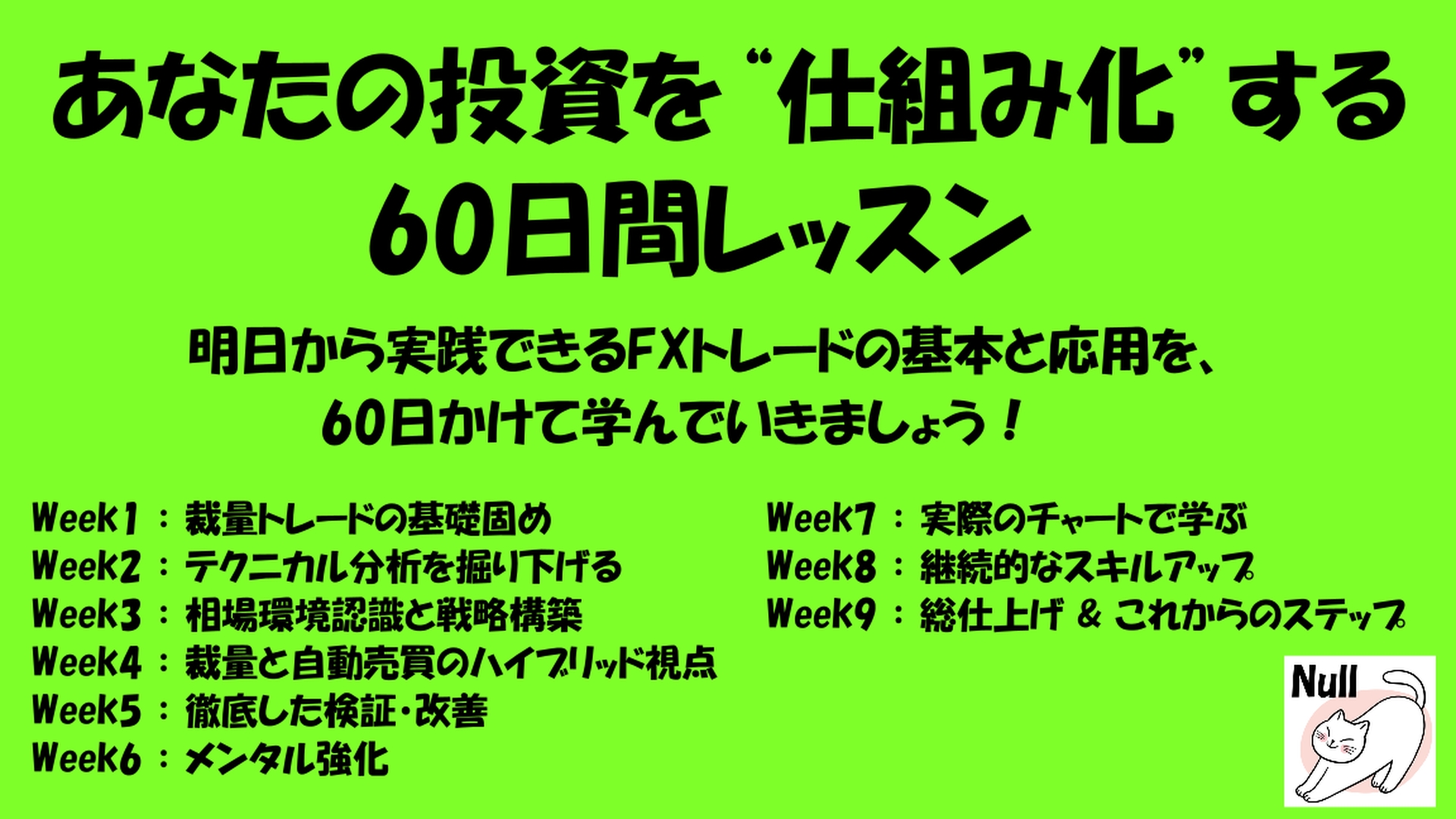
DAY 53: Setting annual goals and measuring performance
In DAY 52,Portfolio Designwe learned about risk diversification by combining multiple methods and currency pairs.
TodayDAY 53as,“Setting annual goals and measuring performance”will be the theme.
To avoid being swayed by short-term wins and losses,an operation plan with a long-term perspectiveis essential. If you decide in advance how long you will operate and what level of results you aim for, you will be less driven by losing streaks or winning streaks, making stable continuation easier. This time, we will coverthe method for setting annual (or monthly/quarterly) goalsandthe indicators to measure performance objectivelytogether.
1. Why are annual goals necessary?
-
Don’t be swayed by short-term fluctuations
- If you collapse mentally because a week or a month’s result shows “the method is bad…” or “the luck is bad…,”the long-term expectancyis hard to realize.
- Having annual goals makes short-term drawdowns easier to keep within plan and reduces impatience.
-
Maintain motivation and the PDCA cycle
- If there are concrete goals (annual return, +50,000 yen per year, etc.), the meaning of daily validation and adjustment becomes clear.
- By watching the gap to the goal, you can regularly adjust strategies and focus on mental management.
-
Aligning life rhythm with trading
- There are work, family events, and seasonal factors throughout the year. In such a context,you can plan when to focus on tradingand when to refrain, making it easier to keep going with less burden.
2. How to set annual goals
(1) Quantify by amount or %
- Example:
- Aim for +500,000 yen per year.
- Aim for +20% annual return (with 1 million yen, end of year 1.2 million yen).
- Key points
- For beginners, setting goals that are too large (e.g., 100% annual return) makes it hard to achieve.
- Based on past validation data and forward-test results,target a realistic range.
(2) Monthly/Quarterly sub-goals
- Reason
- Annual goals take a year to realize and make it hard to feel a short-term sense of achievement.
- Setting small goals monthly or quarterly makes it easier to adjust mid-way.
- Examples
- Monthly goal: +50,000 yen or +2%
- Quarterly: +100,000 yen or +6%
- Both tied to the annual goal (e.g., +500,000 yen or 20%).
(3) Drawdown tolerance level
- Example:
- Throughout the year,limit maximum drawdown to 30%.
- If monthly funds drop by 10% or more, halve the position size; if losing streak continues, take a week off… set concrete rules.
- Effect
- Setting an upper limit on declines helps maintain mental and financial stability.Prevents big crashes..
3. Key indicators for measuring performance
(1) Win rate and average win/average loss (risk-reward)
- Purpose
- Check whether the method has positive expectancy.
- Track win/lose streaks and decide actions during losses (e.g., adjust lot size).
- Caution
- Even with an 80% win rate, if average loss is large, you can be negative.Balance with the risk-reward ratiois important.
(2) Profit Factor (PF)
- Definition: Total profit ÷ Total loss
- PF > 1.0 means a positive net; above 1.5–2.0 is often considered stable.
- Role:
- Gives a single indicator of overall expectancy.
- Higher PF makes short-term profits less volatile when setting annual goals.
(3) Drawdown rate
- Purpose:
- Know how much capital can be lost in a worst-case streak.
- Track DD within the year, and if it deviates from plan, adjust lot size or review strategy.
- Implementation example:
- Maintain a daily updating balance graph and automatically calculate percentage drop from peak.
- Serve as a trigger for emergency action when a large drawdown occurs.
(4) Monthly & quarterly P/L statement
- Reason
- Quantify progress toward yearly goals on a regular basis.
- Allows early adjustments when monthly performance deviates significantly with market conditions.
- Key point
- At month-end, summarize “P/L,” “PF,” “Win rate,” “DD,” etc., and plan for the next month as part of PDCA.
4. Common concerns when planning for the year
-
Q: The market is unpredictable; is planning meaningless?
- A: It’s impossible to predict with 100% accuracy, but on an annual view you can grasp indicator schedules and seasonal tendencies (fiscal year-end, summer lull, etc.), allowing rough planning of when to take bigger risks and when to pull back.
- Plans are broad guidelines. Details can be fine-tuned to market conditions.
-
Q: Beginners feel they can’t achieve a target like annual return 〇%…
- A: The purpose is to quickly understand the gap between reality and ideal.
- If the target isn’t reached, analyze the cause and modify the method, mindset, or study approach.Having a target drives growth in a significant way.
-
Q: Win rate and PF change daily, so they’re hard to chase…
- A: Updating PF and win rate on a daily basis introduces a lot of noise.
- Set intervals like weekly or monthly to update; the numbers tend to stabilize.
5. Going forward: Direction after DAY 54
- DAY 54–55:
- Monitoring multiple EAs/logic: How to manage monthly and quarterly results and make fine adjustments toward annual goals.
- Continued learning and mental updates: Reconfirm outside-trade habits and learning resources, and explore ways to maintain high motivation throughout the year.
- Final Day (to DAY 60):
- Overall summaryand Q&A.
- Reorganize model cases for long-term operation plans and risk management tools, and establish a milestone in your trading life.
6. Summary & Actions
Summary
- WEEK 8’s main theme: Solidify annual goals and the final risk management framework, and create a system that absorbs win/loss fluctuations from a long-term perspective.
- Setting annual goals:
- Quantify by amount or % and set monthly/quarterly sub-goals.
- Also specify drawdown and capital management rules.
- Measuring performance:
- Assess multiple indicators such as win rate, PF, drawdown, monthly/quarterly P/L, and make a holistic judgment.
- Avoid being swayed by short-term results and objectively understand the “gap to plan.”
Action proposals
- (1)Based on your account funds and acceptable risk, decide one annual goal (+X yen or +X%).
- (2)Set monthly or quarterly goals and drawdown limits,and write the guidelines in Excel or a notebook.
- (3)Prototype a risk management dashboard: prepare a format to record PF and DD,and start updating at month-end.
If you are interested in automated trading, please check out the link below.
https://www.gogojungle.co.jp/users/147322/products
If this was helpful, I would be grateful if you press “read more.”
Thank you.