

The market moves are irrelevant. Target only when it gets cheap!
※Tsubame Investment Advisory Homepageplease also take a look.
We are entering an unstable market. It is not possible to predict the market’s future, but as a trend, the financial market (rising) will end due to rising U.S. interest rates,and given the backdrop of the economic cycle and the U.S.-China trade war, the earnings market is likely to reverse. This is something one should recognize.
When stock prices exceed intrinsic value, risk increases
However, just because the future is uncertain, it does not mean we should stop investing. Becausethe future is always uncertain. There is a possibility of both decline and rise from here. Nothing is certain. That is the risk of investing, and it is because investors take on risk that they can receive returns.
If we define “risk” as a decline in stock prices,investing in overvalued stocks is a high-risk activity. Over the long term, prices tend to converge toward intrinsic value. While intrinsic value cannot be known precisely by anyone, it is certain that higher stock prices are more likely to exceed it. In other words, investing in overvalued stocks is a “high-risk” action.
To achieve results in investing,you must suppress risk while generating returns. Investing in undervalued stocks achieves both. More precisely, if you can buy stocks with high growth potential at a cheap price, that would be ideal.
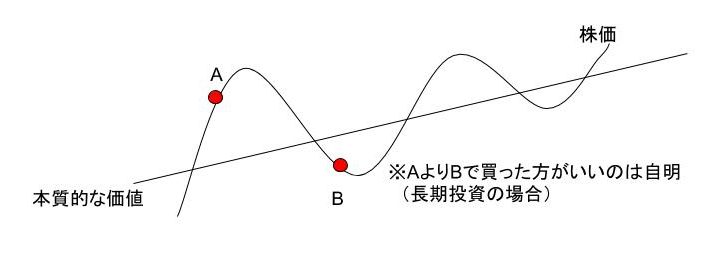
People and computers amplify stock price movements
However, if this can be achieved, either many people will succeed in investing, or the allure of investing will fade. The latter will not happen becausewhen stock prices fall, the majority become anxious and cannot buy.
The inability to buy when prices are falling stems from human psychology.People tend to think what is happening now will continue forever. When prices rise, they think they will keep rising; when they fall, they think they will keep falling. This creates bubbles on one side and excessive undervaluation on the other.
Even when computers come to dominate markets, this tendency does not seem to change. Computers are used by institutional investors, who focus on the immediate one-year—or even monthly—returns.
If one wants to achieve returns in a short period, one must follow the “trend,” so when prices are rising, they will say “buy,” and when they are falling, they will say “sell.” In this way,short-term stock price movements are amplified in both directions.
Such price movements have nothing to do with intrinsic value. No matter how much they rise or fall, as long as financial indicators like profits are a common understanding among investors,in the long run, they converge toward intrinsic value.
Therefore, what long-term investors should do is to buy stocks that have fallen more than necessary and sell stocks that have risen more than necessary through short-term trading.only this.
Ignore Mr. Market!
Benjamin Graham, Buffett’s mentor, personified the stock market’s movements as“Mr. Market”.
Mr. Market knocks on your door every day and asks, “Would you buy at this price?” Sometimes he inflates prices with optimism and sometimes he deflates them with pessimism,an emotionally unstable side.
If he is selling something good,we should buy at low prices and ignore (or sell) at high prices.
What you should remember is that,most of the time you can ignore Mr. Market because nothing about what he is selling changes, so you only need to engage when prices become extremely cheap.
That means,you do not need to look at stock prices every day. If prices are generally low over a long-term span, you can cautiously open the door to see if it’s time to buy.
At the moment, Mr. Market is bullish and bearish. There is no need to open the door seriously yet. As time passes,the right timing to open the door will surely come. Until then, let’s wait by reading.
Tsubame Investment Advisory Homepageplease also take a look.