

Episode 3: Is Salting the Right Thing?! Will Prices Return If We Wait?
“If you wait infinitely, price will eventually revert”Then,“No stop-loss, only take-profit when price rises”Wouldn’t that prevent losses?
“If you wait infinitely, price will eventually revert”Then,“No stop-loss, only take-profit when price rises”Wouldn’t that prevent losses?
If this idea is correct, trading becomes extremely simple.
In other words, if you don’t cut losses, you should be “unlosable” and have positive expectancy!
If this strategy is mathematically valid, then stop-loss is unnecessary, and trading becomesa game of simply enduring and taking profits.
Is this really possible? This time, we will test the hypothesis using mathematics and probability.
Is this really possible? This time, we will test the hypothesis using mathematics and probability.
1. No losing without stop-loss?
“No stop-loss, only profit-taking”Strategyis considered.
This strategy operates under the following rules.
- Take profit when price reaches a certain level
- Do not stop-loss when price falls, simply wait
- If you wait infinitely, price will surely revert, so you will eventually profit
With this strategy,since you don’t cut lossesthere are no losses,and you can wait only for profit-taking opportunities.
“No stop-loss, only profit-taking”Strategyis considered.
- Take profit when price reaches a certain level
- Do not stop-loss when price falls, simply wait
- If you wait infinitely, price will surely revert, so you will eventually profit
2. Expected return (expectation) calculations
Let’s compute the expected profit
First, consider the probabilities of take-profit and stop-loss.
Here,
- xis the entry price
- U−xis the take-profit level
- x−Lis the stop-loss level
(However, you do not stop-loss)
Because you don’t stop-loss, the price will reach
and you will wait without doing anything.the stop-loss probability is 0, so the loss term in the expectation disappears.
Thus the expected value is,
Here,
Looking at this formula,all terms are positive,so the expectancy is guaranteed to be positive!
(entry price is above the stop-loss line)
Therefore,this strategy theoretically always has a positive expectancyappearance!
In other words, as with the previously discussed ratchet, does this imply you can profit in a seemingly random market in theory?
3. Really “wait forever to win”?
However, a crucial question arises here.
Is the assumption that “waiting forever will surely revert” truly correct?
The probability that price will exactly return to the original level is given by the following formula.
This indicates the probability that exactly half of the steps go up and half go down among the n steps, i.e., the chance that the price returns at step n.
Let’s visualize this probability with a graph.
Is the assumption that “waiting forever will surely revert” truly correct?
4. Graph: probability of returning at a specific step
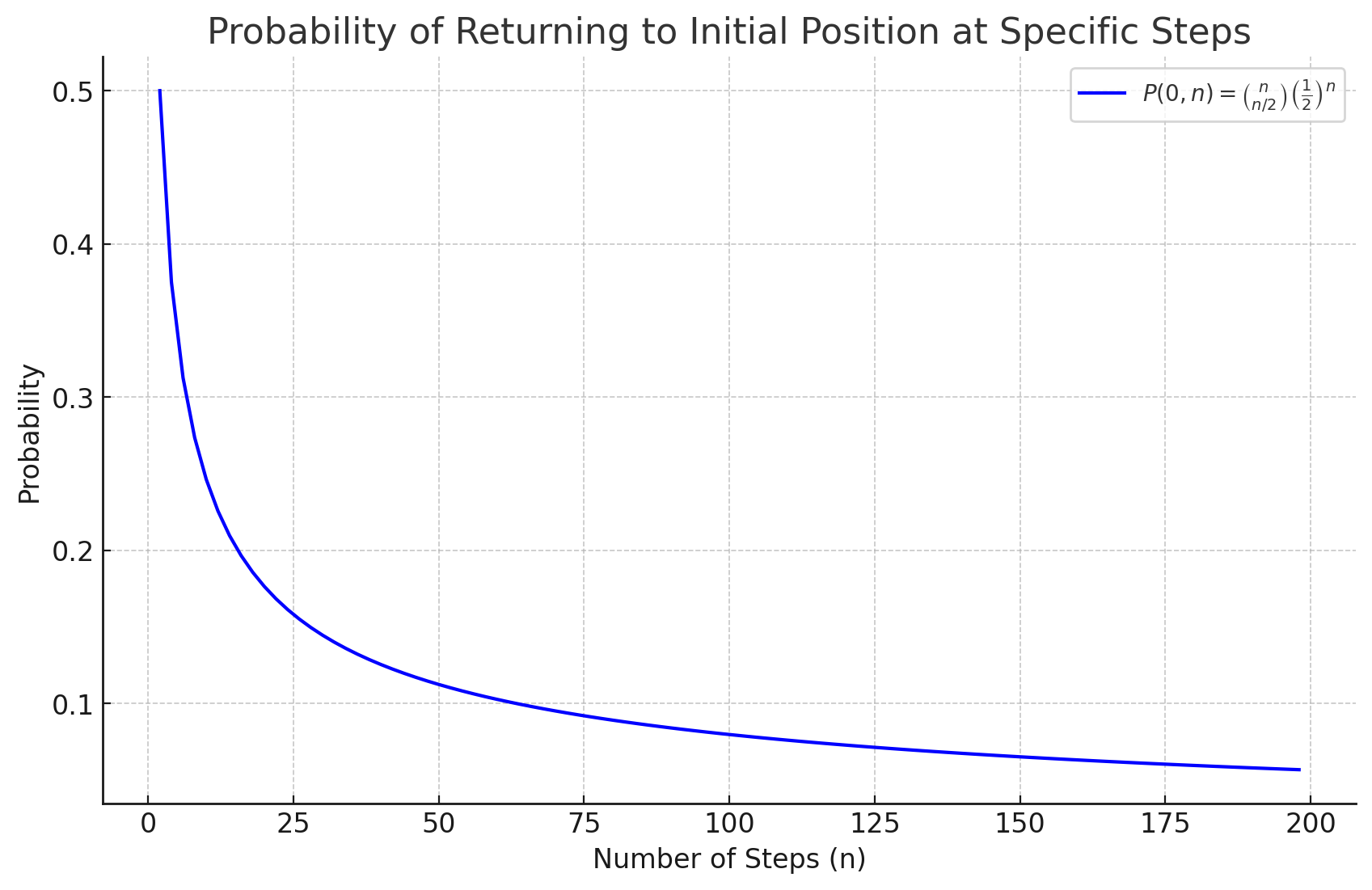
From this graph, as the number of steps n increases, the probability of returning to the initial position at a specific step drops sharply.
- In the short term, there is a reasonable chance of returning (for example, at n = 10, the probability of returning is relatively high).
- In the long term, the probability of returning at exactly one specific step approaches zero.
In other words, as time passes, it becomes extremely difficult to expect a return at a specific timing.
5. Considering cumulative return probabilities
However, as a trader, what matters is not “whether it returns at a specific moment” but“whether it will return eventually”.
Thus, we consider the probability of returning at least once within a certain time frame.
This probability is approximated by the following expression.
6. cumulative probability of return
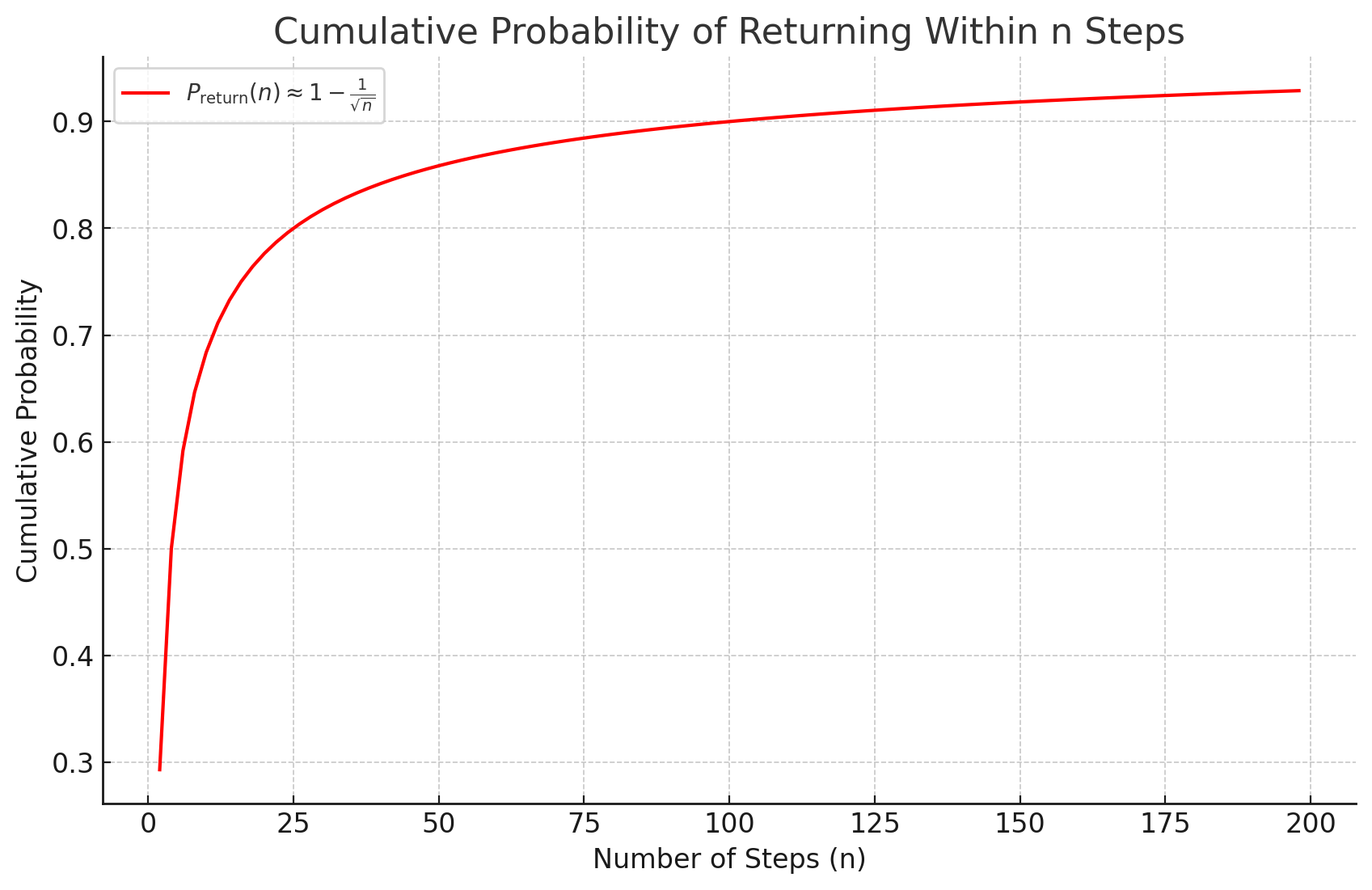
This graph shows the probability of returning to the initial position at least once within a certain time.
- As time grows, the probability approaches 1.
- In other words, the probability that you will eventually return if you wait forever is 1.
But the following issues arise:
- In the short term, the probability of returning is still high.
- For example, at n = 10, the return probability is only about 0.7, not a guarantee.
7. Polya’s Recurrence Theorem
From the graphs and calculations so far, the following intuitive understanding arises:
The cumulative probability suggests that if time were infinite, the probability of eventually returning would approach 1.
This was formally proven mathematically by Polya’s Recurrence Theorem.
Polya’s Recurrence Theorem (G. Polya, 1921)
For a one-dimensional random walk, with infinite time, the probability of returning to the origin is 1.
This mathematically guarantees that“waiting infinitely will inevitably return.”
8. But in reality this strategy does not hold
We have learned that “waiting infinitely will return,” butwhether this is effective as a trading strategy is another matter.
The decisive issue isthat “the expected time for returning becomes infinite.”.
The expected time to return to the original positionis approximately as follows.
For example,
- , the average time to return is steps
- , the average time to return issteps.
In other words, the time for price to revert grows exponentially, meaning there is a high risk of running out of funds or time while waiting. Investment funds address this by enormous capital and perpetual entities, right?
8. Conclusion
- Theoretically, if you wait forever, price will surely revert.
- However, the probability of returning at a given specific step decreases sharply over time.
- The expected time to return grows as n^2, so the risk of depleting funds or life increases.
Therefore,the “wait forever to return”strategy is mathematically correct but hard to apply to real trading.Next time, we will consider“How to improve expectancy within finite time?”