Plus 24% Profit-Taking Kraken Bitcoin (BTC) Leverage Trading
Based on the Bitcoin (BTC) I held, I tried a 3x leveraged long position on Kraken.
As a result... in three and a half months, a +24% return.
Gain: 3,376.88 USD
Loss: 1.14 BTC (rollover fees)
Holding period: 107 days (from August 3 to November 17)
Total position: 19 BTC
Bitcoin price movements since the end of 2015…
The BTCUSD (Bitcoin/US Dollar) chart is displayed.
Access the site and, in the search box next to the cloud icon at the top left, enter “BTCUSD” to display BTCUSD (Bitcoin/US Dollar) chart options.
BTCUSD (Bitcoin/US Dollar) chart is displayed.
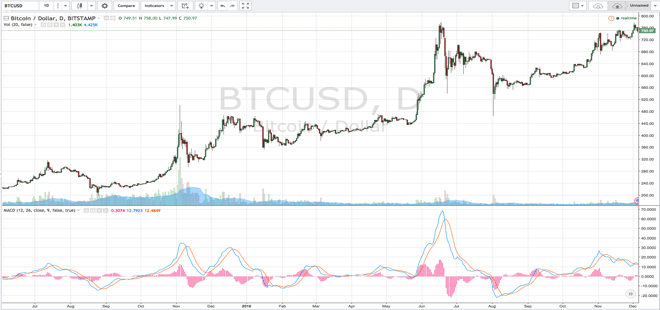
What I referred to this time is from the major Bitcoin exchange BITSTAMP.
On June 18 and 19, it is noted that 1 BTC reached the 770 USD level.
While watching the chart in real time, as prices rose rapidly, I wondered when was the buying opportunity and whether the price would continue to rise.
In 2013, 1 BTC temporarily crossed 1,100 USD, so I thought, could it shoot up further, and in late June I bought more at around 700–750 USD per BTC.
The reason for buying quickly was related to Bitcoin’s halving.
Bitcoin halving means the mining reward is cut in half.
The first halving occurred on November 28, 2012, reducing the mining reward from 50 BTC to 25 BTC, and the second halving occurred on July 10, 2016, reducing it from 25 BTC to 12.5 BTC.
If the mining reward decreases and the price of Bitcoin remains the same, miners who support the Bitcoin network may be adversely affected, so it is expected that the price would rise.
After the first halving, trading activity gradually increased from around January 2013, and what was 1 BTC = 12 USD at one point reached the 250 USD range. The Cyprus deposits cutoff on March 16, 2013 also contributed to the significant price rise.
After the halving, although not immediately, there is potential for noticeable price impact.
A Coindesk report estimated the breakeven point for miners at around 1 BTC = 600 USD, cited as a rough lower bound for Bitcoin’s price.
http://www.coindesk.com/bitcoin-mining-600-profit-consolidation-competitive/
(Although 1 BTC = 600 USD was a guideline, by late May it hovered around the 430 USD range, then unexpectedly jumped to the 700 USD range, so it was a rapid catch-up moment...)
After that... on August 2, the Hong Kong Bitcoin exchange Bitfinex suffered an external hacking attack and lost 119,756 BTC. In response to the news, Bitcoin’s price plummeted to the 460 USD range.
From July 31, Bitcoin’s price had been dropping sharply, so some people speculate that others were aware of Bitfinex’s hacking news.
In response to the Bitcoin price drop…
I woke up and checked Bitcoin’s price and was surprised!
Since the bitcoins I had bought showed unrealized losses, I was disappointed and my brain briefly froze, but…
“Could this timing be a full-on long position?”
“If I were on Kraken, I could trade with leverage!”
I logged into my Kraken account to confirm the trading conditions.
Trades with leverage are treated as Open Positions on Kraken
An explanation of Open Positions on Kraken’s site is…
(On Kraken, Bitcoin is denoted as “XBT.”)
Q)
What is an open position?
A)
An open position uses margin, meaning funds are borrowed to establish the position. The borrowed funds are returned to the exchange when the position is closed. Because funds are borrowed to open a position, profits and losses are not realized until the position is closed.
Kraken’s trading conditions are,
XBTUSD
Base currency: Bitcoin (XBT)
Settlement currency: USD
Quote/settlement currency: USD
Margin call level: 80%
Loss cut level: 40%
Buy orders can use: leverage 2, 3
Sell orders can use: leverage 2, 3
(For XBTEUR, leverage ranges from 2x to 5x.)
Margin rollover fee
0.1% every 4 hours
“All right! I can use Bitcoin as margin to take a long position.”
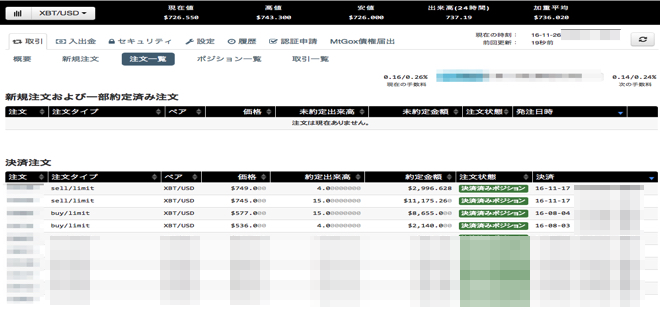
“If another drop comes, it would be problematic, so I’ll start with leverage of 3x and 4 BTC. (August 3)”
Looking at the daily price movement, the rebound is quick, so I added another 15 BTC the next day.
From here, prices gradually recovered, and I left it to see how things would go.
And then…
From Bitcoin’s price movement, I felt that 750 USD per BTC would be a useful benchmark, and at the moment of breaking 750 USD on November 17, I closed out the position.
Unrealized gains are still gains unrealized; unless realized, they don’t count.
Also, the biggest bottleneck was the rollover fee. After 100 days, more than 1 BTC had already been spent…
Because I used Bitcoin to create a long position, after offsetting the opposite trade and closing it, the Bitcoin that had been deposited as collateral plus the dollars of the realized gains were reflected in the account.
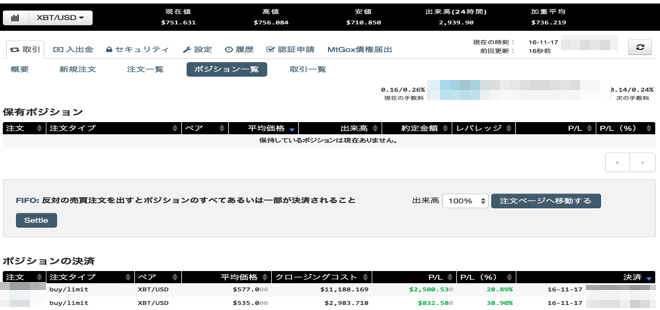
At the time of closing, I wondered whether everything would be settled entirely in USD, but that wasn’t the case.
If you hold Bitcoin in a long-term stance and want to ride the trend when the market moves significantly, using Bitcoin as collateral for sell/buy trades can be a good approach.
However, due to high rollover fees, you need to compare with other exchanges.
Regarding Bitcoin, I will continue to hold, monitor price movements for opportunities, and prepare the exchange setup so I can trade with leverage when appropriate.
I started subscribing to the Bitcoin-related newsletter service “Bitcoin Signal: The Fox in the Sky” distributed by fx-on.
Not only Bitcoin, but the international financial markets (USD/JPY, EUR/USD, crude oil, gold) are analyzed, and with clear comments, chart images, and Excel lists, it becomes possible to see how technical analysts currently view the market.
If the FOMC raises rates, what kind of movement will Bitcoin show? It’s a reference for deciding our stance.
“Bitcoin Signal: The Fox in the Sky”
(Public disclosure to the purchaser: please rewrite this section)