Market analysis interpreted from fundamentals and technicals
First, I would like to briefly write about how I personally approach the market and trading.
My trading style mostly involves holding positions for a few hours to a few days, trading in line with price movements at the time. When there is a strong basis that aligns with both fundamental and technical analysis, I engage in swing trades lasting several weeks to over a month. I am not good at ultra-short-term trades like second-scale scalping, as they require a high frequency of execution and intense concentration and reflexes, which is very demanding, so I do not do them.
I use fundamental analysis to grasp the big picture and then aim for big moves, using technical analysis to enter and exit.
Analysis Method
I confirm the market’s major direction with fundamental analysis while performing technical analysis, but basicallyfundamentals cannot be generalized; I read and analyze market themes such as monetary policy, fiscal policy, national policy, and geopoliticsas they happen!
What I mainly look at in technical analysis is price action of candlesticks, horizontals, trendlines, and chart patterns analyzed in combination to determine the direction of a position and the timing of entries!
There are times when I hold a position and it stretches but then returns to break-even, but by incorporating fundamentals I determine whether it is a position worth holding.
Therefore I cannot take positions too frequently, and my usual trading style is to capture daily ranges and, when the range is broken, to hold on strongly for big moves.
Big price movements come from fundamentals, so there are always things that cannot be explained by technical analysis. Price movements also have meaning, and you can unravel them.
Many beginners might start with easier-to-access technical analysis, but I feel it is important to understand the significance of fundamentals.Of course, both are very important, so it would be wasteful to lean too heavily in one direction.
In technical analysis, even with solid rationale and confidence, you can still hit stop-loss. Why did it trigger? Excessive leverage or ultra-short-term trading are exceptions and not discussed here, but in the past when I traded only technically, most stop-loss events were largely due to contrarian fundamental moves. Therefore, it became clear that analyzing from both technical and fundamental perspectives and increasing our edge is important. Of course this does not guarantee 100% wins, but it helps avoid unnecessary trades without an edge. Winning is important, but not losing is also important.
Large traders and hedge funds always confirm fundamentals. In a world where only about 10% survive, I personally believe that the ability to survive long-term and continue winning hinges on mastering fundamentals.
About the analyzed assets
The analyzed assets include, for example, the inverse correlation between interest rates and gold, or correlations where stock indices rising correspond to currencies falling, etc.Analyzing a variety of market instruments helps you see the market’s flow more clearly, so I do not limit myself to just currency pairs and trade across various markets.
The assets I trade are currencies, commodities, and stock indices.
I also analyze indicators such as the VIX, currency indices, and interest rates (bonds) as needed.
It may seem like a lot, but I do not monitor all of them constantly; I focus on assets that look attractive at the moment, so it does not feel burdensome.
For example, I might skip cross-yen pairs if volatility is low or direction is unclear, and focus on stock indices if their movements and direction are easier to understand.
Some people may react negatively to this, but I personally think you need to do at least this much to keep winning. Each market affects others, so trading only gold charts or only USD/JPY charts is honestly difficult (scalping aside).
Trading Style
My trading style ranges from day trading to swing trading. Therefore, it is not high-leverage trading but rather positions with relatively high maintenance margins. From my perspective, focusing on one trade too much destabilizes my mindset, so I settled into this style. The typical risk-reward ratio ends up around 1:1 to 5.
The fundamental currencies I follow are the United States, Japan, the Eurozone, the United Kingdom, Australia, New Zealand, China, Canada, and Switzerland. The main focus is the first four, but in obvious conditions I also trade currency pairs like AUD and CAD (though information on Australia and New Zealand can be harder to obtain).
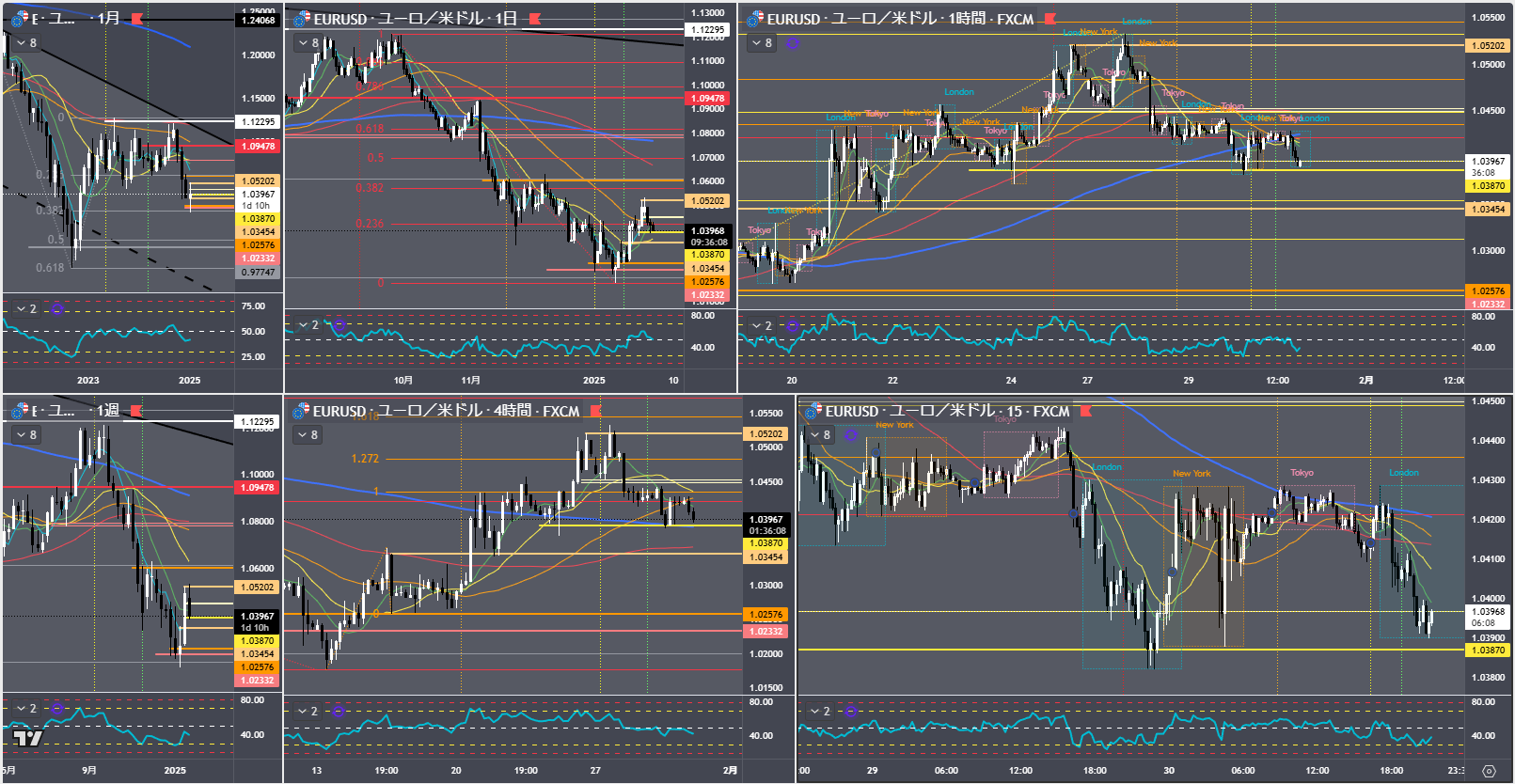
In technical analysis, I mainly analyze from monthly to 15-minute charts. The technical tools I use are horizontals, channels, and trendlines, moving averages (10, 20, 50, 100, 200 SMA, and only 5 SMA on daily charts or higher), and Fibonacci retracements and extensions.
Summary
I have roughly written about my approach and philosophy toward trading. People tend to dislike dealing with complexity. However, I believe there are things you cannot see unless you try anything.
Fundamental analysis is indeed difficult, I think. But there is a clear difference in market perception depending on whether you know it or not, and I think it is a waste to give up on fundamentals out of prejudice. Most readers of this article are already somewhat proficient in technical analysis, I believe. So I think adding both technical and fundamental knowledge will definitely be a plus.
Therefore, I hope to continue writing about market analysis with high potential from both fundamental and technical perspectives. If you are interested, I would be glad to have you along from here on.
※This article is not investment advice or solicitation but is intended to provide information. However, all information presented here is not guaranteed for accuracy or usefulness. Therefore, the author is not responsible for any losses suffered by purchasers. Please understand the above and use the information in this article at your own risk.