

Sector Rotation Investment Method seems to be effective

Sector Rotation Investment Method Seems Effective
I am Warren God.
(About me page:About Me)
As I mentioned before a little, sector rotation is like economic cycles, where there is a flow of booms and busts in each industry.
As one of Warren God's learnings, since I started blogging seriously, I have been reviewing the stock market carefully, and I have come to feel that "sector rotation does exist after all."
▼ Past references
★U.S. Stock Investors Must See! Sector Rotation Is Steadily Advancing
Ride the Trend_Sector Rotation
There are many theories and charts about sector rotation, but this one feels to be the most on target, so I’ll introduce it.
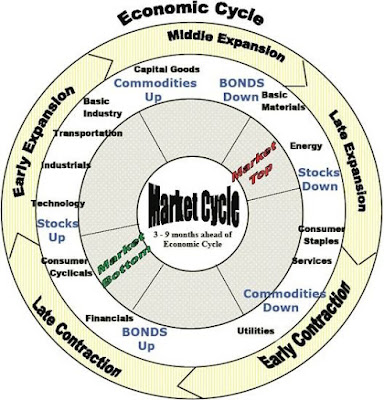
Source: http://www.nowandfutures.com (Global Business Cycles)
Please research the English yourselves. What I found particularly interesting is that it includes the overall stock market ups/downs, commodity prices up/downs, and bond prices ups/downs.
I, Warren God, have always wondered. The sector cycles, the overall stock market, the overall bond market, and the overall commodity market seem related, and I hadn’t found a macro-level explanation that felt right, but I think I’ve found one this time.
For example, in this chart, I think Warren God is currently here.
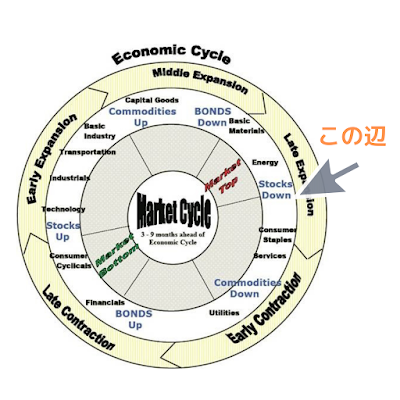
While foundational chemical sectors like Dow Du Pont and energy sectors like Exxon and RD S seem to have peaked, the overall stock market has entered a downturn, while consumer staples like Procter & Gamble are thriving.

This means that after this, the service sector and utilities infrastructure will likely benefit. Unemployment is at historical lows, and companies are short on staff. The service sector will benefit. Also, energy prices are falling, so electricity and gas sectors will benefit.
So, what should we buy now?
Following this diagram, the seemingly undervalued sectors would be Financials, Retail Cycle (automobiles, hotels, leisure, retail stores, etc.). Also, Bonds.
Well, timing investments is difficult, and if you don’t think you can do it well, then stable dividend-yielding, low-volatility stocks are preferable.
Thus, now perhaps it’s a bit late, but infrastructure sectors (electric, gas, water, rail, etc.), along with bonds and stable insurance firms like Travelers Group, may be good targets.
In this way, by consciously practicing sector rotation and gradually increasing positions in high-dividend, stable stocks, I think this is a quite excellent strategy, I’m privately smug about it.
However, remember that investing is everyone’s own responsibility.
▼


There are many theories and charts about sector rotation, but this one feels to be the most on target, so I’ll introduce it.
Source: http://www.nowandfutures.com (Global Business Cycles)
Please research the English yourselves. What I found particularly interesting is that it includes the overall stock market ups/downs, commodity prices up/downs, and bond prices ups/downs.
I, Warren God, have always wondered. The sector cycles, the overall stock market, the overall bond market, and the overall commodity market seem related, and I hadn’t found a macro-level explanation that felt right, but I think I’ve found one this time.
For example, in this chart, I think Warren God is currently here.
While foundational chemical sectors like Dow Du Pont and energy sectors like Exxon and RD S seem to have peaked, the overall stock market has entered a downturn, while consumer staples like Procter & Gamble are thriving.
Sponsored Link
▼「Want to study American companies!If so, start here

Toyo Keizai Shinposha 2018-10-09
This means that after this, the service sector and utilities infrastructure will likely benefit. Unemployment is at historical lows, and companies are short on staff. The service sector will benefit. Also, energy prices are falling, so electricity and gas sectors will benefit.
So, what should we buy now?
Following this diagram, the seemingly undervalued sectors would be Financials, Retail Cycle (automobiles, hotels, leisure, retail stores, etc.). Also, Bonds.
Well, timing investments is difficult, and if you don’t think you can do it well, then stable dividend-yielding, low-volatility stocks are preferable.
Thus, now perhaps it’s a bit late, but infrastructure sectors (electric, gas, water, rail, etc.), along with bonds and stable insurance firms like Travelers Group, may be good targets.
In this way, by consciously practicing sector rotation and gradually increasing positions in high-dividend, stable stocks, I think this is a quite excellent strategy, I’m privately smug about it.
However, remember that investing is everyone’s own responsibility.
Sponsored Link / Car sharing era, selling quickly is also an option
▼ Sponsored Link / Travel to heal your life
Recommended past articles are here(^^♪
▼
▼ Sponsored Link / If you are starting asset management and U.S. stocks, click here
Warren God runs an asset management glossary. Let’s study together!
▼
Asset Management Glossary by Warren God
▼
Asset Management Glossary by Warren God
× ![]()