Important points for loop-ifsudun operations! It is not OK to rely only on the ranking table.
Notes on the Loop If-Dun Operation Ranking (Ichimyo Table)
First, please take a look at this.
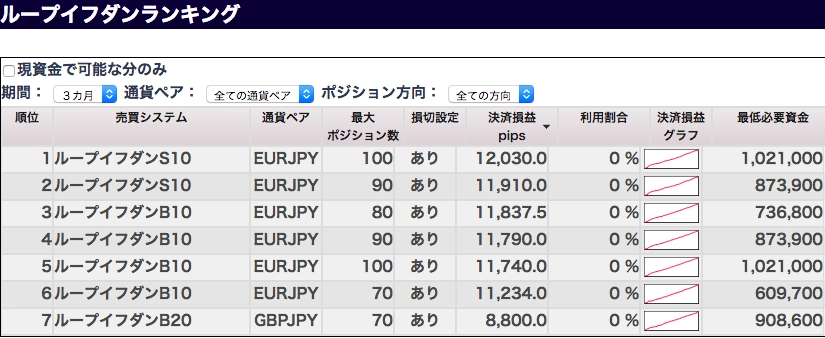
This is the operation ranking for Loop If-Dun released by Inet Securities.
In this ranking,
- you can see which systems are operable with the funds currently deposited in the account
- the profit/loss in pips for each period, currency pair, and position direction (buy, sell) is shown
and so on, making it easy to grasp which system earns how much profit.
Therefore, it seems to be the Ichimyo Table that most people refer to when operating Loop If-Dun.
However, because it is a simplified table,
- it does not show profits including swap points
- it cannot set the maximum number of positions or the presence of stop-loss settings
- it only outputs data from the current period (past data is difficult to verify)
which is the current situation (as of November 2018).
Therefore, if you base Loop If-Dun operation solely on the Ichimyo Table, you may not achieve the expected results.
Slippage between the fill price and actual price frequently occurs with Loop If-Dun
Those actually operating Loop If-Dun may have noticed that, depending on market conditions, there can be discrepancies in the speed of fills and other aspects.Hence, there have been many cases where the fill price deviates considerably from the chosen width based on practical experience.
For these reasons, I believe it is simplistic to decide on a system based only on the ranking table.
In particular, for people who have never engaged in system trading or for investment novices, you might feel“it's different from what you expected”to some extent.
Nevertheless, a system that can be recommended to part-time investors
For me, a part-time investor who works as a company employee,“how to have a system that does not interfere with private life yet yields profits”and so on, system trading proved to be very convenient.However, in practice, when evaluating or operating system trading, the bottleneck becomes configuring the system to match the market environment.
No strategy is万能, and the profit rate varies greatly depending on how well you can choose a system that fits the market environment.
Nevertheless, Loop If-Dun is very convenient because, if used for the long term, you do not need to regularly modify the system to match the market environment.
In particular for part-time investors, you can dramatically reduce the time spent watching charts, so it is recommended.
If you are starting Loop If-Dun, begin with actual performance!
If you are considering operating Loop If-Dun, I recommend referring to more detailed performance data.Especially when operating long-term, profits from swaps not reflected in the ranking can significantly affect P/L, so you should refer to the data to understand it.
I also summarize the performance of USD/JPY and AUD/JPY on this page, so I hope it will be at least somewhat useful to you.