
"魅力 of FX diversification investment: Stable returns and risk control (Leverage Part 2: Practical Applications)"
Raising leverage itself is not the risk; the risk increases as the number of lots and position size relative to your account funds grows. (Remember?
★ One of the important elements in funds management is stop-loss setting. This is a means to minimize losses when the FX market does not move in the intended direction. The important point, as always, I say again and again.
The Importance of Stop-LossThere is a serialization article about it, so please read.Key to Trading Success: Why Pros Enforce Stop-Loss
In the previous serialization article, I compared 25x and 1000x leverage and showed how large the difference is in proportion.
Furthermore, I explained the effects of leverage with concrete examples. (If you have forgotten the content, or have not yet read it,
From here to previous serialization article,“The Charm of FX Diversified Investment: Safety and Profit Growth (Leverage Edition Part 1: Basics)”go here.
This time, as in the last, prepare paper and pen and take notes on parts you like, while thinking about how leverage works in actual trading, and how to manage lot size in detail.
Before starting, since I touched on stop-loss,What is necessary to succeed in FX?I hope this serves as a hint to decipher. I’ll start with small talk first. (After all, stop-loss, right? If you thought so, that’s sharp.)
In the FX world, it’s said that nine out of ten people withdraw. For those who are not doing well to achieve success, it may be important to stay true to their初心, meaning to revert to the beginner's viewpoint and look at things.
For example, you may hear stories of beginners who started FX and had success in their first year. It could be because they could honestly implement “do it this way.”
In my case, it was a bit different, but I continued to test and try what I came up with. I adopted the efficient methods into my trading and kept going with FX. Of course, there were things I did not test. For instance, I had no intention to pursue trades that understood and mastered hedging positions.
To improve trading, you may reach out to books and methods once. Yet I have never bought books, magazines, or methods related to FX. I feel, based on my own sense, that understanding can come from IQ alone, and that the probability axis is solid (I don’t even know FX terminology).
No matter how wonderful a method or way of trading is, whether it yields results is not the key. If nine out of ten people do not succeed, then such things are unnecessary.
Why so many people fail is easy to understand.
In this world, many things can be realized by learning from others’ mistakes.
For example, suppose you hear a story: “This trader is in a state like this now. He has a loss of 50 million yen, and is in a situation to cut some or make more deposits.” Then you might share experiences like: “Oh, I was forced to lose 500,000 yen.”
How about it? In both cases, trades that did not include stop-loss could not cope with sudden market moves. If you had used stop-loss and cut losses, you might have had opportunities later. You would have been able to continue trading FX and trading.
If there is a place you can notice but you don’t try it, you won’t progress. By testing yourself, you may notice new things you didn’t expect. For example, you can’t start playing the guitar until you actually pick it up. You may memorize chords in your head, but when you actually play, rhythms of picking strings become important as well.
By repeatedly making mistakes, you’ll understand with your head and body, and in FX, if you have your own method, you should know about pips you can gain and where to place stop-loss. First, start by trading with a placed stop-loss as a test.
Nine-tenths of those who aren’t doing well, have you convinced them? To be in the top tenth, is it a matter of “being rational”?Rational peopleor?People who always place and manage stop-lossor not? It’s a binary choice, perhaps?
There are always 100,000 yen on funds. A person who says “I can’t keep doing this little by little; it’s throwaway money.”
At the timing of an economic indicator release, one big bet, one of two choices. If you fail, you lose all; if you succeed, you could gain over 1,000,000 yen.
By aiming for favorable timings and probabilities, success becomes easier. (Ending with “whatever, every time” is easier than heavy topics.)
It’s important not to forget初心 either. For me, it’s like being told to test and verify.
Now, I’m not sure if this is a worthwhile story, but let’s get to the main article.
In this serialization, we will look at the mechanism of leverage, its characteristics, and the parts that many people misunderstand, using practical examples.
In the previous article, most people end up increasing the amount of the lot size. That is the risk. That is what I conveyed.
If you still misunderstand that raising leverage is dangerous, we will review it here as well, so please check the actual permissible range.
For those who have read this far,(Leverage Edition Part 1: Basics)If you haven’t read it yet, please read it first.
One reason FX does not generate profits is that position size is too large relative to funds. It is important to set appropriate trade size relative to funds and trade with careful consideration. Profitability in FX requires money management and risk management.
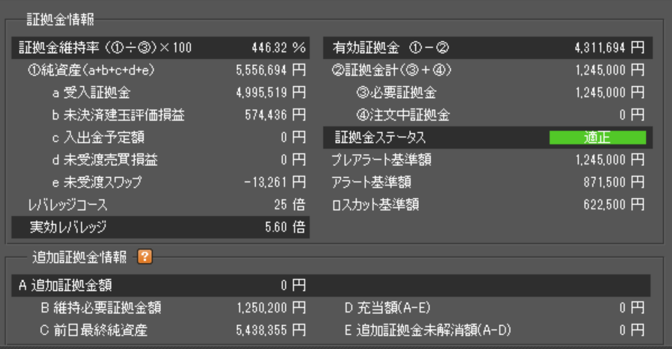
(green indicates your ability.)
As an example, open a demo account with 25x leverage and 5 million yen account, place positions in advance, and use it to explain.
(It has grown to 6 million, but please don’t mind.)
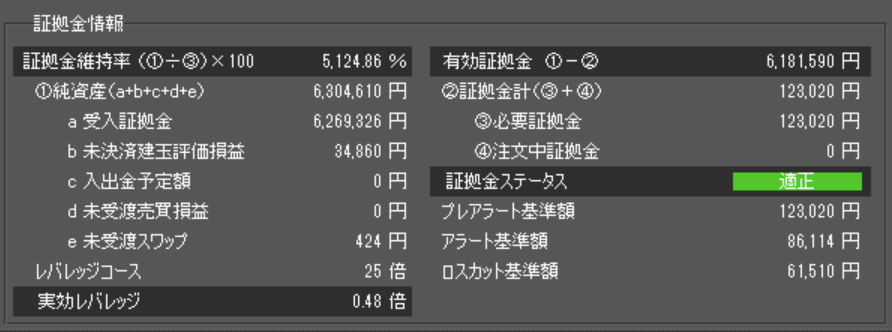

Looking at the above margin information, you can see there is ample room in margin rate and effective leverage. Therefore, there’s no need to check exact numbers. (★ If you always place a stop-loss firmly, you shouldn’t worry about your account information. Because placing stop-loss will never lead to forced liquidation.)
In the bottom trading information, I held a position of 2 million yen with 60,000 units.
Overall information content(A completely carefree environment) where the trading volume is not an issue, those who set stop-loss or think of ways to extend profits find trading easier. Also, ideal not to hold unnecessary positions.
Many people tend to hold larger positions chasing profits.It becomes a risk when the position size is too large relative to funds (Do not, by mistake, hold even more positions in the same currency pair.)

What to decide first in trading is whether you will cut losses at a stop-line or take profits at target values and whether you will extend profits as much as possible. This is particularly important around entering and exiting positions.
Some people may think, “Wouldn’t it be better to increase position size a bit more?” However, that is somewhat mistaken.If you know how much you want to trade and at what price you want to take profits,it’s better to focus on extending pips rather than increasing position size.All risks decrease significantlyby following that principle.
(If price moves from 152.019 to 156.800, you’ll gain 95,620 yen in profit plus swaps. Even if it falls, you can end with a profit by using a trailing stop.”)
Calculation of Lot Size1 lot = 10,000 currency units (typical setting) Therefore, 20,000 currency units are: Unrealized Profit Calculation1. Exchange rate fluctuation
2. Unrealized profit formulaUnrealized profit = (Current rate − Rate at entry) × Number of currency units | Here’s what I want you to consider: is 3,4860 yen enough? (Swaps included, about 60,000 yen now.)If you had 6,000,000 yen, and thought about trading around 6 lots, you might have ended up with about 104,580 yen in profit if it went well. Conversely, let’s calculate what would happen if it had reached the 35 pips lower stop-loss at the initial point. Unrealized loss calculation1. Exchange rate fluctuation
2. Unrealized loss formulaUnrealized loss = (Rate at entry − Current rate) × Number of currency units
With 6 lots, when deciding stop-loss levels or holding unrealized profits, the amount may become a concern and you may not trade as freely. Thus, ideally you would aim to gain unrealized profits more than this amount. |
Margin calculationEffective Value CalculationEffective value = Account balance + Unrealized profit/loss Unrealized profit/loss calculation:
Unrealized loss = (152.019 − 151.650) × 60,000 Useful value = account balance − unrealized loss Maintenance Margin CalculationMaintenance margin rate = () | Margin Calculation (No Leverage)Trading quantity: 6 lots = 60,000 currency Trading rate: 1 USD = 152.019 yen Trading quantity: 1,000 currency Required margin is calculated as follows: Effective Value CalculationEffective value = Account balance + Unrealized profit/loss Unrealized profit/loss calculation:
Unrealized loss = (152.019 − 151.650) × 60,000 Useful value = account balance − unrealized loss
Maintenance margin rate = () Required margin for 60,000 currency Required margin=Trade quantity×Trading rate |
With 6,000,000 yen in funds, calculate the maximum number of lots you can hold without leverage.Conditions
CalculationFirst, calculate the total amount of USD you could buy with 6,000,000 yen.
Result Maximum leverage-free lots you can hold is approximately 39.465 lots (39,465 currency). 60,000 currency cannot be held. (Using leverage, the reason maintenance margin is higher is that the required margin is discounted by leverage, making it possible to trade with lower funds.) |
Here you can see that
Holding large positions or large lot sizes is extremely risky. When losses approach, you should consider what pips amount would make stop-loss a normal, acceptable amount.
If the worst happens and you lose all funds, it is crucial to have risk control in place so you don't lose all funds at once.(If you thought 10 lots might be okay just now, did you reconsider? If 50,000 or 60,000 could be wiped out quickly, you might be better off.)
Raising lot size increases risk.
Because leverage increases tolerance, you should use it to trade with confidence.
From here on, I’ll discuss measures to prevent taking too large a position based on position size, then explain briefly.
Measures to prevent taking too large a position:
Setting target pips and position sizeSetting target pips and position size
Know what pips you’re aiming for and set your position size accordingly. For example, with 2 lots, 100 pips yields 20,000 yen unrealized profit.Clarify how many pips you target and set the position size. For example, 2 lots yields 20,000 yen unrealized with 100 pips.Setting stop-lossSetting stop-loss
Always set stop-loss orders a certain number of pips away (35, 40, 50 pips ahead) to prevent large losses.Always set stop-loss 35, 40, or 50 pips ahead to avoid large losses.Transferring profitsTransferring profits
When profits are large, move funds.When profits are high, transfer funds.Be mindful of maintenance margin and actual leveragePay attention to maintenance margin and practical leverage benchmarks indicators
Even if maintenance margin is high, too many positions are dangerous. Increasing positions in the same currency pair concentrates risk and can cause large losses.Even with a high maintenance margin, excessive positions are dangerous. Increasing positions in the same currency pair concentrates risk and can cause large losses.
(Even if maintenance margin is 5000% or 1000%, do not feel you have all the room to take many positions. Having room helps trading.)(Even if maintenance margin is 5000% or 1000%, do not feel you have ample time to take many positions. Having room helps trading.)
Here, we will verify the top goal pips and position size settings.Here, we will check the top target pips and position size settings.
Since different brokers display lot sizes differently, I’ll first explain that.Because different accounts display lot sizes differently, I’ll explain first.
What a lot represents varies by FX company, and the following units are widely used:What a lot represents varies by FX company, and the units commonly used are:
“1 lot = 1,000 currency,” “1 lot = 10,000 currency,” “1 lot = 100,000 currency”“1 lot = 1,000 currency,” “1 lot = 10,000 currency,” “1 lot = 100,000 currency”
If 1 lot is 10,000 currency, then 0.1 lot means 1,000 currencyIf 1 lot equals 10,000 currency, then 0.1 lot means 1,000 currency. (This time I’ll describe only domestic accounts, so I’ll look at the dark option above.). (This time I’m explaining only domestic accounts, so I look at the black above.)
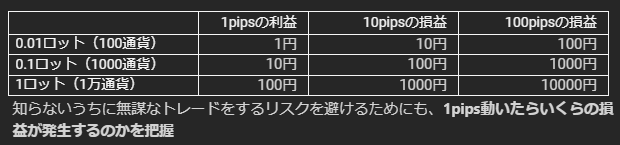
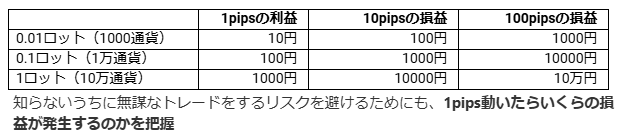
From here, just take a quick lookFrom here, just skim through
The calculation of how much 1 lot costs is obtained by the following formula.The cost of 1 lot can be calculated by the following formula.
- 1 lot amount = current exchange rate × 1 lot currency1 lot amount = current exchange rate × 1 lot currency
For example, with USD/JPY at rate “1 dollar = 150 yen” and 1 lot = 1,000 currency, calculation yieldsFor example, with USD/JPY rate “1 dollar = 150 yen” and 1 lot = 1,000 currency, the calculation yields
150 yen × 1,000 currency = 150,000 yen
- Required margin for 1 lot = current rate × 1 lot currency ÷ leverageRequired margin for 1 lot = current rate × 1 lot currency ÷ leverage
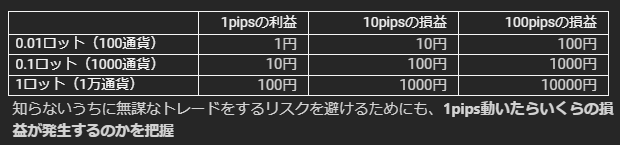
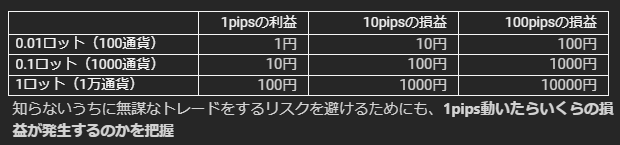
With 100,000 yen capital,
Position for 10,000 currency10000 currency positions Maintenance Margin164.49% | Maintenance Margin | Maintenance Margin |
In a demo account, with 25,000 yen and 25x leverage, going 0.01 lots, the maintenance margin is 409.68%.

Required Margin CalculationRequired margin = position size × entry rate ÷ leverage. Trading Profit CalculationTrading profit is the difference between the exit rate and the entry rate multiplied by the position size. | Required MarginThe required margin is as calculated above. Total FundsTotal funds after trading are as calculated earlier. Maintenance Margin CalculationMaintenance margin rate = ( Calculation |



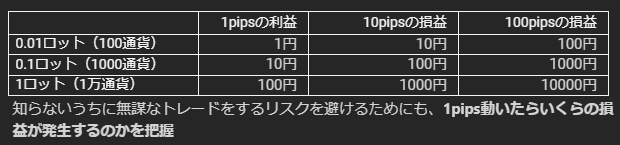
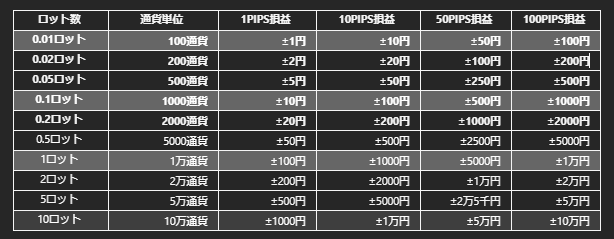
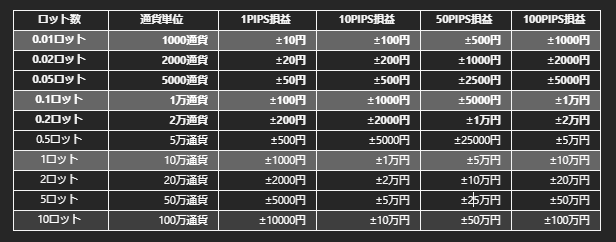
To convey what I want to say, in shortSummary.
I’ve said this many times, so it might be okay to end here.
About choosing an account,
FX “minimum trading unit” means the smallest trading unit you can place in one order. For FX beginners, choosing an account with a small trading unit is recommended. Smaller trading units require less capital and reduce losses. For example, many FX accounts offer 1,000 units for major currency pairs with high liquidity. There are also accounts where you can trade 100 units or even 1 unit. Beginners should start with a smaller minimum trading unit and gradually increase the trading volume as they become more comfortable.Even with a small minimum trading unit, it is possible to trade 10,000 or 100,000 units.As you gain experience, gradually increase your trading volume considering your funds and risk.
In domestic accounts, choosing a 25x leverage allows you to meet a lower required margin and increase your maximum trading quantity. However, if you do not increase your position size and manage your funds properly, it becomes very convenient to use.
By setting appropriate lot sizes according to your funds, you gain trading flexibility.
Risk is always related to your position size (how many lots or contracts you hold). Be especially careful not to hold too many positions. For example, if the market moves 45 pips in the opposite direction, and you don’t set stop-loss properly, your losses may be large. Many traders believe the market will come back, and this belief can cause you to lose all your funds.
Therefore, ensure your stop-loss reaches within your risk tolerance and can be recovered in the next trade.
On adjusting position size and risk avoidance
A reason many people don’t see their funds increase is that currency pairs are overly biased or the position sizes are too large. For example, holding positions in USD/JPY, EUR/JPY, and AUD/JPY requires care since these pairs tend to move in similar directions at times.
Additionally, attempting to catch deviations by buying on dips or selling on rallies at 10-pip intervals without stop-loss can cause the market to move 300 pips against you. This can yield large losses and, in the worst case, force a major drawdown of funds.
To avoid such situations, do the following in advance:
If you’re worried about your FX account, it may be because you are not setting stop-loss, holding too much position size, repeatedly trading on short-term moves, or not having a defined profit target.
Maybe you are trading without thinking (hence I’m writing this deliberately).
There may still be people who don’t understand, so I’ll continue writing.
Why? Because,people who chase only profitsaresaying that if this happens every time, it would be the oppositeto what you expect. I want you to know that.
What is clear is that, if you can manage funds, FX can yield profits.
—- Only here, for those who don’t want to read further, skip this section. ————
There are people who accept religion and those who don’t; it’s a matter of individual choice and perspective.
Some walk a life saying “God is great,” “Christ is wonderful,” and “always living with gratitude.” This may simply be a matter of whether you accept that faith at this time.
For example, you may wonder why God causes disasters. But when a disaster occurs, it is an unavoidable event. Many die, and if you survive, you may later feel that you were kept alive by a higher power. Then you may choose to live in the mountains with a few people rather than in the city with many. This could be the first step.
Then you may realize that life in the mountains is wonderful (good food every day; never a day without). You become grateful for the mountains and rivers and eventually feel that God is amazing. You realize that everything is necessary and everything is in motion. You may end up living with gratitude to God and living with the Earth and God. (As a result, you may have accepted it.)
---------- The discussion ends here -----------
If you think about the majority of people again, and if forced liquidations occur for many because of not placing stop-loss as a trade size grows with account funds, the rate of forced liquidations may be similar whether funds are 1 million or 100,000. The ratios are probably similar.
Stop-loss
When you increase leverage, the way to reduce risk as much as possible is your trading skills (methods, money management and stop-loss, diversification of position sizes and currency pairs, etc.) and the amount of lot size only.
There are always people who possess the skill to turn quickly to profit, but even if the rate returns, they can still close with a limit order. However, when starting from a negative, many people wonder how much to set for their stop-loss and profit target. (Have you considered the leverage feature?)
When you consider all this (and even with planning), looking at the maintenance margin doesn’t persuade you to use less. You still think you have 1000% or 500% left, and you end up increasing your position.
This action is exactly the behavior of not following your plan and expanding risk despite planning.